
A few years ago, a brand ran what they called their “biggest campaign of the year,” completely unaware of the actual ROI for promotions.
It was the festive season. The banners were everywhere. Influencers were posting. The sales team was fired up. There was a flat 25% discount across categories. By the end of the week, the numbers looked incredible. Revenue was up 48%. New customers had poured in. The team was celebrating.
And then, two weeks later, someone pulled the margin report.
Despite record revenue, profit had barely moved. In some categories, it had actually dropped. Nothing was “wrong” with the campaign. The creatives worked. The ads performed. The sales spike was real. What nobody had calculated before launching was the break-even point of that 25% discount. They assumed that higher volume would automatically compensate for lower margins. But discounts don’t work like that. They change the math. And unless you calculate that math upfront, you don’t really know whether you’re running a growth campaign… or just accelerating revenue while thinning profit.
That’s why understanding break-even promotion math and the right promotion ROI formula isn’t optional anymore.
Let’s break it down properly.
TABLE OF CONTENTS
- The First Number That Actually Matters
- What a 20% Discount Actually Does
- The Break-Even Reality Most Teams Might Miss
- The Deeper the Discount, the Harder the Climb
- Now Let’s Talk About ROI
- Discounts vs Incentives: A Subtle but Important Difference
- The Costs Everyone Forgets
- Loyalty Programs: A Different Time Horizon
- Before You Launch Your Next Campaign
- The Real Shift
The First Number That Actually Matters
Before we talk about ROI, discounts, incentives, or loyalty programs, we need one simple thing: Your contribution margin.
Contribution margin is not a complicated concept. It’s just: Selling Price – Variable Cost
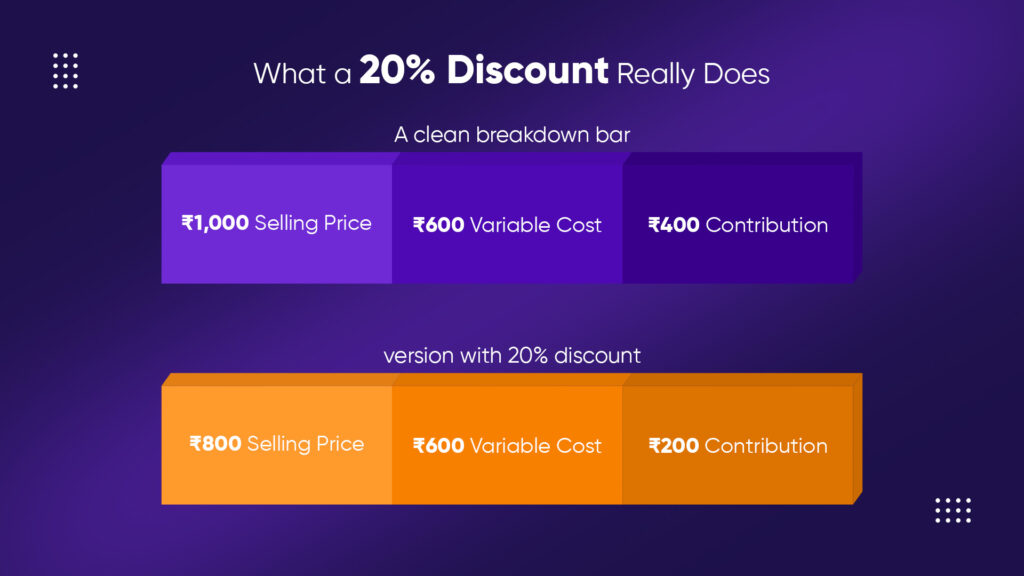
If you sell a product at ₹1,000 and it costs ₹600 to produce, ship, and fulfil, your contribution per unit is ₹400. Your margin is 40%. That ₹400 is what pays for your fixed costs, your marketing, your technology, your team and hopefully leaves something behind as profit.
This is your starting point. Without this number, any promotion is guesswork.
What a 20% Discount Actually Does
Now, let’s say you decide to run a 20% discount.
Your new selling price becomes ₹800. Your variable cost is still ₹600. Your new contribution per unit is ₹200.
You didn’t reduce profit by 20%. You cut it in half. Your margin has dropped from 40% to 25%.
And this is where things get interesting. Because now the question isn’t “Did sales increase?” The real question is, “How much do sales need to increase just to earn the same total profit as before?”
The Break-Even Reality Most Teams Might Miss
Here’s the formula: Required Volume Increase = (Original Margin ÷ New Margin) – 1
Using our example:
40% ÷ 25% = 1.6
1.6 – 1 = 0.6
You now need a 60% increase in sales volume just to break even. Not to grow profit. Not to outperform last quarter. Just to stay in the same place.
And that’s assuming:
- All additional sales are truly incremental
- Your operational costs don’t increase
- Returns don’t spike
- You’re not discounting customers who would’ve bought anyway
When you look at it this way, promotions start feeling like financial decisions that deserve more and more attention.
The Deeper the Discount, the Harder the Climb
Let’s keep the same 40% base margin and see what happens as discounts increase:
| Discount | New Margin | Volume Needed to Break Even |
| 10% | 33% | 21% |
| 20% | 25% | 60% |
| 30% | 18% | 120% |
| 40% | 13% | 200% |
At 40% off, you need to triple your sales. And if your campaign historically delivers a 30–40% lift, the math doesn’t magically bend to optimism. This is why revenue spikes can coexist with profit dips.
Now Let’s Talk About ROI for promotions
Many teams calculate promotion ROI like this: (Sales Growth – Campaign Cost) ÷ Campaign Cost
The problem is that this measures revenue growth, not profitability. Revenue is loud. Profit is quieter, but far more important.
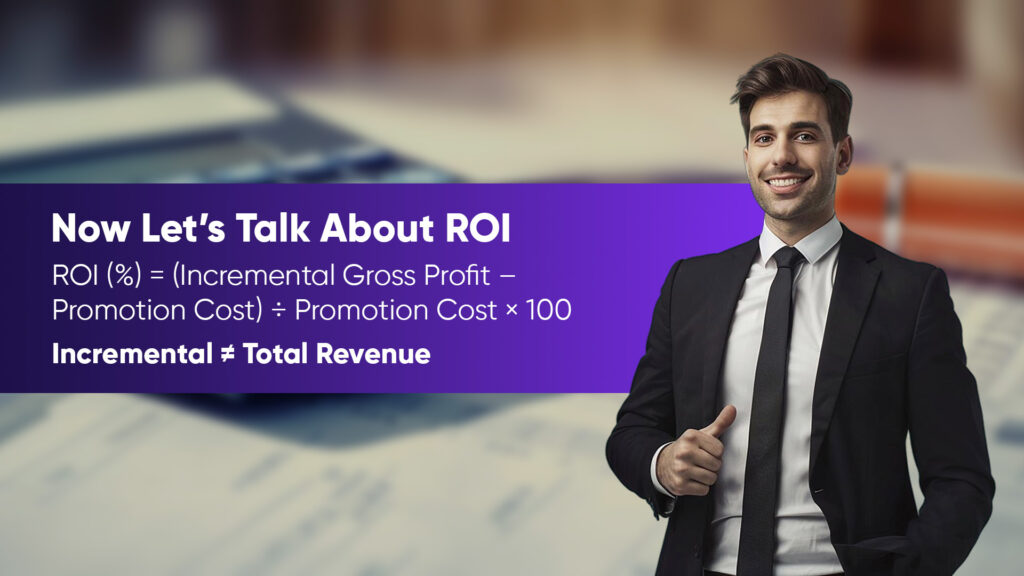
The more accurate promotion ROI formula is: ROI (%) = (Incremental Gross Profit – Promotion Investment) ÷ Promotion Investment × 100
Notice the word incremental. If those sales would have happened anyway, they don’t count.
For example:
Campaign cost: ₹5,00,000
Incremental sales: ₹20,00,000
Margin: 30%
Incremental gross profit = ₹6,00,000
Net profit after campaign cost = ₹1,00,000
ROI = 20%
Now you’re measuring what actually matters.
Discounts vs Incentives: A Subtle but Important Difference
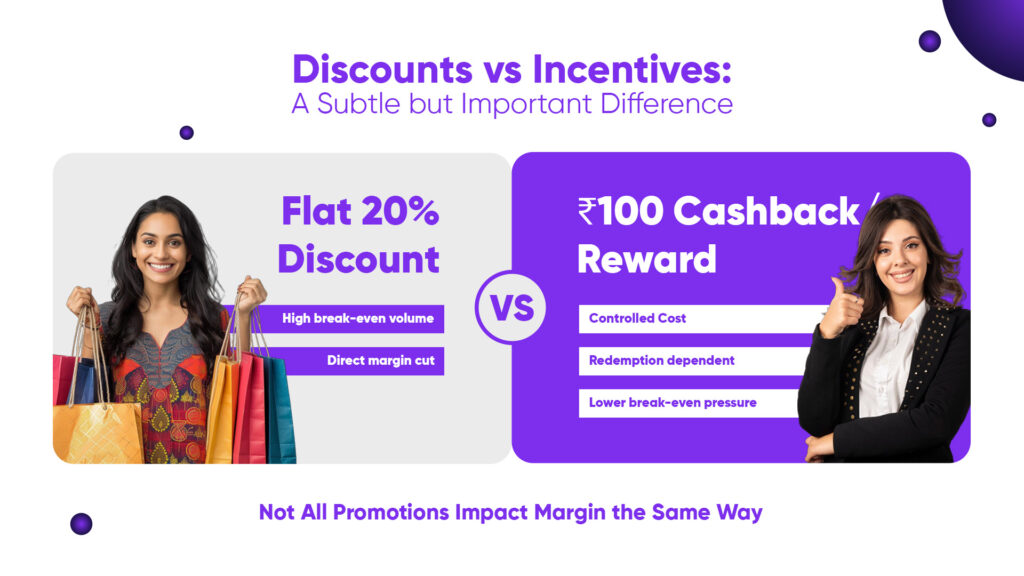
Not all promotions hit margin the same way. A discount reduces your price directly. An incentive doesn’t always have to.
For instance: Instead of offering 20% off (₹200 reduction), you offer ₹100 cashback or reward points. The perceived value may still be strong. But your margin impact is smaller.
And here’s where it gets interesting. If only 60% of customers redeem the reward, your actual cost reduces further. That changes your break-even threshold significantly. This is why incentive ROI often looks healthier than flat discount ROI.
The Costs Everyone Forgets – ROI for promotions
A proper break-even promotion calculation includes:
- Technology platform fees
- Creative and production costs
- Agency retainers
- Fulfilment expenses
- HR bandwidth
- Tax on rewards
- Redemption assumptions
When these are excluded, ROI looks impressive. When included, it becomes realistic. And realistic is what helps you scale sustainably.
Loyalty Programs: A Different Time Horizon
Loyalty programs often get judged too quickly. Unlike flash promotions, loyalty ROI compounds over time, it shows up through:
- Higher purchase frequency
- Increased basket size
- Better retention
- Reduced reliance on blanket discounts
- Higher lifetime value
In many industries, it takes 12–14 months to see meaningful returns. Short-term ROI may look modest. Long-term ROI can be substantial. Different tools. Different timelines.
Before You Launch Your Next Campaign
Ask yourself:
- What is my current contribution margin?
- What will it become after this promotion?
- What volume lift do I need to break even?
- Is that lift realistic based on historical data?
- Am I discounting customers who would buy anyway?
- What happens if I achieve only 75% of the projected lift?
If the answers feel unclear, the campaign needs refining.
The Real Shift
Promotions are not bad. Discounts are not reckless by default. Incentives are not “extra costs”. They’re financial levers. But every lever has physics behind it. When you understand break-even promotion math and use the correct promotion ROI formula, campaigns become calculated growth decisions. And that’s the difference between celebrating revenue and building profit.
If this made you pause and rethink how your next campaign is being planned, share it with your team before the creative goes live. The best time to calculate break-even is before the discount banner is designed.
For more info, write to us at [email protected] or follow our journey on LinkedIn by clicking here.