

Distributor incentive program design in pharma is broken — not because brands lack data, but because they are not using the data they already have. Every pharma brand of meaningful scale runs a Distribution Management System (DMS). The secondary sales patterns, territory-level SKU movement, scheme redemption rates, outlet-level purchase frequency, and distributor engagement signals sitting inside it are some of the richest channel intelligence available. In most organisations, they inform compliance reporting and almost nothing else.
Relevant Buyerr solutions: Channel Partner Program | Trade Promotions | Cashback and Digital Coupons | Loyalty Solutions
1. What Your DMS Already Knows
A well-implemented DMS captures primary data (orders, quantities, schemes) and secondary data (distributor-to-retailer sales, outlet coverage, SKU velocity by territory). Over a full quarter, this builds a detailed picture of which distributors are growing secondary sales versus stagnating, which geographies are over-indexed on one SKU, and which scheme structures drive incremental off-take versus being gamed. None of this requires additional research. It is already in the system.
Also Read: Motivating Channel Partners: Incentives and Training
2. The Gap: DMS as Tracking Tool vs. Incentive Design Tool
Most pharma brands use their DMS reactively — consulting data after performance problems appear. The proactive use is different: it uses patterns in the data to design the incentive structure before the scheme period begins. Only 19% of pharma companies globally say their incentive compensation plans are highly effective, and 89% are actively redesigning them. The most consistent finding: static, uniform incentive structures fail in complex distribution environments. The antidote is territory-specific, behaviour-specific incentive design informed by real DMS data.

3. Five DMS Data Signals for a Smarter Distributor Incentive Program
Signal 1: Secondary Sales Velocity by SKU and Territory
Drives tiered incentive structures that reward distributors for pushing focus SKUs, not just aggregate volume. Rewarding a distributor for high volume on a self-sustaining product is incentive cost with no incremental behaviour change.
Signal 2: Outlet Coverage and Visit Frequency
Drives coverage-linked incentive components. A channel partner incentive program that rewards new outlet additions within a defined geography directly incentivises the distribution expansion that secondary sales growth depends on.
Signal 3: Scheme Redemption Rates and Patterns
Drives scheme structure adjustments that prevent gaming and improve broad participation. A brand whose scheme is redeemed by the top 20% of distributors, with the bottom 80% consistently missing the threshold, has a calibration problem — not a generosity problem.
Signal 4: SKU Mix at the Outlet Level
Drives a retailer engagement program that rewards portfolio breadth rather than single-SKU depth. The DMS outlet-level mix data serves as both the baseline and the measurement mechanism — no additional audit infrastructure needed.
Signal 5: Distributor Engagement Consistency Over Time
Drives loyalty-tier architectures that recognise the consistent partner. A distributor who hits 80% of target consistently for eight consecutive quarters is more strategically valuable than one who hits 120% in Q2 and 50% in Q3.
Also Read: Trade Promotion Strategies That Move Inventory
4. Four Stages of DMS-Informed Incentive Design
Stage 1: Segment the network. Use DMS to segment distributors into high performers, mid-tier, and low-engagement groups. Each needs different thresholds and reward types.
Stage 2: Set targets from DMS baselines. Set targets bottom-up from what the DMS shows each distributor is realistically capable of — not top-down from planning assumptions.
Stage 3: Link reward to the specific behaviour. If the objective is secondary sales growth, the reward should be triggered by secondary sales data — not primary ordering volume. Real-time digital reward disbursement triggered by DMS data events makes this operationally practical.
Stage 4: Build in quarterly recalibration. DMS data is live. A quarterly review allows the incentive program to adapt in near-real time rather than waiting twelve months to discover miscalibration.
5. Common Mistakes in DMS-Led Incentive Design

Using primary sales as a proxy for secondary behaviour rewards stocking, not market-building. Setting uniform thresholds without geographic adjustment structurally disadvantages growth markets. Rewarding volume without rewarding consistency builds quarterly transactions, not long-term channel loyalty. Measuring success by disbursement rate rather than behaviour change subsidises performance that would have happened anyway. Use promotion ROI analysis to confirm actual behaviour change.
6. Quick Decision Framework
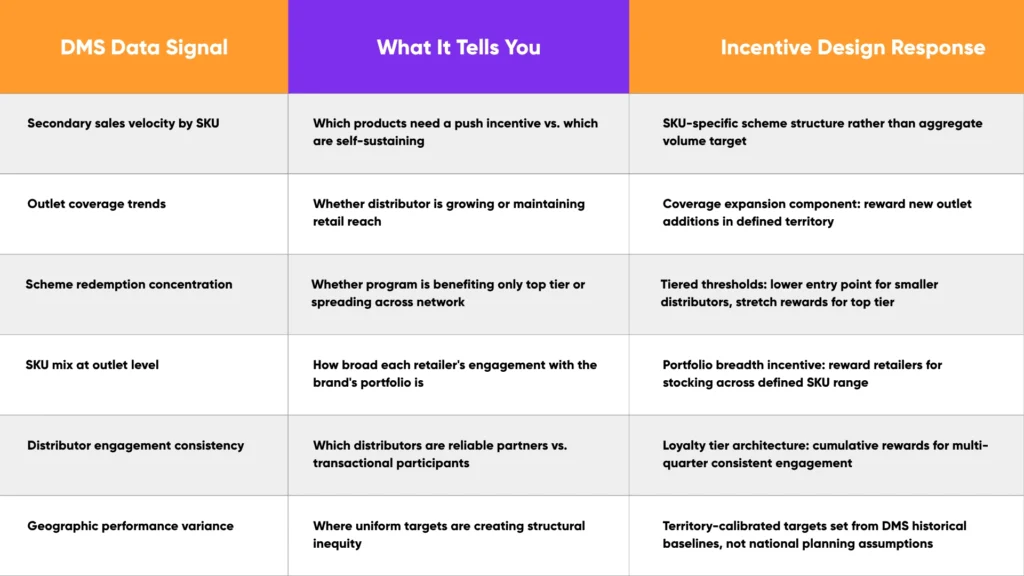
If your scheme targets are set from a planning deck rather than DMS historical baselines, recalibrate before the next scheme period. If you are measuring scheme success by primary order volume rather than secondary sales movement, you are measuring the wrong thing. If the same scheme applies uniformly across metro and Tier 2 territories, it is structurally disadvantaging your growth markets. If your channel partner program resets entirely at quarter end, it is building transactional compliance rather than long-term engagement.
In Closing
The data problem most pharma brands believe they have is not a data shortage. It is a data utilisation problem. The DMS already contains the channel intelligence needed to design a distributor incentive program that is territory-specific, behaviour-linked, and measurably more effective than the uniform quarterly scheme. Follow Buyerr on LinkedIn for more frameworks.
Explore Buyerr’s channel partner and trade loyalty solutions or get in touch directly to discuss your incentive program design.