Scan and earn chemist loyalty program India — this is the commercial opportunity sitting inside infrastructure that already exists on every major drug pack in the country. The Government of India made QR codes mandatory on the packaging of India’s top 300 drug brands on August 1, 2023, under the amended Drugs Rules, 1945. The Drugs Controller General of India has since been actively enforcing compliance, and most major pharma companies have implemented it across their product range.
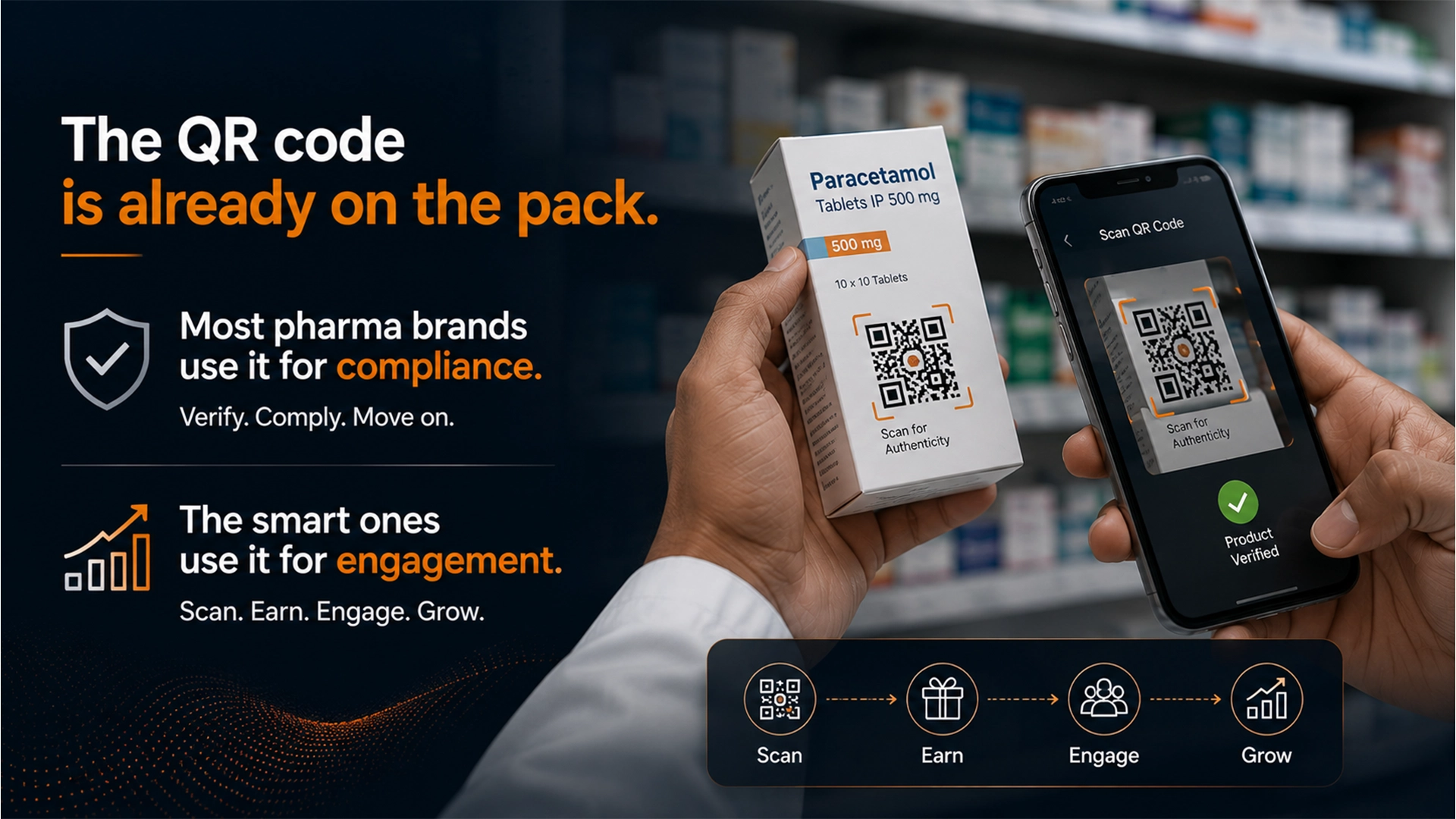
The compliance use case is anti-counterfeiting. The commercial opportunity hiding inside that same infrastructure is something most brands have not yet picked up. The QR code is already on the pack. The question is what happens when the chemist scans it.
For most pharma brands today, nothing happens after the scan. The code verifies authenticity. The retailer moves on. The brand has no idea whether that product was scanned, displayed, recommended, or sold. For brands that have built a scan and earn chemist loyalty program on top of that same QR infrastructure, the answer is very different: the retailer earns a point, the brand gets a data signal, and a commercial relationship that was previously invisible becomes trackable, rewardable, and sustainable.
Before we get into this, here are a few relevant resources from Buyerr:
- Channel Partner Program — Structured retailer and trade loyalty
- Trade Promotions — Incentive design for pharma channel partners
- Rewards and Incentives — Digital reward disbursement at scale
- Cashback and Digital Coupons — Instant UPI reward delivery
- Loyalty Solutions — Channel and trade loyalty architecture
You can also explore: Motivating Channel Partners: Incentives and Training, Trade Promotion Strategies That Move Inventory, Loyalty Program Best Practices for Retail Brands, and How Promotion ROI Analytics Helps Boost Your Campaign Performance.
What we’ll cover in this blog:
- The engagement gap most pharma brands are not closing
- What a scan and earn chemist loyalty program actually does
- The secondary sales visibility problem it solves
- How to design a scan and earn chemist loyalty program
- What the best programs get right
- How to measure whether your program is delivering
The Engagement Gap Most Pharma Brands Are Not Closing
India’s pharmacy retail market is valued at USD 27.38 billion and is projected to grow at 10% CAGR through 2030. Retail pharmacies account for 64.57% of all pharma sales in India in 2025, making the chemist and retailer network the single most commercially significant touchpoint in the entire distribution chain.
And yet, 88.70% of India’s retail pharmacies are unorganised local medical stores, operating without digital systems, without formal loyalty infrastructure, and without a direct relationship with the brands whose products line their shelves. The brand’s relationship with these retailers runs almost entirely through the distributor and the field representative. What the brand knows about what happens at the retail counter is largely inference.
This is the engagement gap. Pharma brands can track primary sales from manufacturer to distributor. They can estimate secondary sales from distributor to retailer. What they almost never have is real-time visibility into what happens at the point of dispensing: which SKUs are moving fastest, which chemists are actively recommending the brand, which outlets are stocking the product but not selling it.
A study by BI WORLDWIDE India and KANTAR found that two-thirds of channel partners in India’s pharmaceutical sector feel “trapped” in their brand relationships, remaining with a brand not out of loyalty but out of the absence of a better alternative. A chemist who feels trapped is not an advocate. They are a passive conduit. And in a market where OTC products are growing at 7.24% CAGR and chemist recommendation is the primary conversion lever, a passive conduit is a commercial liability.
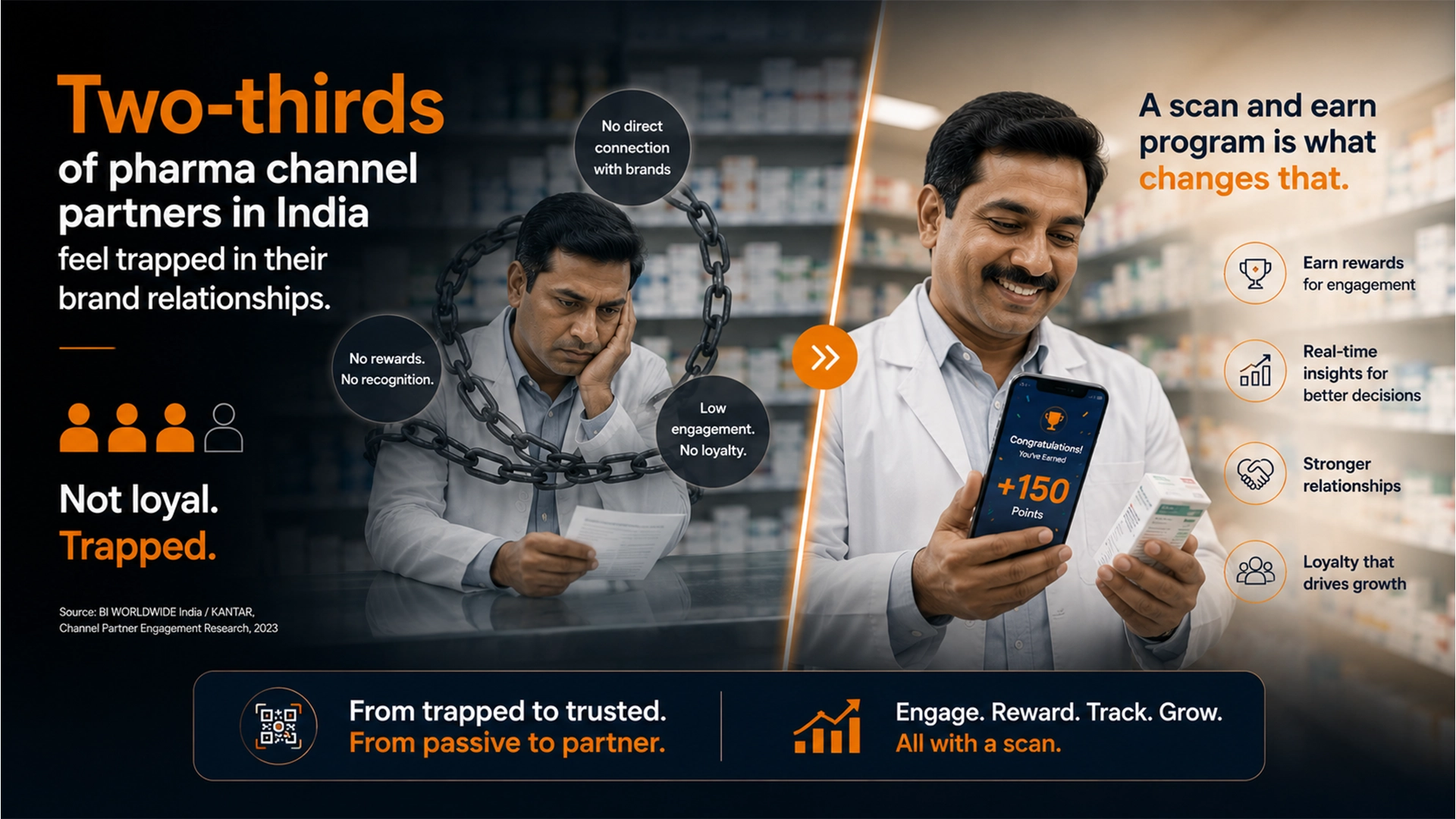
A scan and earn chemist loyalty program India pharma brands deploy is designed to close this gap — not by replacing the distributor relationship or the field force, but by creating a direct, digital engagement layer between the brand and the retailer that generates both loyalty and data simultaneously.
Also Read: Motivating Channel Partners: Incentives and Training
What a Scan and Earn Chemist Loyalty Program Actually Does
A scan and earn chemist loyalty program is structurally simple. Unique QR codes — either on individual product packs or on shipping cartons — are linked to a retailer-facing loyalty platform. When a chemist scans the code, typically at the point of receiving or displaying stock, they earn points instantly credited to a digital wallet. Those points are redeemable through a catalogue of rewards: instant UPI cashback, product vouchers, merchandise, or digital gifts. The entire interaction takes under a minute and requires no app download, no complex registration, and no field force involvement.
This is what makes the mechanic transformative for pharma: it requires no new behaviour from the chemist. The retailer is already handling the product. They are already looking at the pack. Adding a scan step that earns them an instant reward introduces almost no additional friction while creating an entirely new commercial relationship between the brand and the outlet.
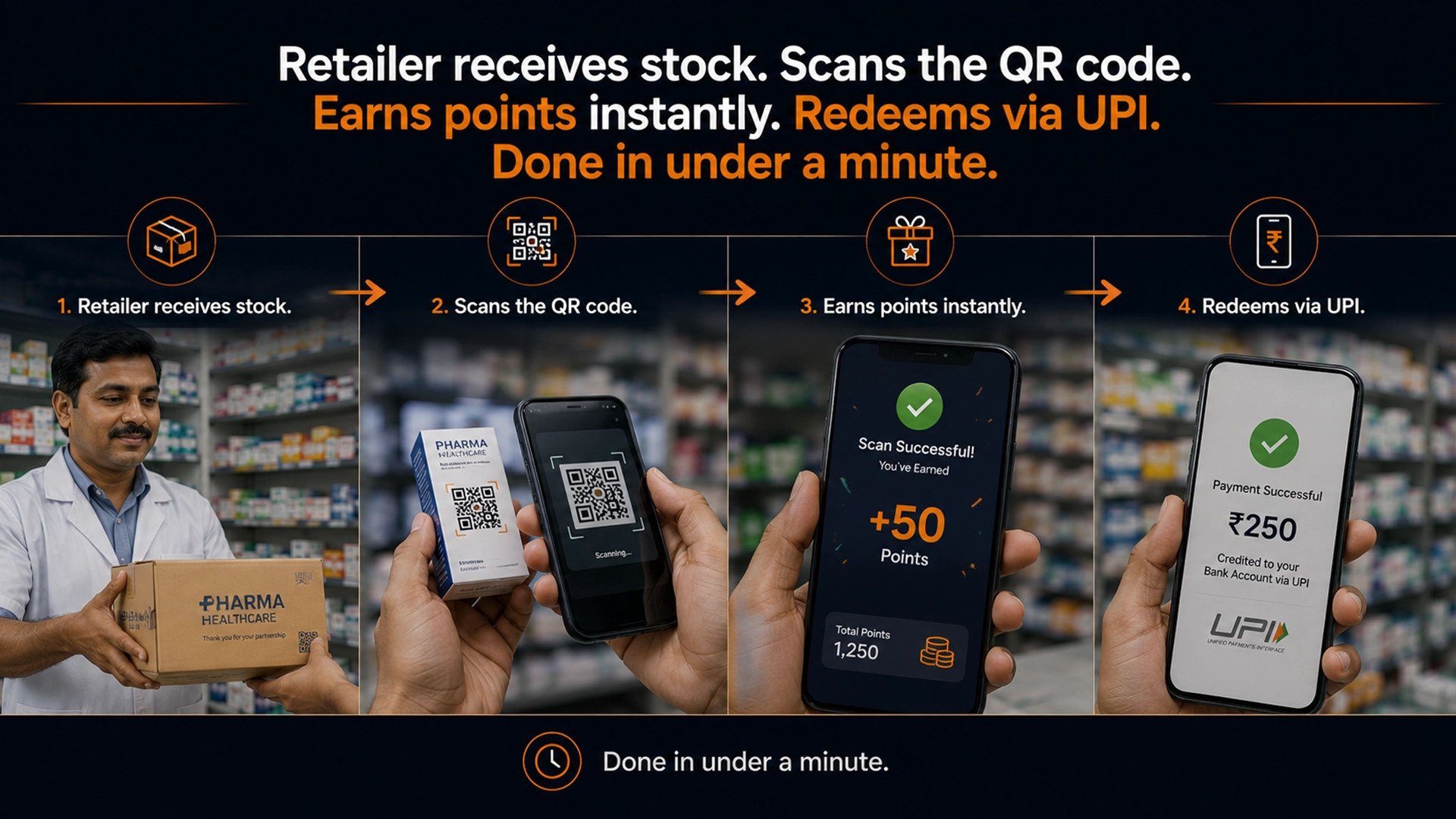
From the brand’s side, every scan generates a data event: which outlet scanned, which SKU, in which geography, at what time. Aggregated across a distribution network of thousands of chemists, this becomes real-time secondary sales visibility that no field force report or DMS estimate can match in granularity or speed.
The mechanic also solves a second problem that plagues most pharma retailer programs: the lag between behaviour and reward. Traditional scheme programs credit retailers monthly or quarterly, creating a disconnect between what the chemist does today and what they receive weeks later. A scan and earn chemist loyalty program that delivers a reward within minutes of the scan closes this loop entirely. The cause and effect are immediate, and immediate rewards change behaviour far more reliably than deferred ones.
The Secondary Sales Visibility Problem a Scan and Earn Chemist Loyalty Program Solves
Most pharma brands operating in India face a significant blind spot between secondary and tertiary sales. They know what left the warehouse. They have estimates of what reached the retailer. What they do not know, with any real confidence, is what the chemist sold and to whom.
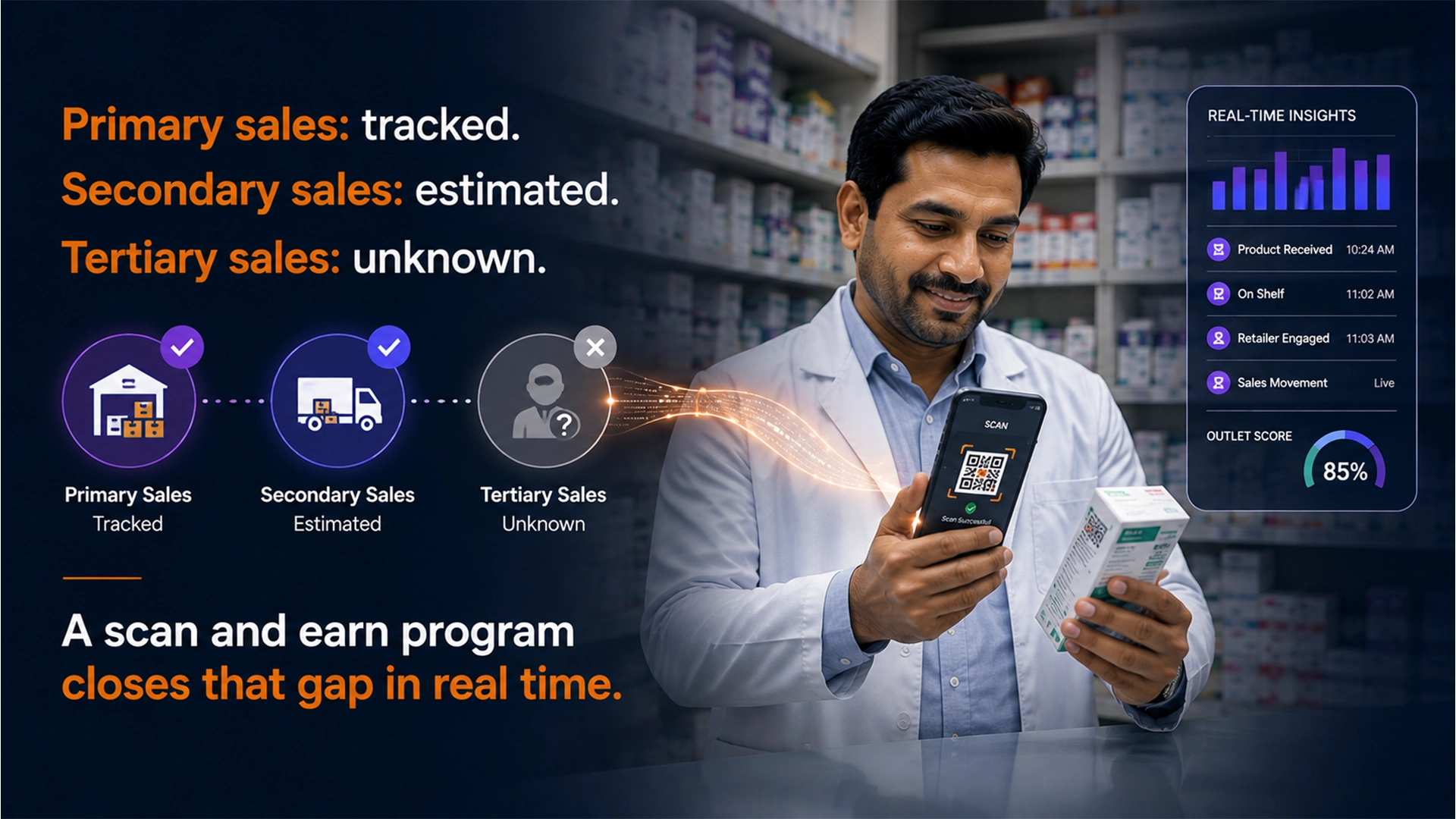
This matters because the entire field force deployment, trade scheme design, and marketing investment of a pharma brand is predicated on assumptions about retail performance that are often several weeks old and geographically aggregated. A region that looks strong in secondary sales data may have specific pockets of underperformance at the outlet level. A product that appears to be distributed may be sitting in back-stock rather than on the shelf.
A scan and earn chemist loyalty program converts every retailer interaction into a real-time data point. When a chemist scans a pack at the point of receipt, the brand knows the product has arrived. When they scan at the point of display, the brand knows it is on shelf. When the scan rate at a particular outlet drops below its historical average, the brand has an early signal of disengagement — weeks before the next secondary sales report would surface the same information.
This visibility is not just commercially useful. It changes how the field force operates. Instead of making territory visits based on rotation schedules and distributor feedback, field representatives can prioritise visits based on real-time scan data: the outlets showing low engagement, the geographies where a new SKU is being scanned but not selling through, the clusters of chemists where a competitor is gaining ground.
For OTC-focused pharma brands, this visibility is particularly valuable. The OTC market in India is projected to grow at 13% CAGR through 2030, with the chemist’s recommendation as the primary conversion lever at the point of dispensing. A brand that knows which chemists are actively engaging with its OTC products, which are in high-recommendation geographies, and which are dormant, can direct its advocacy investment with a precision that a purely push-based model cannot achieve.
Also Read: Trade Promotion Strategies That Move Inventory
How to Design a Scan and Earn Chemist Loyalty Program India Pharma Brands Can Sustain
The structural design decisions that determine whether a scan and earn chemist loyalty program India brands launch delivers real engagement or merely collects data fall into four areas.
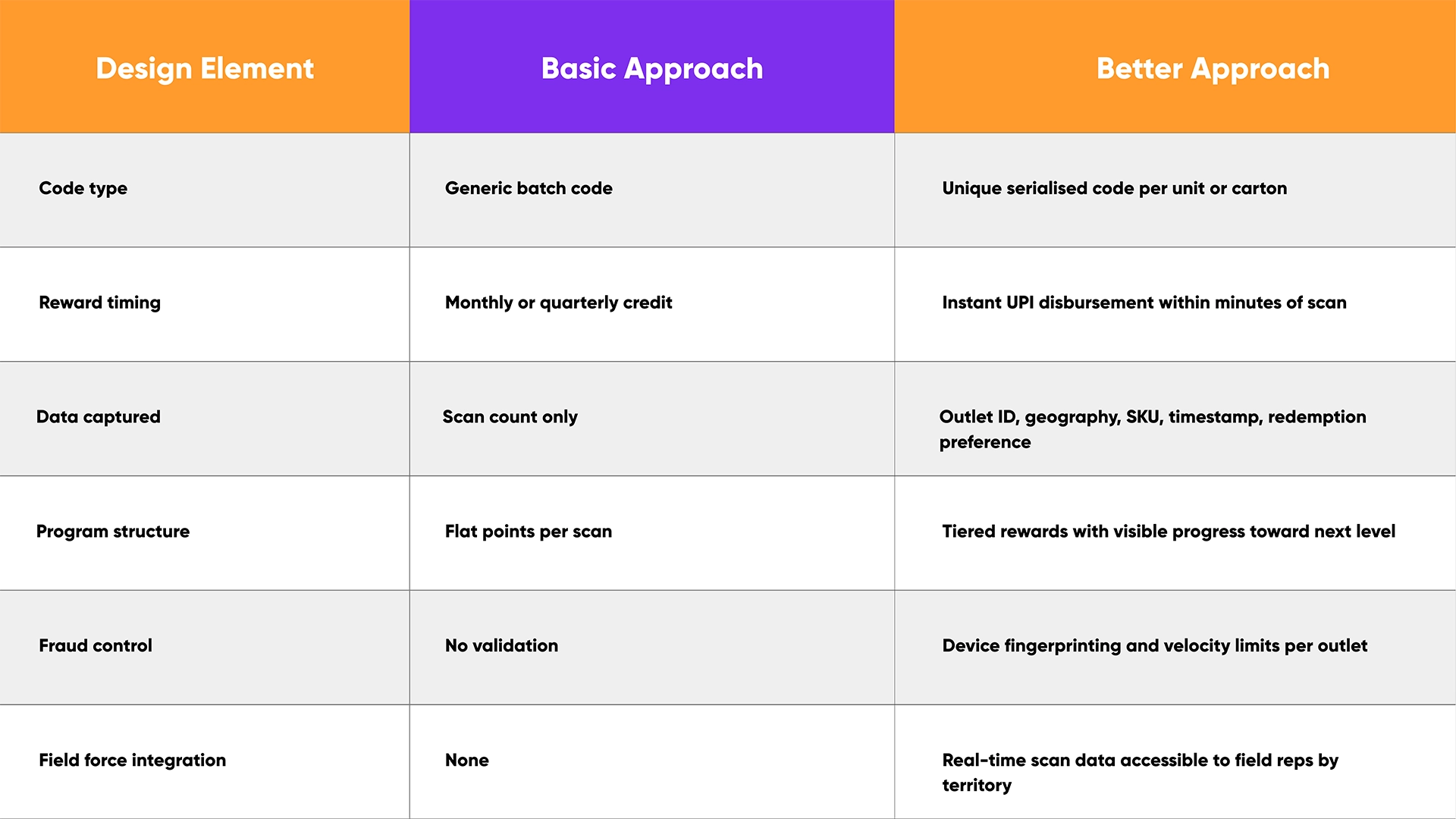
Code architecture: unique versus generic. The single most important technical decision is whether each pack or carton carries a unique, serialised code or a generic code shared across the entire batch. Generic codes cannot detect fraud and cannot be used for outlet-level attribution. Unique, serialised codes tied to individual units or cartons are the baseline requirement for a program that produces usable data and controls fraudulent redemption.
Reward immediacy. The reward that arrives within five minutes of a scan performs fundamentally differently from the reward that arrives at the end of a quarter. Indian chemists, particularly the 88.70% who operate as independent local stores, have limited patience for complex redemption flows and deferred reward cycles. Instant UPI cashback disbursement, credited directly to the chemist’s bank account or UPI wallet within minutes of scanning, is the mechanic that converts sceptical first-time participants into consistent program users. The first reward experience is the program’s most important moment. If it is fast, it creates trust. If it is slow, it creates churn.
Data capture at the point of scan. The scan itself generates an outlet identifier, a timestamp, and a product identifier. But the program can be designed to capture additional data at the moment of redemption: the chemist’s phone number, their pincode, and their preferred reward type. Over multiple interactions, this builds a first-party retailer database that the brand owns and can use for targeted scheme design, field force prioritisation, and future campaign planning.
Tiered engagement design. A flat points-per-scan program creates participation without progression. A tiered program, where a chemist who consistently scans across a quarter unlocks a higher reward tier, creates forward momentum. The chemist who is two weeks away from achieving Silver status has a concrete reason to continue scanning that a flat rewards structure cannot replicate. Tier design should be calibrated to realistic scan volumes for the outlet size and geography.
What the Best Scan and Earn Chemist Loyalty Programs Get Right
The programs that produce sustained chemist engagement share a set of design principles that go beyond the basic mechanic.
They treat the chemist as a professional partner, not a transaction point. The best channel partner programs in pharma combine transactional rewards — points for scans — with recognition elements that make the chemist feel valued: milestone acknowledgements, certified retailer status for consistent engagement, and periodic recognition from the brand. Research consistently shows that 72% of loyalty program members say the program makes them more likely to spend with their preferred brand when they feel genuinely recognised. The scan and earn mechanic creates the transaction layer. Recognition creates the loyalty layer.
They connect the scan data to field force behaviour. A scan and earn chemist loyalty program that generates data no one looks at is not a program. It is a database. The brands getting the most from their retailer engagement programs are the ones that have integrated scan visibility into field representative workflows: territory dashboards showing engagement rates by outlet, alerts when high-value chemists drop below their usual scan frequency, and heatmaps of geography-level engagement that inform where to invest activation resources in the next cycle.
They design for the unorganised majority. With 88.70% of Indian retail pharmacies operating as independent, unorganised local outlets, a program that requires smartphone proficiency, app downloads, or complex registration will exclude the vast majority of its intended participants before the first scan. WhatsApp-based redemption flows, SMS verification as an alternative to app-based login, and IVR claim options for low-connectivity markets extend the program’s reach from the digitally comfortable minority to the broad base of the chemist network that actually drives volume.
They start with a data objective, not just an engagement objective. Before the first code is printed, the most effective programs define what questions the scan data will answer: Which geographies have the highest chemist engagement? Which SKUs are being scanned but not selling through? Which outlets are consistently active versus dormant? Designing the data capture around these questions ensures the intelligence generated is actionable from the first week of the program.
Also Read: Loyalty Program Best Practices for Retail Brands
Measuring Whether Your Scan and Earn Chemist Loyalty Program Is Delivering
Beyond scan volume and reward redemption rates, the metrics that indicate whether a scan and earn chemist loyalty program India pharma brands run is creating genuine commercial value are:
Secondary sales correlation. Program-enrolled outlets should show stronger secondary sales velocity than non-enrolled outlets in the same territory. If they do not, the program is creating engagement without moving product.
Engagement consistency over time. A chemist who scans in month one and drops off in month two is an acquisition cost without a return. Tracking multi-month retention by cohort, and identifying the program elements that predict sustained engagement versus early drop-off, is the feedback loop that improves every successive scheme cycle.
Data completeness per outlet. What percentage of active chemists have provided complete profile data: phone number, outlet type, geography, preferred reward? The more complete the retailer profile, the more precisely the brand can tailor future schemes and field force priorities.
Fraud detection rate. In any scan-based program across a large chemist network, some level of scan gaming will occur. Tracking the percentage of flagged scans, and the outlets generating them, gives the brand a real read on the integrity of the data it is using for commercial decisions.
Before Your Scan and Earn Chemist Loyalty Program Goes Live: Quick Checklist
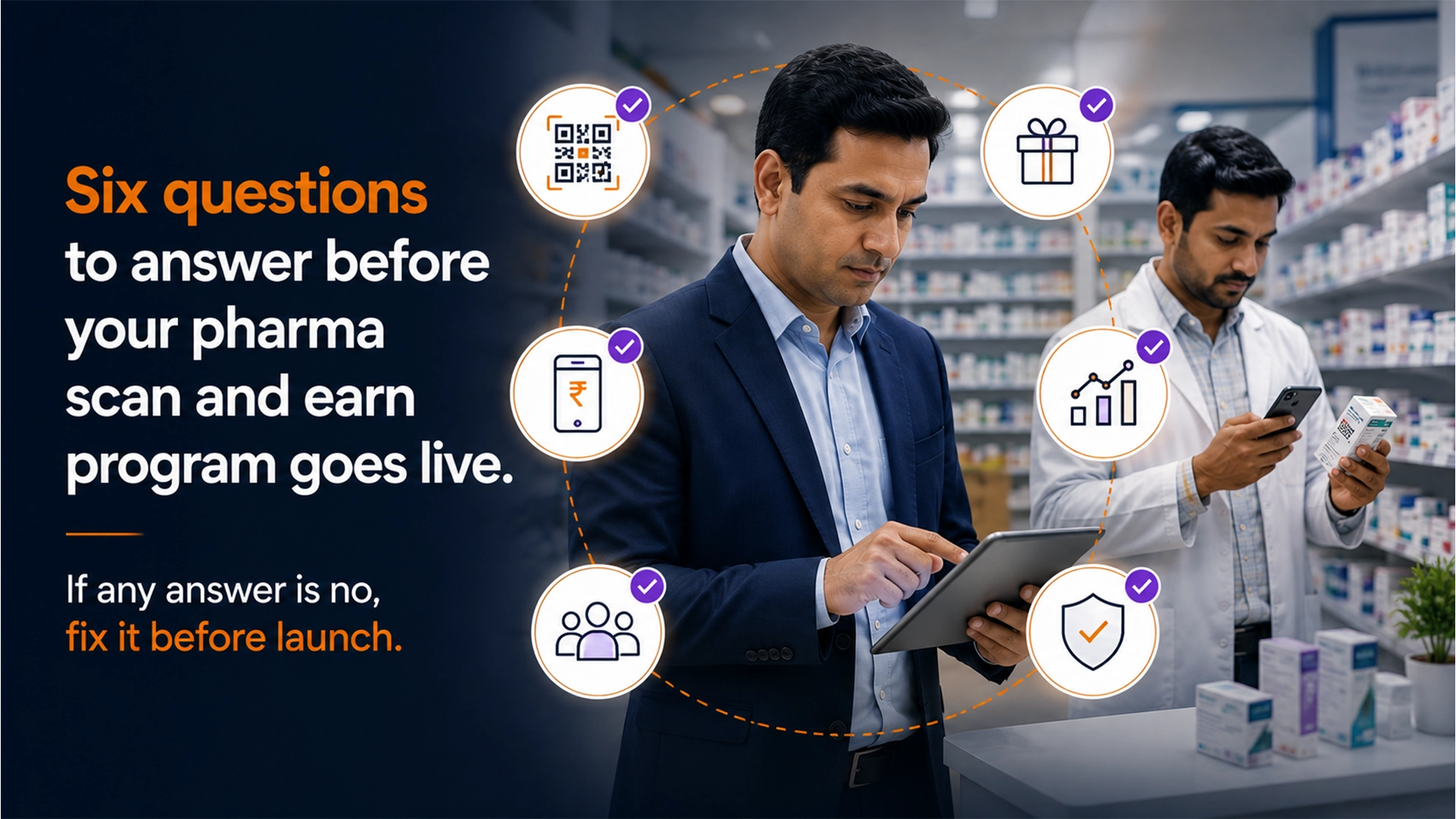
- Are your QR codes unique and serialised? Generic codes create fraud and produce no outlet-level data
- Does the chemist receive a reward within minutes of scanning? If not, redesign the disbursement before launch
- Is the claim flow accessible on a basic smartphone without an app download? If not, add a WhatsApp or SMS alternative
- Have you defined 3 to 5 data questions the scan data will answer? If not, the data will accumulate without informing decisions
- Is scan data visible to your field force in real time, by territory? If not, the program is generating intelligence no one is using
- Is there a tiered reward structure with visible progress for the chemist? If not, there is no incentive to sustain engagement beyond the first scan
In Closing
The QR code is already on the pack. India’s top 300 pharma brands are mandated to carry it. The infrastructure exists. The question every pharma trade marketing head should be asking is not whether to use QR codes, but whether they are using them only for compliance or also for commercial engagement.
A scan and earn chemist loyalty program India pharma brands build today converts mandatory packaging infrastructure into a retailer loyalty engine: one that rewards every product interaction, generates real-time secondary sales visibility, and builds the first-party chemist database that most pharma brands do not yet have. India’s loyalty program market is growing from USD 4.3 billion in 2025 to an estimated USD 17.1 billion by 2035 at 16.1% CAGR, and the pharma channel, with its vast unorganised retailer base and persistent engagement gaps, is one of the most significant untapped opportunities within it.
The brands that build this layer now will enter the next growth cycle with a commercial asset their competitors are still trying to construct.
If you found this useful, these related reads may also be worth your time:
- Motivating Channel Partners: Incentives and Training
- How Promotion ROI Analytics Helps Boost Your Campaign Performance
- Gamification in Loyalty and Promotions: What Works?
- Emerging Trends in Consumer Promotions and Loyalty in 2026
- Trade Promotion Strategies That Move Inventory
- Loyalty Program Best Practices for Retail Brands
Want to build a scan and earn chemist loyalty program India retailers will actually use? Get in touch with Buyerr to discuss your program design — from code architecture to real-time reward disbursement. To explore more frameworks, write to us at [email protected] or follow our updates on LinkedIn.