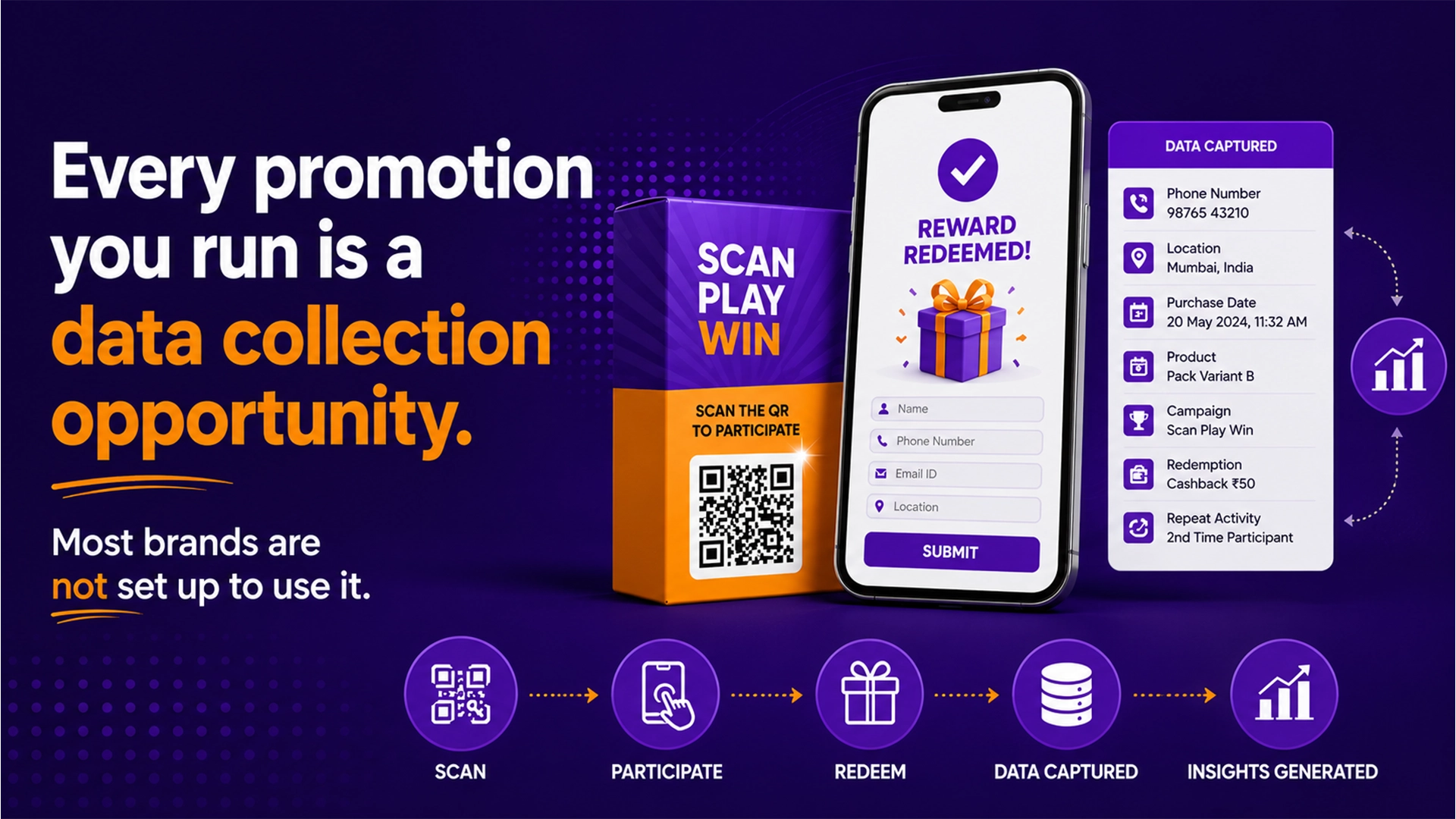
Most brands running consumer promotions today are sitting on a data collection opportunity they are not fully using. Every time a consumer scans a QR code on a pack, claims a cashback, enters a contest, or redeems a reward: that interaction contains information. Phone number. Location. Purchase date. Pack variant chosen. Time of day. Frequency of repeat. If the promotion is set up correctly, all of it is captured, structured, and usable. If it is not, the brand walks away with a sales number and nothing else.
This guide is for brand managers, trade marketing heads, and D2C founders who want to change that. Not by adding complexity to their campaigns, but by designing the data capture into the promotion mechanic from the start, so that every rupee of promotion spend builds something that outlasts the campaign itself.
By the end of this guide, you will know:
- What data to collect and why, before designing anything
- Which promotion mechanics naturally generate data and which do not
- How to build a redemption flow that captures cleanly without friction
- How to stay compliant with India’s DPDP framework
- How to structure and activate the data after the campaign ends
Before we get into this, here are a few relevant resources from Buyerr:
- 1st Party Data and Consumer Insights
- Consumer Promotions – End-to-End Campaign Solutions
- Retail and On-Pack Promotions
- Consumer Research
- Cashback and Digital Coupon Solutions
You can also explore:
- How to Plan a High-Impact Consumer Promotion Campaign in India
- Regulatory and Compliance Pointers for Consumer Promotions in India
- How Promotion ROI Analytics Helps Boost Your Campaign Performance
- Emerging Trends in Consumer Promotions and Loyalty in 2026
What we’ll cover in this guide:
- Decide what data you actually need before designing anything
- Choose a promotion mechanic that creates a natural data moment
- Design the redemption flow as a data capture flow
- Handle consent correctly under India’s DPDP framework
- Structure the data for actual use
- Activate the data after the campaign ends
- Measure data quality, not just campaign performance
Step 1: Decide What Data You Actually Need Before Designing Anything
This is the step most brands skip, and it is the one that determines whether the data they collect is useful or just stored.
Before choosing a mechanic, before briefing the creative team, before thinking about the reward: write down the three to five questions you want to be able to answer about your consumer that you cannot answer right now. These become your data objectives, and they should drive every subsequent decision.
Common questions worth building toward:
- Who is actually buying my product at general trade, versus modern trade, versus online?
- Which geographies are driving repeat purchase versus trial-only behaviour?
- Which pack size or SKU does a consumer buy first, and does it predict what they buy next?
- How frequently does the same consumer purchase within a 30 to 90-day window?
- What is the age and household profile of buyers in my highest-volume markets?
Once these questions are defined, work backwards. A phone number and purchase location answers geography. A purchase date and repeat scan behaviour answers frequency. A survey question at the point of redemption answers profile. Each piece of data has a source, and each source needs to be built into the promotion mechanic deliberately.
The mistake most brands make: they collect whatever is easy to collect, usually just a phone number, and then wonder why the data does not help them make better decisions. Data that does not answer a specific business question is storage, not intelligence.
What to do: Before briefing your next promotion, write three specific questions you want answered about your buyer. Then check whether the promotion mechanic you are planning is capable of answering them.
Step 2: Choose a Promotion Mechanic That Creates a Natural Data Moment
Not all consumer promotion mechanics are equal when it comes to data collection. Some create a natural interaction where data capture feels like a reasonable exchange for the reward. Others create friction where asking for information feels intrusive and kills redemption rates.
Here is how the most common mechanics compare:
| Mechanic | Data Collection Potential | Natural Exchange? | Friction Risk |
| QR code on-pack – cashback claim | High: phone, location, purchase data | Yes – reward justifies the ask | Low if flow is simple |
| Scan and win – instant prize | High: phone, pack variant, geography | Yes – excitement justifies the ask | Low |
| Contest or gamified entry | High: name, email, preferences | Yes – participation justifies the ask | Medium |
| Scratch card – physical | Very Low: anonymous interaction | No digital touchpoint | Not applicable |
| Gift with purchase – in-store | Very Low: no digital claim required | No digital touchpoint | Not applicable |
| Loyalty punch card – digital | Very High: behaviour over time | Yes – ongoing reward justifies ongoing data | Low if UX is good |
The mechanics with the highest data collection potential are the ones with a digital claim step. Any time a consumer has to go online to receive their reward, there is a structured moment to collect information. QR code-based on-pack promotions, gamified contests, and cashback mechanics with UPI disbursement are all natural data collection vehicles because the consumer expects to provide some information to receive something in return.
Physical mechanics, scratch cards, gift-with-purchase, and counter-based redemptions generate almost no usable first-party data because there is no digital touchpoint in the journey. If data collection is a campaign objective, these mechanics need to be modified or replaced.
What to do: If your next promotion uses a physical-only mechanic, add a digital layer. Even a simple QR code on the gift receipt or a WhatsApp-based claim flow creates the data touchpoint that makes collection possible.
Step 3: Design the Redemption Flow as a Data Capture Flow
This is where most campaigns collect far less than they could, not because the mechanic is wrong, but because the redemption flow was designed purely around reward delivery and data capture was treated as an afterthought.
A well-designed redemption flow captures data at three natural points without the consumer feeling interrogated.
Point 1: At claim initiation. When the consumer scans the QR code or initiates the claim, capture: phone number, the code or pack identifier (which gives you SKU and location if outlet-mapped), and timestamp. These three fields cost the consumer almost nothing to provide and give the brand purchase verification, geography, pack variant, and date. This is the minimum viable data capture for any promotion.
Point 2: During reward disbursement. If the reward is a UPI cashback, the consumer must provide a UPI ID or linked phone number. This is already happening. The question is whether the brand’s platform is structured to retain this data against the consumer’s profile, or whether it processes the transaction and discards it. The difference between a promotion that builds a database and one that does not is often this single architectural decision.
Point 3: Post-redemption survey – optional but high value. After the reward is confirmed, a consumer who has just received money in their account is in their highest-satisfaction moment with the brand. One or two questions at this point, asked well, get answered. “Which store did you buy this from?” or “How often do you buy this product?” are questions that add significant analytical value and take the consumer 15 seconds to answer. More than two questions at this point, and completion rates drop sharply.
What to get right: The total time from scan to reward confirmation should be under two minutes. If the data capture step adds more than 30 seconds to this journey, it will cost redemption rate. Speed of reward and brevity of data collection are not in conflict: they need to be designed together.
What goes wrong: Brands ask for too many fields upfront. Name, email, address, date of birth, and a product feedback question, all before the reward is confirmed. Consumers abandon the flow. The brand ends up with a 20% completion rate and blames the mechanic, when the problem was the design of the claim journey.
Step 4: Handle Consent Correctly Under India’s DPDP Framework
This step is no longer optional.
India’s Digital Personal Data Protection Act, the DPDP Act, is in active implementation. The DPDP Rules were notified on November 13, 2025. The Data Protection Board of India came into existence the same month. The consent manager framework goes live in November 2026, and full compliance obligations kick in by May 2027. (Source: Agency Reporter, March 2026 / DLA Piper Data Protection Laws India)
What this means practically for a brand running a consumer promotion:
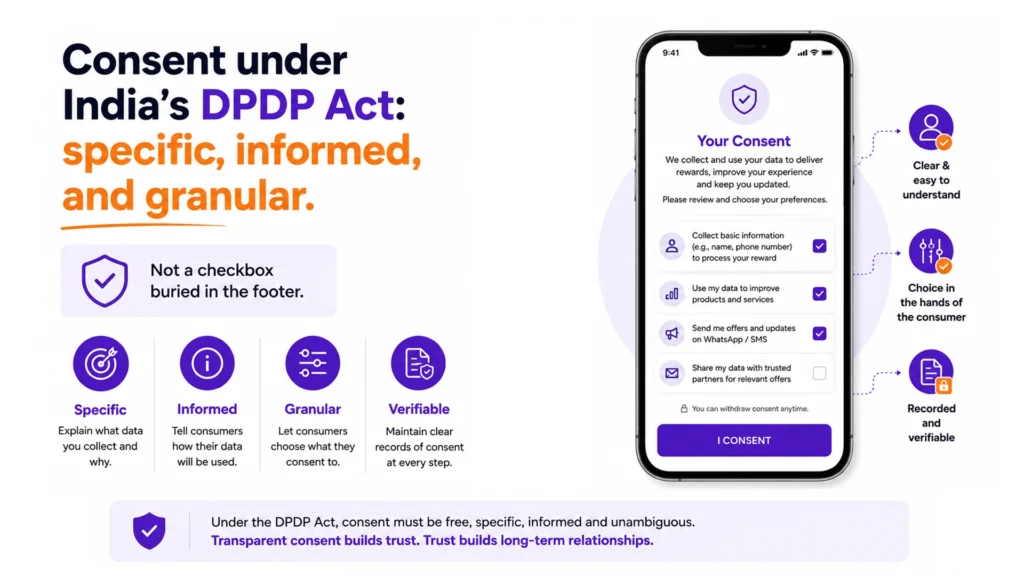
Consent must be specific, informed, and granular. A generic “by participating you agree to our terms” buried in the footer of a campaign landing page will not meet the standard the law requires. The consumer must be told, clearly, what data is being collected, why it is being collected, and who it may be shared with. (Source: EY India, DPDP Act 2023 and DPDP Rules 2025)
This does not make data collection harder. It makes it more structured. And structure, in this case, works in the brand’s favour: a consumer who actively consents to share their data, because they understand the exchange and trust the brand, is a more valuable data point than one whose information was collected through a vague permissions flow. The consent is the quality filter.
What to build into the flow:
- A clear, plain-language statement at the start of the claim journey: “We collect your phone number and purchase information to process your reward and to send you relevant offers from [Brand]. You can opt out at any time.”
- An explicit opt-in checkbox, not pre-ticked, for marketing communications. This separates the transaction consent from the marketing consent.
- A clear opt-out mechanism, accessible in every subsequent communication.
What to avoid: Assuming that a consumer’s participation in the promotion constitutes consent to all future marketing. It does not, under DPDP. Transaction and marketing are two separate consent categories. Build them separately from the start.
For brands who want to understand the full regulatory landscape around consumer promotions in India, the regulatory and compliance guide on the Buyerr blog covers this in detail.
Step 5: Structure the Data for Actual Use
Collecting data and having usable data are not the same thing. This step is about the gap between the two, and it is where most brand data initiatives stall.
The most common outcome of a promotion data capture exercise: a spreadsheet with 40,000 rows of phone numbers, timestamps, and redemption statuses that sits in someone’s Google Drive and is referenced once in a post-campaign presentation.
For data to be usable, it needs to be structured around the questions from Step 1. That means three things:
Tagging. Every data point should carry the context of its collection: which campaign, which outlet, which geography, which SKU, which time period. Without tags, 40,000 phone numbers are just 40,000 phone numbers. With tags, they are a segmented audience of buyers who purchased a specific SKU in a specific market during a specific window, and can be treated accordingly in the next campaign.
Deduplication and cleaning. The same consumer may scan the same code twice, enter the same contest from two devices, or claim a reward twice from different numbers. Raw promotion data almost always contains duplicates and junk entries. Cleaning the data before it is used for targeting or analysis is not optional: sending a “welcome new customer” message to someone who has bought your product 12 times because their second number appeared in the dataset is the kind of mistake that erodes rather than builds brand trust.
Merging across campaigns. A consumer who participated in your summer promotion and your Diwali promotion is a different, more valuable consumer than one who appeared in only one. Platforms that build a persistent consumer profile, appending new interaction data to an existing record rather than creating a new one each time, create a progressively richer picture with every campaign run. This is the compounding value of structured first-party data and consumer insight infrastructure.
What to do: Before the campaign launches, define the data schema. Decide what fields will be collected, how they will be tagged, and where they will live. This takes two hours before the campaign and saves weeks of cleanup after it.
Step 6: Activate the Data After the Campaign Ends
This is the step that separates brands that treat data as a campaign output from brands that treat it as a business asset.
A first-party consumer database collected through a promotion has at least four immediate activation uses:
Re-engagement for the next campaign. A consumer who claimed a cashback in May and gave you their phone number is a warm audience for your June campaign. A WhatsApp message with early access to the next offer, sent to the validated buyers from the last promotion, will outperform a cold campaign to a new audience on almost every metric: open rate, redemption rate, and repeat purchase rate.
Festive season targeting. If your summer promotion captured 50,000 verified buyers with purchase dates, geographies, and SKU preferences, that audience is ready for a personalised Diwali communication in September. This is the compounding effect of well-captured promotion data: each campaign makes the next one more precise and less expensive to run.
Trade and distribution decisions. Geography-tagged purchase data from a promotion can tell a brand which markets have the highest verified buyer density, which channels are driving actual purchase, and which SKUs are moving in which regions. This is consumer insight that most brands currently pay panel research firms to approximate, when the real data is already available through their own promotions.
Lookalike audience building. A clean, validated list of actual buyers, with phone numbers and UPI IDs, can be used to build lookalike audiences on digital platforms for acquisition campaigns. The quality of a lookalike audience is entirely dependent on the quality of the seed data. Verified buyers, who self-identified through a purchase interaction, are a significantly higher-quality seed than a modelled audience or a purchased list.
What to do: Before the campaign ends, assign ownership of the data. Who is responsible for activation? What is the first thing that happens with it within 30 days of campaign close? If there is no answer to these questions, the data will sit unused.
Step 7: Measure Data Quality, Not Just Campaign Performance
Standard post-campaign measurement covers redemption rate, cashback disbursed, sales uplift, and ROI. These matter. But if data collection was a campaign objective, there is a second set of metrics that most brands do not track.
Capture rate. Of all the consumers who redeemed the promotion, what percentage completed the data fields correctly? A 40% capture rate means 60% of redemptions generated no usable data. This is a design problem, not a consumer problem, and it is fixable in the next campaign.
Data completeness. Of the records captured, how many have all the fields needed for activation: phone, location, SKU, date? A record with a phone number but no geography tag is only partially useful. Tracking completeness helps identify which fields are being abandoned in the flow and why.
Data quality. How many records are valid after deduplication and cleaning? If 10% of phone numbers are junk entries or duplicates, the effective database from the campaign is 10% smaller than the raw number suggests.
Repeat capture rate. In a multi-purchase mechanic, how many consumers appear more than once in the dataset? A consumer who has interacted with the brand twice in a single campaign is a materially different signal from one who appeared once.
Consumer segments generated. At the end of the campaign, how many usable segments has the data created? High-frequency buyers, single-purchase buyers, premium SKU buyers, urban buyers versus Tier 2 buyers: each of these is an activation-ready audience if the data is structured correctly.
Tracking these metrics alongside the standard campaign KPIs changes the conversation about what a promotion is worth. A campaign that drove moderate sales uplift but captured 80,000 clean, segmented, consented first-party records may well be more valuable to the brand than one that drove a strong short-term spike and captured nothing.
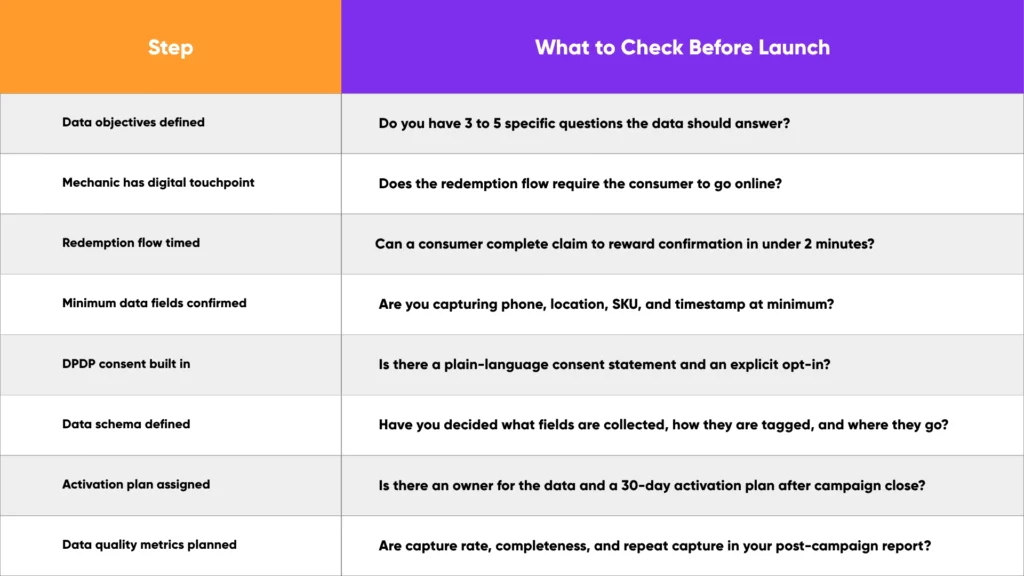
Quick Reference: First-Party Data Capture Checklist
In Closing
India’s Digital Personal Data Protection Act is moving from framework to enforcement. Media costs are rising. Third-party data is becoming less reliable and more expensive. Google’s Privacy Sandbox was shut down in October 2025 after six years of development, and the structural shift toward privacy-first marketing is now irreversible regardless of what any single platform does. (Source: MarkHub24, March 2026)
The brands that will have a durable advantage in this environment are the ones that own their consumer data: not rented from a panel, not inferred from a model, but collected directly from real buyers through promotions they were already running.
50% of millennials are willing to share personal data in exchange for better experiences and personalised offerings. (Source: The Grocer / SAP, 2024) The exchange is there. The infrastructure to capture it correctly is available. The only thing most brands are missing is the decision to design for it from the start.
Every promotion you run between now and the end of 2026 is either building that database or it is not. The campaigns are happening either way.
If you found this useful, these related reads may also be worth your time:
- How to Plan a High-Impact Consumer Promotion Campaign in India
- Regulatory and Compliance Pointers for Consumer Promotions in India
- How Promotion ROI Analytics Helps Boost Your Campaign Performance
- Emerging Trends in Consumer Promotions and Loyalty in 2026
- The 7 Most Effective Consumer Promotions for B2C Brands
- Loyalty Program Best Practices for Retail Brands
Want to run consumer promotions that build a verified first-party database while driving sales? Explore Buyerr’s consumer promotion and data solutions, or get in touch directly to discuss your next campaign.
To explore more frameworks, write to us at [email protected] or follow our updates on LinkedIn.