
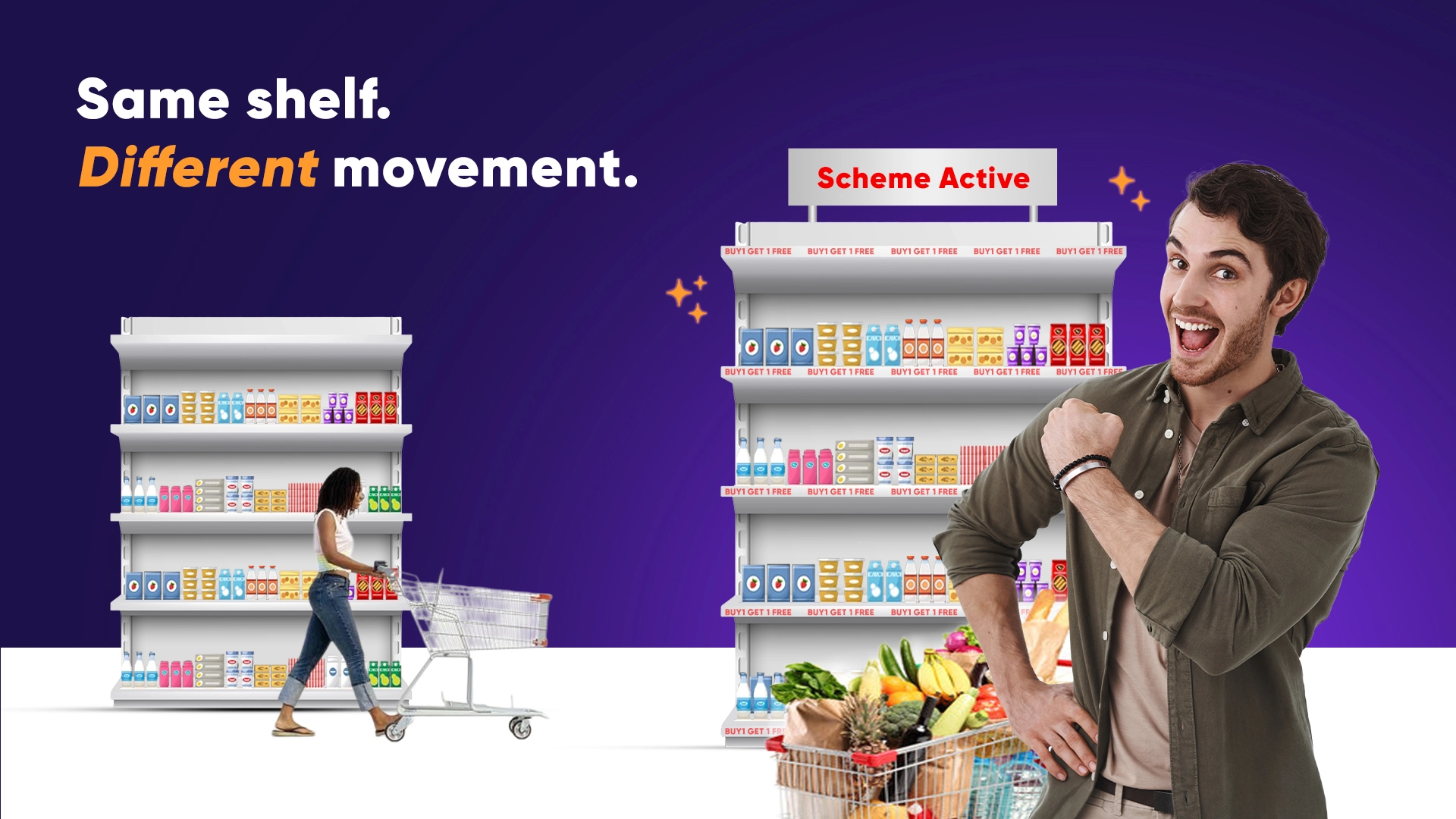
Walk into any retail market towards the end of the month, and you’ll notice a pattern that doesn’t show up in reports.
Two products sit next to each other. Same category. Similar pricing. Sometimes, even similar demand. But one of them moves faster while the other struggles to keep pace. If you ask the retailer why, the answer is rarely about brand love or marketing recall. It’s usually something much simpler and much more practical: “Isme scheme better hai.”
That one line explains a lot about channel behaviour. At the last mile, decisions are driven by what works for the person selling it: today, this week, in that moment.
There is no universal answer here. Channel incentive models like points, rebates, spiffs, tiered structures, each serve a specific purpose, in a specific context, for a specific person in the chain. Choosing the wrong one is not a failure of intent; it is usually a failure of matching. And that is worth understanding carefully.
Before we get into the models themselves, it helps to place this in a slightly larger context. If you’re thinking about channel incentives as part of broader campaign planning, you might want to revisit how this connects with:
And if you’ve explored our earlier work:
You’ll notice a common thread: incentives don’t just reward behaviour, they shape it.
What we’ll cover in this blog:
- Why the Model Matters More Than the Budget
- Spiffs: Fast, Personal, and Easy to Misuse
- Rebates: The Volume Engine That Stalls at the Shelf
- Points Programs: Loyalty Built Slowly, Lost Quickly
- Tiered Incentives and Growth Accelerators
- What Often Goes Wrong (And Why It’s Worth Examining)
- The Incentive Selection Framework: A Quick-Decision Cheat Sheet
1. Why the Model Matters More Than the Budget
Here is a data point that should give most channel teams pause. According to the 2023 State of Channel Incentives Report by 360insights, 87% of brands reported concerns about unclaimed incentive budgets and under-engagement in their programs. Not underfunding. Under-engagement. The money existed. Partners just were not chasing it.
A separate study by Brightspot found that companies running structured channel partner incentive programs saw 9% higher annual revenue growth, 4% more profitable partners, and 6% higher partner retention compared to those without. The gap is not marginal. And yet, most brands still default to whatever scheme ran last quarter.
The issue, typically, is not budget size. It is design. Specifically, it is the gap between what a brand is trying to achieve and which incentive mechanic they are using to achieve it.
Think about it this way. Your distributor, at any given point, is managing products from 15 to 20 different brands. Your sales representative may carry an even wider portfolio. There is no loyalty by default. There is attention, and attention goes to wherever the next reward is clearest, fastest, and most worth chasing. According to research cited by 360insights, 75% of global trade flows through indirect channels which means the battle for mindshare in those channels is where most of the real commercial action happens.
Designing that mindshare intentionally starts with picking the right model.

2. Spiffs: Fast, Personal, and Easy to Misuse
A Spiff (Sales Performance Incentive Fund) is possibly the most misunderstood tool in trade marketing. It is short-term, individual-level, and tied to a specific product or a specific window of time. The reward goes directly to the frontline salesperson, not to the distributor as an organisation.
This matters enormously. When a brand launches a new SKU and needs it actively recommended at retail, a spiff is one of the few mechanisms that can influence that last-metre behaviour. Not the distributor’s billing target. Not the company-level rebate. The individual who is standing behind the counter deciding which product to push.
Where spiffs work well: product launches where the product needs active recommendation, short sales cycles, competitive environments where a rival brand is actively being preferred by frontline reps, inventory clearance scenarios where specific units need to move fast.
Where they tend to fall short: when the goal is volume stocking rather than sell-through, when the program runs too long (spiffs lose urgency after 6–8 weeks), and when there is no tracking at the point of sale to verify who actually pushed what.
Let’s say a personal care brand is launching a new variant of a premium shampoo. The distributor has stocked it. But in the first month, it is not moving because shelf staff are defaulting to the SKU they know. A well-structured spiff, a direct daily or weekly incentive to the retail counter staff for recommending and converting a unit can shift that behaviour within days. It does not require a category-wide scheme. It requires a targeted, fast, personal mechanic.
One practical caution worth noting: if spiffs run simultaneously for multiple products across a portfolio, they dilute each other. The frontline rep gets confused about what to push and ends up pushing whichever product the scheme is easiest to claim for. Simplicity and focus are what make spiffs work.
This is also where gamified promotions or short-term retail contests can work well alongside spiffs especially when the goal is to drive attention quickly without overcomplicating execution.

3. Rebates: The Volume Engine That Stalls at the Shelf
Rebates are the workhorses of trade marketing. They are company-level incentives, paid after a threshold is crossed, and they reward distributors or channel partners for purchase volume over a defined period. A flat 3% back on monthly billing above ₹10 lakhs. A tiered structure where crossing ₹25 lakhs unlocks 5%. The mechanic is familiar to most sales teams.
Rebates are designed to influence sell-in. They give a distributor a compelling financial reason to order more. The assumption is that higher inventory levels will eventually translate to higher offtake, but that assumption does not always hold.
Where rebates work well: building consistent billing across quarters, growing stocking levels of a core portfolio, rewarding long-term partner commitment, and building distributor margin visibility.
Where they tend to fall short: when offtake is the real problem (not ordering), when slabs are set too high for smaller distributors to ever reach, and when payout timelines are delayed so significantly that the incentive has lost its motivational currency by the time it lands.
In many cases, brands are now pairing rebate structures with cashback-led incentives or digital couponing systems to reduce payout friction and improve visibility for partners.
There is a well-documented structural issue with rebates in Indian FMCG: the payout lag. A distributor hits a September target and receives the rebate credit in December or January. By that point, the connection between the effort and the reward has evaporated. The distributor was motivated in September by the scheme; by January, it is just an accounting entry. Brands that have moved to faster, system-driven payout cycles consistently report higher engagement in subsequent cycles because the behaviour-reward loop stays intact.
A useful analogy: a rebate is like a salary increment. It rewards sustained performance. A spiff is like a spot bonus. It rewards a specific action in a specific moment. Both have their place. The mistake is using an increment to solve a problem that needed a spot bonus.

4. Points Programs: Loyalty Built Slowly, Lost Quickly
Points programs are the longest-horizon model in the channel incentive toolkit. They work on accumulated value: every purchase, every product sold, every action taken earns points that build up and can be redeemed over time from a defined catalogue or platform.
The logic is sound from a behavioural standpoint. A distributor or retailer who has accumulated 18,000 points in a brand’s program has a psychological stake in continuing. Switching to a competing brand’s products means starting from zero. The cost of switching is not just financial, it is the sunk investment of all the accumulated credit. This is the stickiness that points programs are designed to create.
Research by the Incentive Research Foundation found that non-cash reward programs (which include points-based models) can increase channel partner revenue by up to 32% and market share by 30%. Separately, Forrester’s 2024 B2B Summit research found that customer-obsessed companies, those who systematically centre decisions around partner and buyer value grow revenue 28% faster than their peers, with 33% higher profitability growth and 43% better retention rates. The implication for points programs is direct: sustained engagement, not transactional rewards, is what compounds over time.
Where points programs work well: building long-term loyalty with kirana retailers or small-format outlets, engaging the “middle 60”: the moderate performers who can be influenced either way, sustained brand preference in competitive general trade environments.
Where they fall short: when redemption is difficult, when the catalogue is irrelevant to the partner’s actual life or business, and when the time-to-first-reward is too long for a partner to stay interested. Research on channel program ramp-up times consistently shows that new loyalty programs see an initial surge from highly engaged participants, followed by a slow build over months 3 to 12, before full engagement stabilises at 18 to 24 months. For a brand expecting quarterly impact, that timeline is a structural mismatch.
The stronger programs today are the ones connected to a broader consumer loyalty or channel partner program, where points are just one part of a larger engagement system.
Consider Havells’ Club Energy program, a points-based model for electricians, retailers, and distributors, with redemption options covering tools, cashback, and travel. The program reportedly drives nearly 50% higher repeat-order likelihood among active participants. What makes it work is not just the points; it is the quality of the redemption experience and the relevance of the rewards to the daily reality of an electrician or trade partner. Points without a compelling redemption ecosystem are just numbers on an app nobody opens.
5. Tiered Incentives and Growth Accelerators
Tiered incentive structures are commercially elegant because the reward scales with the outcome. A brand pays a higher percentage only when the distributor delivers a higher volume. This alignment between cost and performance is what makes tiering so widely used.
The structure is straightforward: define volume slabs, assign increasing reward percentages at each slab, and make progression visible. A distributor billing ₹15 lakhs gets 2% back. One billing ₹25 lakhs gets 4%. One crossing ₹40 lakhs unlocks 6%. The progression is the motivation.
Growth accelerators take this a step further by benchmarking current performance against the same period last year, rewarding incremental growth rather than absolute volume. Instead of asking a distributor to hit a fixed slab, you are asking them to grow their own business and rewarding them proportionally when they do.
According to data cited by the Everstage Distributor Incentive research, well-designed tiered and loyalty-based models can deliver between 2:1 and 4:1 ROI compared to flat-rate structures. The difference comes from sustained motivation across the full cycle, not a single end-of-quarter scramble.
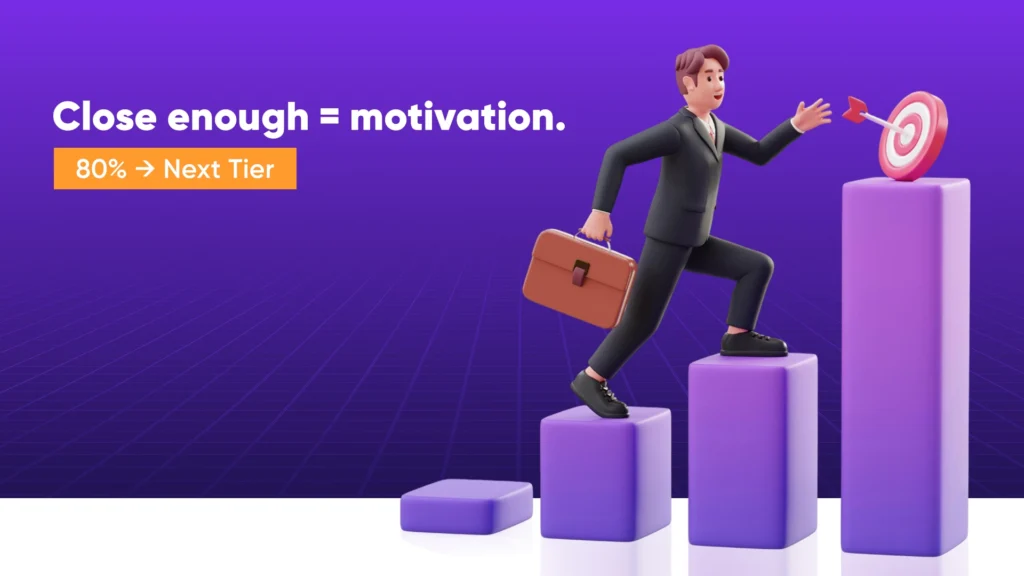
The behavioural pull here is proximity. A distributor who can see they are at 82% of the next slab is actively motivated to close that gap. Real-time tracking showing a partner how close they are to the next reward level materially changes participation. The finish line has to be visible for the last sprint to happen.
One area worth being cautious about with growth accelerators: if a distributor had an anomalously strong prior year (due to a competitor’s stockout, a one-time event, or a geographic windfall), the baseline becomes very difficult to beat. This can demotivate exactly the partners who are already performing well. Reviewing and adjusting baselines regularly, rather than locking them in annually, is a design choice that brands running growth accelerators should build into their operating rhythm.
| Model | Best For | Speed | Behaviour Type |
| Spiff | Retail push | Fast | Immediate |
| Rebate | Volume stocking | Medium | Planned |
| Points | Loyalty | Slow | Habit |
| Tiered | Growth | Medium | Progressive |
6. What Often Goes Wrong (And Why It’s Worth Examining)
Most channel incentive failures are not about budget. They are design, communication, and tracking problems and they are more common than the post-scheme review meetings tend to acknowledge.
Complexity quietly kills participation. A program that requires understanding multiple conditions, eligibility windows, and payout matrices will not get operationalised at the ground level. Distributors are managing 15 to 20 brands. Their field teams are not sitting with your scheme brochure. A study by Everstage found that programs with convoluted language, one example: “Partners must sell qualifying products X, Y, or Z between June 1st and August 31st to receive up to 7% performance bonus subject to prior volume attainment thresholds” see dramatically lower claim rates than programs with clear, one-sentence eligibility rules.
Incentivising the wrong node in the chain. A distributor-level rebate does not change the behaviour of the sales representative deciding which product to pitch today. A spiff to a retail outlet does not make the distributor order more. The person who receives the reward and the person whose behaviour needs to change must be the same person. This sounds obvious in a strategy meeting. It gets missed in execution more often than it should.
Delayed payouts break the behaviour loop. This is especially relevant in the Indian context, where quarterly rebate credits arriving months later are still common. The Brightspot Incentives research team notes that when participants must manually submit claim forms, take rates drop to between 20–40%. When claims are auto-validated through a digital system, engagement is meaningfully higher. Platforms that enable real-time reward visibility and fast disbursements are not a luxury feature, they are what separates a program that works from a program that looks good on paper.
No visibility into progress. Without real-time tracking dashboards, partners have no way of knowing how close they are to the next tier or reward. Shadow accounting, distributors and reps building their own spreadsheets to track progress is a documented behaviour when visibility is poor. It is wasted effort on both sides. Structured incentive ecosystems that show live progress significantly improve engagement and claim rates.
This is why brands are increasingly moving toward structured systems that combine first-party data capture, real-time validation, and reward delivery to actually understand what’s working.

7. The Incentive Selection Framework: Quick-Decision Cheat Sheet
| Objective | Best Fit Model | Common Risk |
| Push a specific SKU at retail for 4–8 weeks | Spiff (individual-level) | No POS-level tracking to verify |
| Drive volume stocking at distributor | Rebate (slab-based) | Stocking without sell-through |
| Build long-term retailer loyalty | Points program | Weak redemption experience |
| Reward incremental growth vs prior year | Growth accelerator | Anomalous baseline distorts target |
| Sustained quarterly motivation | Tiered rebate | Slab jumps too wide to feel achievable |
| New territory or market launch | MDF + Spiff combo | Partner not yet onboarded to brand |
| Improve billing consistency cycle to cycle | Monthly flat rebate | Training partners to bunch orders at deadline |
The fast decision logic:
- Goal is sell-through at retail → Spiff
- Goal is sell-in (distributor stocking) → Rebate
- Goal is partner retention and loyalty → Points
- Goal is growth beyond last year’s baseline → Tiered / Accelerator
No single model sustains a channel strategy on its own. The most effective programs layer a core rebate structure for volume with a spiff overlay for priority SKUs, and a points program running in the background for retention. The design thinking is always the same: what behaviour needs to change, in whom, and over what timeframe?
In Closing
Channel incentives work when there is clarity on one question: who needs to do what differently, and what is it worth to the brand if they do?
That question, honestly answered, usually points clearly to the right mechanic. The spiff if it is the frontline rep’s behaviour that matters. The rebate if it is the distributor’s ordering volume. The points program if it is long-term loyalty with retail partners. The tiered structure if it is pushing high-performers to their next ceiling.
What is worth keeping in mind is that the failure of an incentive program is rarely because the idea was wrong. It is usually because the model was mismatched, the communication was unclear, the payout was delayed, or the tracking was absent. These are execution gaps and they are fixable.
The brands that tend to get this right are not always the ones with the largest trade marketing budgets. They are the ones who treat incentive design as a strategic decision. And they tend to build systems that track what actually changed because of the scheme.
If you’re thinking about how to structure your next channel program, whether it’s a short-term push or a long-term engagement system, it’s worth stepping back and looking at how your incentives are designed, tracked, and delivered.
If you want to explore how structured incentive systems can work across distributors, retailers, and sales teams, take a look at how Buyerr approaches trade and channel engagement.
To explore more frameworks, write to us at [email protected] or follow our updates on LinkedIn.