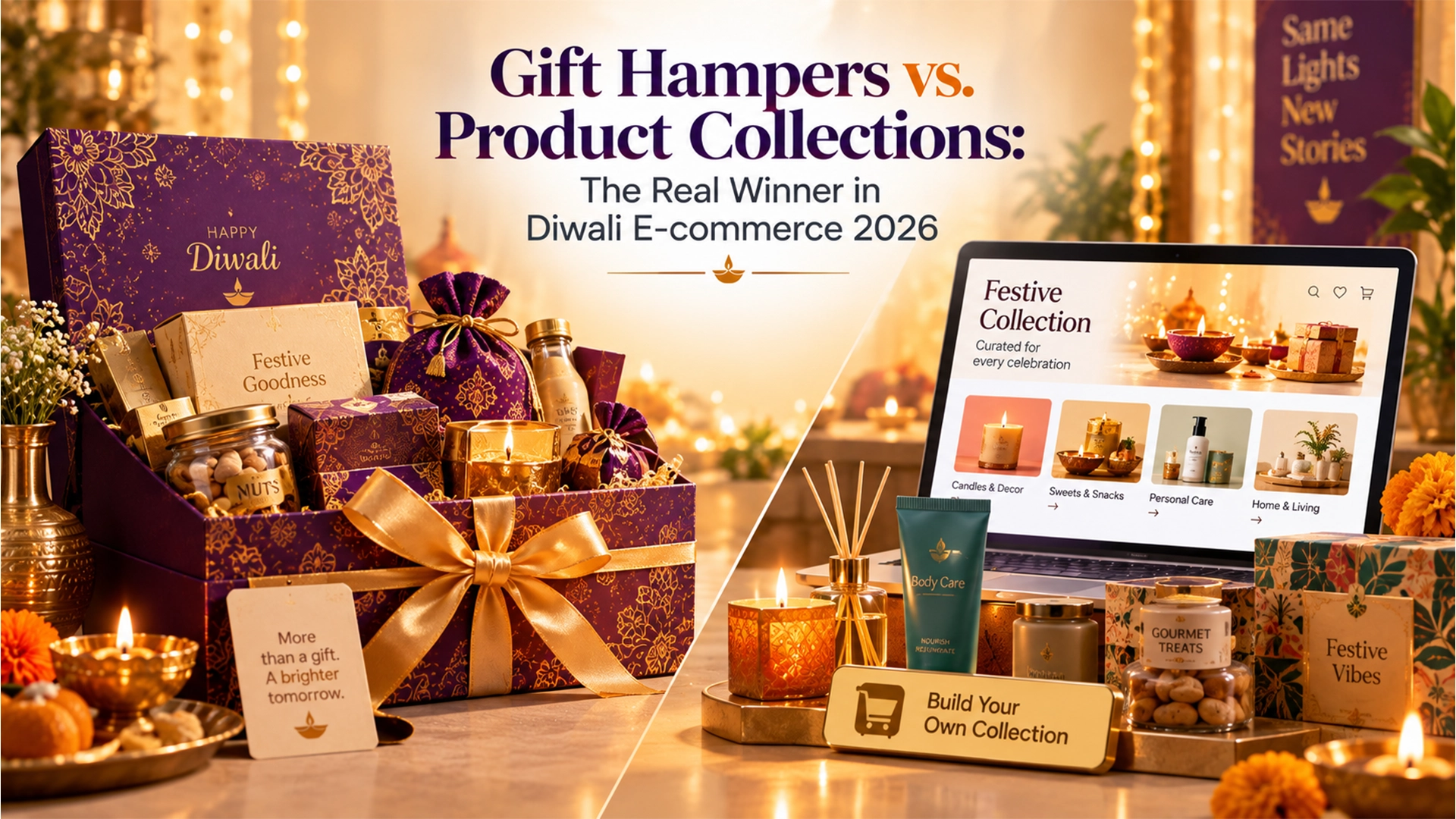
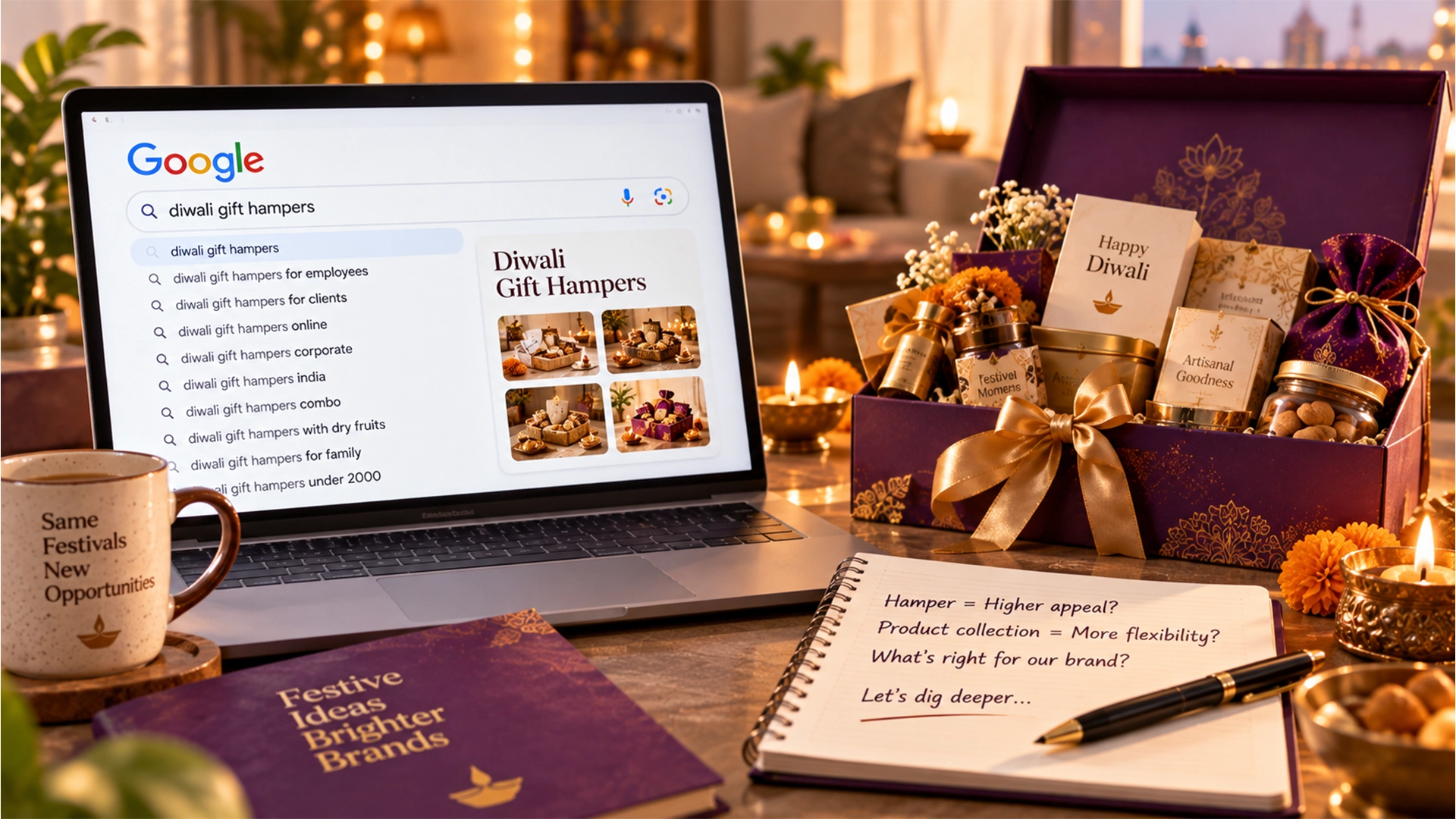
Diwali gift hampers India is the highest-searched gifting query on Google every October. More searched than diyas. More searched than festive decor. More searched than electronics deals. That tells you something about what Indian consumers are looking for when they open their browsers six weeks before Diwali. They are not searching for a specific product. They are searching for a solved gifting problem.
A hamper is, at its core, a shortcut. The person doing the gifting does not want to think too hard. They want something that looks considered, feels appropriate, and arrives on time. A curated box of things ticks all three. This is why the hamper has dominated Indian festive gifting for decades and why it still dominates search volume despite everything that has changed about how India shops.
But here is the more interesting question for a brand manager or a D2C founder sitting down to plan their Diwali strategy in 2026: is a gift hamper actually the right product strategy for your brand, or are you defaulting to it because that is what everyone does in October?
Before we get into this, here are a few relevant resources from Buyerr:
- Thematic and Seasonal Campaign Solutions — Festive campaign design end-to-end
- Retail and On-Pack Promotions — Festive mechanics at scale
- Experiential Rewards — Gifting that builds brand memory
- Cashback and Digital Coupons — Instant reward disbursement
- 1st Party Data and Consumer Insights
You can also explore: Festival Promotion Ideas and Timing Guide, How to Plan a High-Impact Consumer Promotion Campaign in India, and Gamification in Loyalty and Promotions: What Works?
What this blog covers: The real case for hampers. The real case against them. What product collections do better and where they fall short. The data that complicates both arguments. And the actual answer, which is not what either camp usually says.
The Case for Diwali Gift Hampers India Is Stronger Than You Think
Start with the numbers. India’s Diwali retail market reached nearly USD 69 billion in 2025. Two-thirds of India’s entire annual corporate and personal gifting happens during Diwali. This is not a niche occasion. It is the country’s biggest commercial gifting event, and Diwali gift hampers India brands sell are the dominant product format driving that volume.
Over 67% of metro consumers actively prefer curated hampers over generic sweets when choosing Diwali gifts. Even in Tier 2 markets, where conservative gifting traditions run deeper, 45% of consumers now prefer customised gifting options over standardised products.

Why? Because the hamper solves a real consumer problem that the product collection does not. When someone is gifting a client, a family friend, a colleague, or a neighbour, they are not thinking about brand strategy. They are thinking: “Will this feel like I put thought into it?” A hamper, by design, signals curation. Multiple items, a considered selection, attractive packaging, a price point that feels appropriate: together these signal that the gifter made a decision rather than grabbed the nearest available product.
Corporate buyers have understood this for years. Premium hampers containing curated selections of sweets, dry fruits, chocolates, and festive groceries are now ordered by companies as single-transaction bulk solutions. The hamper is not just a gifting product. It is a logistical and commercial solution that reduces decision complexity and increases perceived value simultaneously.
The unboxing advantage is real and underestimated. A well-packaged hamper is a physical experience that a product collection sitting in a standard e-commerce box is not. The recipient opens a ribbon-tied box and encounters a deliberate arrangement of items: this moment has emotional weight that a single-SKU product delivery does not produce.
Also Read: Festival Promotion Ideas and Timing Guide
But Diwali Gift Hampers India Has a Serious Problem

Here is what the search volume data does not tell you. Every competitor is doing it.
By the second week of October, every client, every distributor, every vendor a company works with has sent a hamper. They arrive together, they sit together, they get opened together, and in many cases they stop being opened at all because the curiosity has run out by the fourth box. The gifting recipient has more hampers than they need and a diminishing ability to remember which one came from which brand.
This is the hamper’s structural weakness. It is so prevalent during Diwali that it has lost the power to differentiate. A hamper that costs ₹2,000 and arrives in a well-designed box creates a positive interaction. A hamper that costs ₹2,000 and arrives in the same brown corrugated box as the fifteen other hampers from other companies creates almost no brand memory at all.
The most significant shift in Indian corporate and personal gifting in 2025 and 2026 is precisely this: businesses are actively abandoning the one-size-fits-all gift hamper in favour of more specific, more personalised, more experience-led gifting formats. The hamper as a category is not dying. But the generic hamper — the dry fruits and sweets in a printed box with a brand logo — is rapidly losing its ability to create any meaningful brand association.
And there is a data problem too. A hamper purchased as a gift tells the brand almost nothing about the end recipient. The buyer’s information is captured. The recipient’s is not. For a brand trying to build first-party consumer data through its festive season activity, the hamper is a commercial success that produces no consumer intelligence.
The Case for the Product Collection
The product collection — a curated range of brand SKUs presented together as a Diwali gifting option rather than a multi-brand assortment — addresses several of the hamper’s weaknesses while creating new ones of its own.
It anchors the brand. When a consumer buys a Nykaa festive beauty collection, a Forest Essentials festive ritual kit, or a Bombay Shaving Company grooming set for Diwali, the entire gift experience is brand-coherent. The recipient does not receive a vague assortment of unrelated items. They receive a point of view. Brand recall for the recipient is therefore categorically higher than with a multi-brand hamper, because there is only one brand to remember.
It performs better for premium and D2C brands whose products are the hero rather than a component of a larger assortment. If your product is well-designed, well-packaged, and carries an emotional or functional premium, putting it inside a hamper with eight other products dilutes it.
In e-commerce specifically, product collections have a conversion advantage. The consumer searching for a specific branded gift is further down the purchase funnel than the consumer searching “Diwali gift hampers.” They know the brand. The conversion rate from branded search to purchase is meaningfully higher than from generic gifting queries where the consumer is still exploring options.
Quick commerce is also more naturally suited to product collections than to hampers. Quick commerce grew 120% during the Diwali period in 2025, with Blinkit, Instamart, and Zepto recording record-breaking order volumes. Impulse purchases rose to 57% of festive shopping in 2025. The product collection that is available immediately, at a clear price point, for a specific recipient profile, captures this impulse buyer in a way that a carefully curated hamper ordered three weeks in advance cannot.
Also Read: How to Plan a High-Impact Consumer Promotion Campaign in India
Where the Product Collection Falls Short
For all its advantages, the product collection has one problem that the hamper does not: it only works if the brand is already known.
A consumer who has never heard of your brand will not search for your product collection. They will search “Diwali gift hampers,” land on a curated multi-brand option, and gift something that is not yours. The product collection is a retention and upsell gifting format. The hamper is an acquisition gifting format. They serve different commercial objectives, and conflating the two is a planning error.
The product collection also requires a portfolio depth that not every brand has. A single-SKU brand cannot build a product collection. For the product collection to feel like a coherent gifting proposition, the brand needs enough SKUs across a related range that the selection itself feels curated.
There is also a perceived value problem. A product collection at ₹1,500 contains ₹1,500 of branded product. A hamper at ₹1,500 contains an assortment of items that, presented together, can feel like significantly more. The hamper’s perceived value frequently exceeds its actual value in a way that a product collection rarely does. For gifting, where the social signal of the gift matters as much as its utility, this perceived value gap is commercially significant.
What the Data Actually Says About Who Is Winning in Diwali Gift Hampers India 2026
Neither format is outright winning. The data points to something more interesting: the winning format is the hybrid, and most brands have not designed for it deliberately.
The hybrid looks like this. It starts with a brand’s hero product or product range, the way a product collection does. But it is packaged, presented, and positioned the way a hamper is: deliberately, with narrative, with a Diwali-specific occasion story, with packaging that creates an unboxing moment. And it is paired with a digital experiential reward that extends the brand into the recipient’s Diwali experience beyond the physical product.
Nykaa does this well. Their festive collections are, technically, product collections: all Nykaa products, brand-coherent, range-specific. But they are packaged, priced, and positioned as gifts: the box is beautiful, the occasion story is clear, the product selection is curated for a recipient archetype. A consumer buying the Nykaa festive beauty kit is buying something that feels like a hamper but remembers like a product collection.
Vahdam Teas has built an entire business model around this format. Their Diwali gifting collections are hero-product-led (tea), presented with the thoughtfulness of a curated hamper, priced at a clear gifting tier, and available across e-commerce, quick commerce, and D2C channels. This is the format that wins in Diwali e-commerce 2026.

Hybrid gifting — combining physical gifts with digital experiences or vouchers — is gaining significant traction in corporate and personal gifting contexts in India. The physical product creates the immediate gift experience. The digital reward, a dining voucher, an OTT subscription, a wellness credit, a UPI cashback, extends the brand into the recipient’s festive life after the unboxing. And every digital redemption captures first-party data that neither the pure hamper nor the pure product collection produces.
Also Read: Emerging Trends in Consumer Promotions and Loyalty in 2026
How to Choose: A Direct Guide by Brand Type
You are an FMCG brand with a strong single hero product. Build a hybrid. Take your hero SKU, create a Diwali-specific bundle with a complementary product or a limited edition packaging, add a QR-based digital reward that the recipient can claim, and position the whole thing as a Diwali gift set rather than a product promotion. You are not competing on the “Diwali gift hampers” search. You are creating a brand-specific gifting proposition that your existing consumers and their networks can buy for the people in their lives.
You are a D2C brand with a premium product range. Product collection, built like a hamper. Your brand is known in your category. Design a Diwali collection across your range, invest in the packaging and the occasion story, price it at a clear gifting tier, and ensure it is available on quick commerce for the last-minute gifting surge. ₹1,15,000 crore of festive e-commerce GMV in 2025 means the consumer is buying digitally and buying impulsively. Be where they are when they decide.
You are a brand entering the gifting market for the first time. Hamper, but done with enough specificity to differentiate. The generic multi-product assortment in a brown box is dead. But a well-themed, occasion-specific, attractively packaged Diwali gift hamper India brands design with a clear recipient narrative — “for the wellness-conscious colleague,” “for the home decorator,” “for the family who has everything” — still converts because it solves the gifting decision problem that most consumers face in October.
You are a corporate gifting brand planning bulk orders. The one-size-fits-all hamper is declining. The smarter play in 2026 is mass personalisation: a standard hamper structure with personalised elements, recipient names on cards, customised product selections within a defined budget, digital reward components that the recipient chooses themselves. Companies are actively abandoning standardised solutions in favour of gifting that feels personal even at scale.
The Question Nobody Is Asking About Diwali Gift Hampers India
Most Diwali gifting strategy conversations focus on what to put in the box. The more commercially significant question is what happens after the recipient opens it.
A hamper is opened, enjoyed, and forgotten. The brand association fades because there are too many other hampers competing for the same mental space. A product collection builds brand recall because there is only one brand in the box. But both formats, unless they include a mechanism for the brand to continue the relationship after Diwali, produce a one-time gifting interaction with no follow-through.
The brands that win in Diwali e-commerce 2026 are the ones that use the gifting occasion to start a consumer relationship, not just complete a transaction. A QR code on the festive packaging that unlocks a Diwali-specific experience for the recipient. A digital reward that the recipient claims through a frictionless flow and in doing so gives the brand their contact information and preferences. A follow-up communication in November that references the Diwali gifting interaction and introduces the brand to someone who received a product as a gift but has never bought one themselves.
Diwali generates 60 to 65% of India’s annual gifting sales. The brand that treats this as a transaction misses the most valuable commercial output of the season: a warm audience of gift recipients who encountered the brand for the first time and can be converted into buyers if the brand has the infrastructure to reach them.
Neither the hamper nor the product collection, in isolation, does this. The hybrid — anchored by a great product, packaged for a gifting occasion, extended by a digital reward, and backed by a data capture and re-engagement infrastructure — does.
In Closing
The real winner in Diwali gift hampers India 2026 is not the hamper. And it is not the product collection. It is the brand that stops choosing between them and starts designing for the thing both formats are trying to achieve: a gift that the recipient remembers, attributes to a specific brand, and returns to independently when the festival is over.
“Diwali gift hampers” will remain the top festive gifting search query in October 2026. The consumer’s need for a solved gifting problem has not changed. What has changed is their tolerance for generic solutions, their preference for experience alongside product, and their willingness to pay a premium for something that feels deliberate.
The brand that meets all three of those things — with a product that is the hero, a presentation that creates the occasion, and a digital reward that extends the relationship — does not need to choose between a hamper and a collection. It has built something better than either.
Related reads worth your time before Diwali planning begins:
- Festival Promotion Ideas and Timing Guide
- How to Plan a High-Impact Consumer Promotion Campaign in India
- Emerging Trends in Consumer Promotions and Loyalty in 2026
- Gamification in Loyalty and Promotions: What Works?
Planning your Diwali gifting strategy and want to build the digital reward and data capture layer that makes it work beyond the unboxing moment? Get in touch with Buyerr to discuss your Diwali campaign architecture. Follow our updates on LinkedIn.