Alcohol marketing India Diwali season is one of the most commercially significant, and most legally constrained, challenges in the entire alcobev calendar. Every October, somewhere in a marketing team inside an alcobev company, a version of the same conversation happens. The festive season is here. The country is spending. India’s liquor stores stocked 30% more inventory for Diwali 2025 than the previous year. North India’s whisky gifting is surging. Premium single malts are flying off shelves. Corporate gifting is up. The consumer is in a buying mood, the product is perfectly positioned for the season, and the brand manager has almost no legal way to talk about it in public.
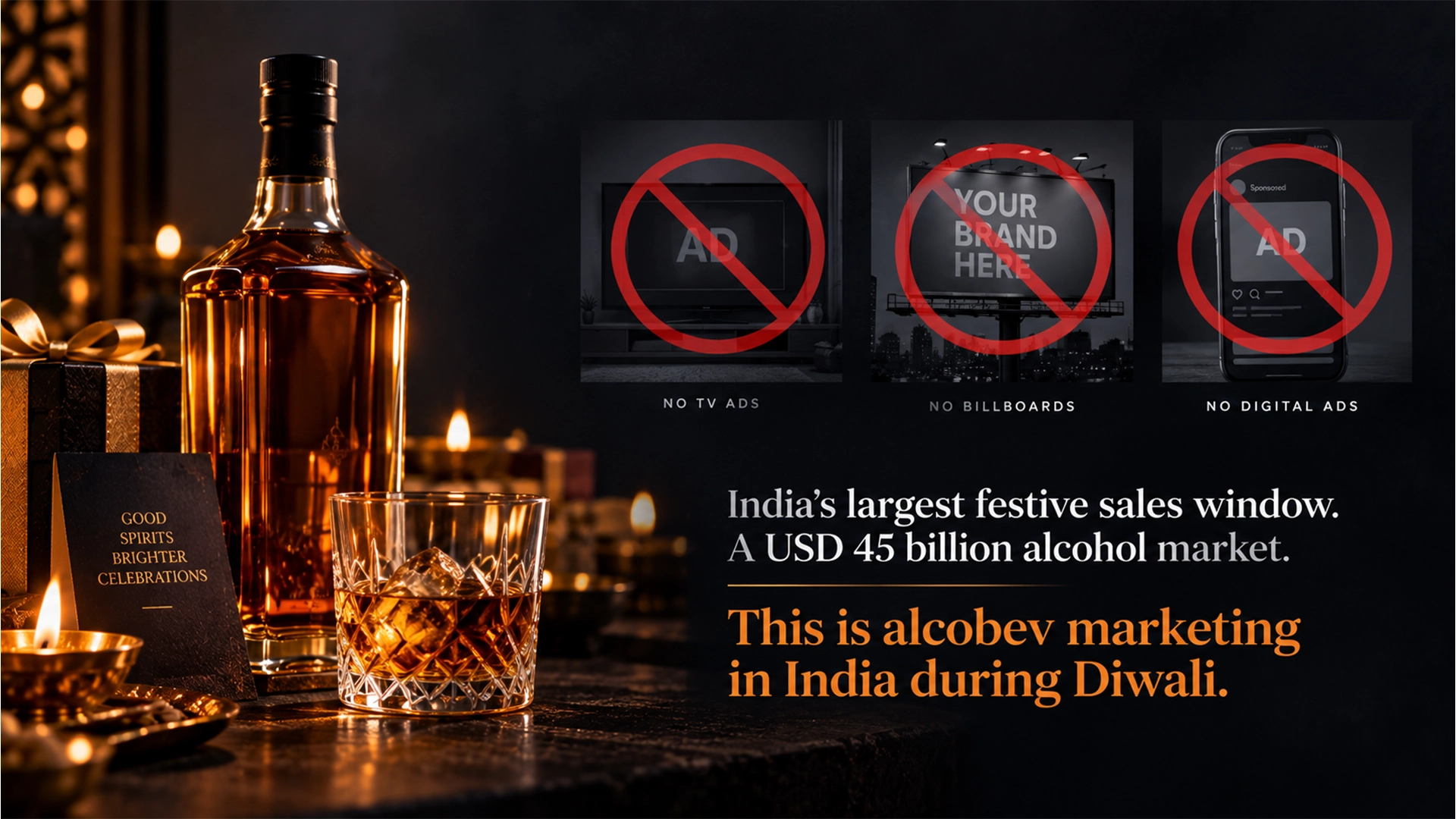
That is the peculiar situation of alcobev marketing in India. One of the world’s largest and fastest-growing alcohol markets, with annual revenues approaching USD 45 billion, governed by one of its most restrictive advertising regimes. The product sells itself during Diwali. The question is how the brand shows up for the season without walking into a regulatory problem.
This blog is the honest answer to that question. What you legally cannot do. What is now under scrutiny that used to be a safe play. And what actually works for alcobev brands during Diwali when the conventional advertising toolkit is largely off the table.
Before we get into this, here are a few relevant resources from Buyerr:
- Consumer Promotions — On-trade and off-trade activation solutions
- Thematic and Seasonal Campaign Solutions
- Experiential Rewards — Gifting that builds brand memory
- Channel Partner Program — Retailer and trade loyalty
- Trade Promotions — Incentive design for alcobev channel
You can also explore: Trade Promotion Strategies That Move Inventory, Motivating Channel Partners: Incentives and Training, and Loyalty Program Best Practices for Retail Brands.
What we’ll cover in this blog: The regulatory landscape as it actually stands in 2026. What is definitively banned. What is now under scrutiny that used to be safe. And what alcobev brand managers can do during Diwali that drives real commercial outcomes without legal exposure.
The Regulatory Landscape for Alcohol Marketing India Diwali, Plainly Stated
India has maintained a blanket ban on direct alcohol advertising since the Cable Television Networks Rules of 1994. No television commercials for alcohol. No radio spots. No print advertisements. No outdoor hoardings. No digital display ads that directly promote the product. The restriction is not ambiguous. It covers every conventional advertising medium and has been consistently enforced.
For decades, the industry’s response to this was surrogate advertising: promoting a brand extension product, soda water, music CDs, glassware, mineral water, using the same brand name, logo, and visual identity as the alcohol product, without technically showing the alcohol product itself. The regulatory intent was obvious to everyone. The legal loophole was useful to the industry. It produced some of India’s most recognised brand campaigns across Bacardi, Kingfisher, Royal Stag, Tuborg, and dozens of others.
That loophole is closing.
The Central Consumer Protection Authority (CCPA), empowered by the Consumer Protection Act 2019, now has direct authority to penalise misleading advertisements including surrogate advertising. First-time violations carry penalties of up to ₹10 lakh. Subsequent contraventions can attract penalties of up to ₹50 lakh. These apply to manufacturers, advertisers, and celebrity endorsers.

The draft rules circulating through 2024 and 2025 go further. They specifically prohibit the promotion of surrogate items, including zero-alcohol beer, mineral water, and glassware, that use “similar label, design, pattern, or logo” as the associated alcohol brand. The net effect is that the visual identity of a Carlsberg, a Diageo, or a Pernod Ricard cannot legally appear on a soda water bottle and be advertised.
Event sponsorships, another long-standing alcobev marketing lever, are also being restricted under the proposed rules. The Ministry of Information and Broadcasting has separately issued advisories covering OTT platforms and digital media, extending the advertising restrictions into the digital environment where alcohol brands had been operating more freely.
To summarise: the days of the surrogate ad as a reliable marketing vehicle are effectively over for most alcobev brands in India. The brand that is planning its Diwali 2026 campaign around a mineral water or music CD surrogate needs a compliance review before anything goes to production.
Also Read: Trade Promotion Strategies That Move Inventory
What This Means for Alcohol Marketing India Diwali Specifically
Diwali is the single highest-volume sales period for alcobev in India. The commercial opportunity is enormous and entirely real. India’s whiskey market alone is projected to grow from USD 19.16 billion in 2024 to USD 48.65 billion by 2030 at a CAGR of 16.8%, and Diwali is one of the clearest annual demand spikes in that growth trajectory. Premium products above ₹2,000 per bottle are showing the strongest growth, as aspiration consumption rises among India’s urban middle and upper classes.
The brand that gets its alcohol marketing India Diwali strategy right is capturing a consumer who is actively seeking premium gifting options, spending deliberately, and making brand choices that will influence their purchasing and gifting habits through the following year. The regulatory constraints do not diminish this opportunity. They simply require a different approach to capturing it.
What You Cannot Do

Television, radio, and print advertising are banned. Directly and completely. Digital display advertising and OTT promotions are now covered by MIB advisories. Surrogate advertising with brand visual identity is banned under the CCPA framework. The visual resemblance test is the enforcement mechanism. Celebrity endorsements now extend penalty liability to endorsers themselves. Outdoor hoarding campaigns are banned. Broad event sponsorships using the alcohol brand name that function as de facto brand advertising are specifically targeted under the proposed rules.
Also Read: Motivating Channel Partners: Incentives and Training
6 Legal Strategies That Work for Alcohol Marketing India Diwali
The constraint is significant. It is not total. And the brands that are doing well in Diwali, despite the restrictions, are doing so through a consistent playbook that is entirely within the regulatory framework.
1. Premium Packaging and Gift Sets at the Point of Sale
This is the most direct and most effective alcobev Diwali strategy, and it is fully compliant. A bottle of premium whisky paired with two branded crystal glasses in a beautifully designed Diwali gift box is not an advertisement. It is a product. It sits on the shelf of a licensed liquor retail outlet. The consumer picks it up. The packaging does the communication that advertising cannot.

The legal communication channel for alcohol marketing India Diwali is the pack itself: the design, the premium materials, the gift-ready presentation, and the occasion story told on the bottle. A beautifully presented festive gift set at ₹3,500 to ₹5,000 with premium glassware is communicating luxury, occasion-appropriateness, and gift-readiness to the consumer at exactly the moment they are making their decision.
2. Retailer and Trade Marketing
The consumer cannot be reached through mass media. The retailer absolutely can be reached through trade programs, and the retailer is the most powerful influence on what the consumer buys at a licensed outlet. Structured retailer incentive programs that reward liquor store staff and owners for displaying, recommending, and promoting the brand’s premium SKUs during the festive window are entirely legal and highly effective.
In-store display and visibility programs are point-of-sale marketing that is fully permitted. What is banned is advertising outside the licensed retail environment. Inside it, significant visibility and promotion is possible. The brands that win in Diwali off-trade are the ones whose trade marketing teams have built the strongest retailer relationships before the season begins. A retailer who has been engaged through a structured channel partner program throughout the year will actively push your brand during Diwali.
3. On-Trade Experiential: Cocktails, Activations, and Curated Events
What cannot happen in mass media can happen inside a licensed bar, restaurant, or hotel. Cocktail masterclasses, curated Diwali tasting sessions, whisky and food pairing dinners, premium bar activations at high-footfall urban venues are entirely legal marketing formats for alcobev brands. Younger urban consumers are drawn into brand loyalty through discovery experiences rather than advertising.
Experiential rewards built around the festive season, cocktail kits delivered to high-value consumers, exclusive tasting invitations for loyalty program members, pairing guides sent to opted-in digital communities, all operate within the regulatory framework and create brand associations that a surrogate water bottle ad never could.
4. Consumer Loyalty Programs Through Licensed Channels
A consumer who has purchased from a brand before can be engaged through a loyalty mechanic that operates within the regulatory framework. WhatsApp-based loyalty programs for opted-in consumers, email communications to existing customer databases, and digital communities built around cocktail culture or whisky appreciation are not advertising in the regulated sense. They are direct brand communications with consumers who have explicitly consented to receive them.
Building this opted-in audience before Diwali, and engaging them with festive cocktail content, limited-edition product announcements, gifting guides, and exclusive access offers, is a Diwali marketing strategy that is both compliant and commercially effective.
5. Corporate Gifting Through Direct and Trade Channels
Corporate gifting is one of the fastest-growing segments of the Diwali alcohol market. An alcobev brand with a premium SKU can market directly to corporate procurement teams, corporate gifting agencies, and hospitality buyers through B2B channels that are entirely outside the consumer advertising restriction framework. The CCPA restrictions govern consumer-facing advertising. A direct sales conversation with a corporate gifting manager is a sales activity, not an advertisement, and it can reference the product directly.
6. Genuine Brand Extensions With Standalone Commercial Merit
The brand extension route is not fully closed. It is simply much more restricted than it used to be. A genuine brand extension, a product that has its own commercial identity, its own standalone consumer proposition, and does not visually impersonate the alcohol brand, remains permissible. The key test under the emerging regulatory framework is whether the brand extension would survive commercially on its own, without the association to the parent alcohol brand.
Also Read: Loyalty Program Best Practices for Retail Brands
The Real Alcohol Marketing India Diwali Playbook for 2026

Taken together, the strategy that works for alcohol marketing India Diwali looks nothing like a conventional festival marketing campaign. Premium packaging does the work of the television commercial at the point of purchase. Trade marketing does the work of the outdoor hoarding inside the licensed retail environment. On-trade experiential events do the work of the brand awareness campaign. Corporate gifting channels access a high-value, high-spend consumer segment without touching the consumer advertising framework. Loyalty programs and opted-in digital communities build the direct brand relationship that surrogate advertising was trying to approximate.
India’s whiskey market alone is projected to reach USD 48.65 billion by 2030. The Diwali opportunity inside that number is real, growing, and available. The constraint is on the advertising mechanism, not on the commercial outcome. The brands that understand this distinction are the ones arriving at October with a trade-ready retailer network, a premium gift set on the shelf, an experiential event calendar in their key markets, a corporate gifting pipeline, and a consumer loyalty community that has been warmed up for six months.
That is the alcohol marketing India Diwali campaign that works in 2026.
Related reads worth your time:
- Trade Promotion Strategies That Move Inventory
- Motivating Channel Partners: Incentives and Training
- Loyalty Program Best Practices for Retail Brands
- How Promotion ROI Analytics Helps Boost Your Campaign Performance
- Festival Promotion Ideas and Timing Guide
- Navratri Gifting Campaign India: 7 Ideas Beyond the Discount
Planning your alcobev Diwali activation within the regulatory framework? Get in touch with Buyerr to explore trade promotion and consumer engagement solutions that work for your brand, channel, and market. Follow our updates on LinkedIn.