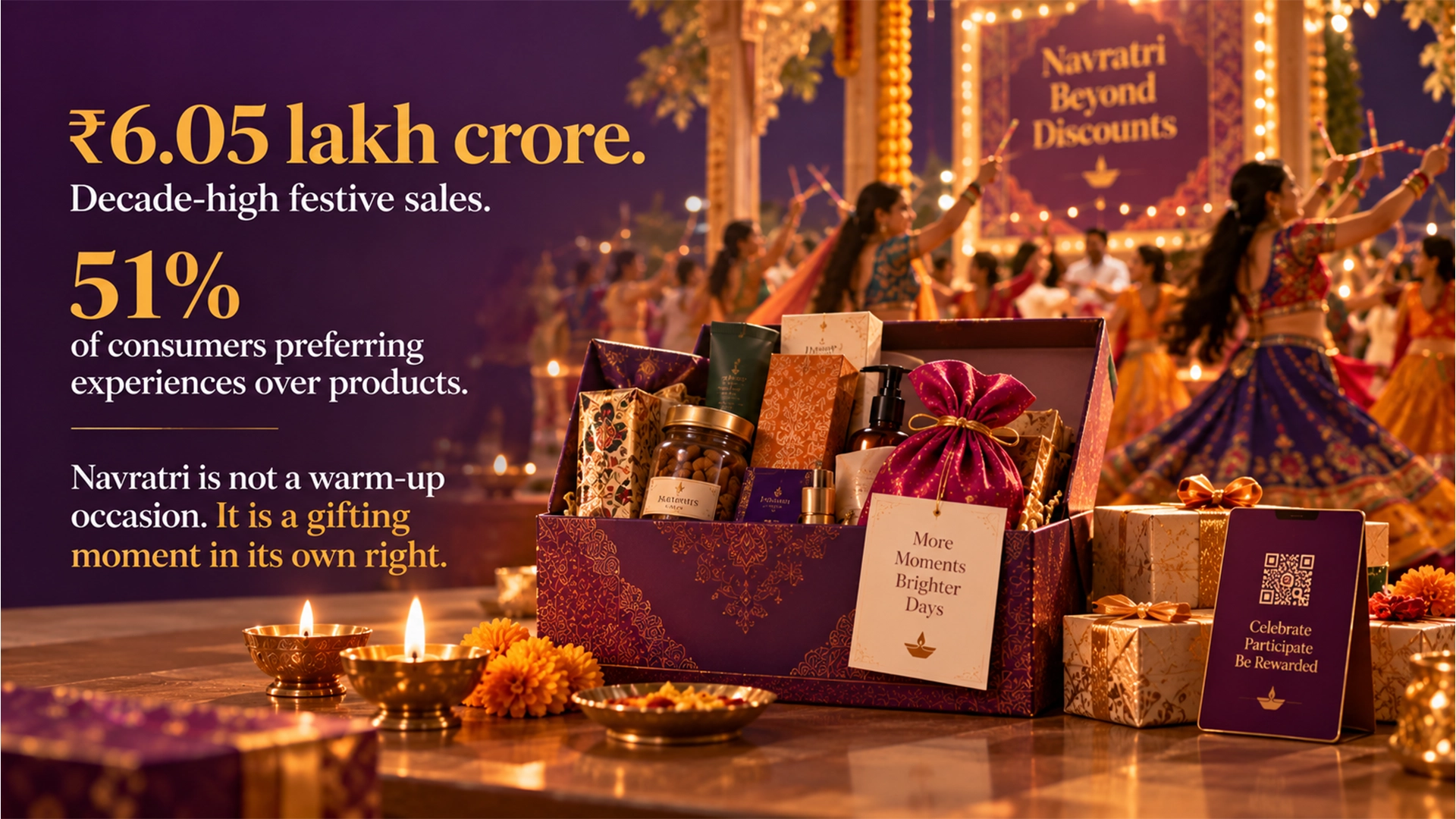
A Navratri gifting campaign India brands run this season should not look like every other campaign from September. Navratri 2025 delivered something India had not seen in over a decade: decade-high festive sales, record consumer spending, Maruti Suzuki posting 100% sales growth during the Navratri window, and a total Navratri-to-Diwali trade figure of ₹6.05 lakh crore, the highest festive turnover ever recorded in India.
The consumer showed up. Enthusiastically. With money. And most brands responded with a discount. There is nothing wrong with a festive discount. 73% of festive shoppers in 2025 said promotional offers influenced their purchase decisions. Price remains a lever. But it is a blunt one, and in a season where every competitor is pulling it simultaneously, the brand that only discounts competes on a dimension where differentiation is nearly impossible.
The more interesting data point from the same festive cycle: 51% of Indian consumers preferred experience-based gifts over physical products. The consumer’s definition of a good gift has changed. The Navratri gifting campaign India brands need is a different kind of campaign from the one that simply marks a product down by 20%.
Before we get into this, here are a few relevant resources from Buyerr:
- Thematic and Seasonal Campaign Solutions — Festive campaign design end-to-end
- Experiential Rewards — Gifting that builds brand memory
- Retail and On-Pack Promotions — Festive mechanics at scale
- Consumer Promotions — End-to-end festive campaign solutions
- Cashback and Digital Coupons — Instant reward disbursement
- 1st Party Data and Consumer Insights
You can also explore: Festival Promotion Ideas and Timing Guide, How to Plan a High-Impact Consumer Promotion Campaign in India, and Emerging Trends in Consumer Promotions and Loyalty in 2026.
What we’ll cover in this blog: Why Navratri is the most underutilised gifting occasion in the FMCG and FMCD calendar. What the consumer actually wants when they say “gifting.” The campaign mechanics that work for FMCG brands during Navratri. How FMCD brands can convert a high-consideration purchase into a gifting moment. The reward types that resonate with the Navratri occasion specifically. How to use Navratri as the first chapter of a campaign that compounds through Diwali. And your pre-Navratri campaign checklist.
1. Why Navratri Is the Most Underutilised Gifting Occasion for a Navratri Gifting Campaign India
Most brand planning calendars treat Navratri as a promotional warm-up. A content moment before the real push. The sentiment-led post goes live on October 2. The discount offer runs for nine days. And then the team pivots to Diwali planning, which is where the real campaign budget sits.
This framing misses something commercially significant.
Navratri spans over 2,000 organised events across Indian cities, from the massive Garba celebrations in Ahmedabad, Vadodara, and Surat to community events in Mumbai, Delhi, Pune, and increasingly, Tier 2 markets across Gujarat, Rajasthan, and Maharashtra. The consumer is not at home during Navratri. They are out. They are celebrating. They are meeting people, giving gifts, buying outfits, eating out, and attending events. The consumer’s willingness to spend, share, and engage is at a seasonal high that Diwali, which is more home-bound and more planned, does not fully replicate.
Godrej Appliances understands this. Their festive strategy explicitly segments the 87-day festive window: Navratri gets localised activation in West India, followed by a larger e-commerce thrust and then the Diwali burst. Not a single campaign. Not a discount that runs from Navratri to Diwali. A distinct activation for a distinct occasion, each designed for what the consumer is actually doing in that window.
The brands that treat Navratri as a genuine gifting occasion, and build a Navratri gifting campaign India mechanic around that specific consumer behaviour, come out of the nine days with something the discount-running brand does not: a consumer relationship that is already warm before Diwali even begins.
Also Read: Festival Promotion Ideas and Timing Guide
2. What the Consumer Actually Means by “Gifting” During Navratri
The gifting occasion during Navratri in India is specific and consistent. It is not the grand gifting of Diwali. It is the in-the-moment, relationship-led gifting of a shared celebration. A box of mithai brought to a Garba event. A small token exchanged between friends dressing up together. A product purchased as a treat for oneself during a festival that celebrates female energy and collective joy. A hostess gift for the home where the celebration is happening.

This is contextual, occasion-specific gifting. And it rewards brands that meet the consumer in the context of the celebration rather than brands that simply offer a better price on the same product they sell all year.
The “9 Nights, 9 Surprises” format that some brands have experimented with captures this logic well. Rather than a flat discount running across the nine days of Navratri, a daily reveal mechanic, where each day of Navratri unlocks a new offer, reward, or experience, mirrors the rhythm of the festival itself. The consumer wakes up each morning of the celebration with something to look forward to from the brand. The promotion becomes part of the festive routine rather than background noise.
The consumer who is gifting during Navratri is also making a statement about the brand they are associated with. A gift that comes with an experiential reward — a Garba event ticket, a dining voucher for a festive thali, a wellness credit for the post-celebration morning — says something more deliberate than a product with a 15% sticker discount. More than 70% of Indian shoppers now favour active engagement over passive offers when interacting with brands during festive periods.
3. For FMCG Brands: The Navratri Gifting Campaign India Mechanics That Work
FMCG brands face a specific challenge during Navratri gifting: the products themselves, packaged food, personal care, household goods, are rarely perceived as premium gift items without additional context or framing. The campaign mechanic’s job is to create that context.
The Festive Bundle as a Gift Object. A single FMCG product is rarely a gift. A curated bundle, designed around the Navratri occasion with appropriate packaging and a clear occasion story, becomes one. Amul, Parle, Britannia, Dabur, and dozens of FMCG brands have demonstrated this repeatedly: the product in a festive box with a brand-consistent occasion narrative is a gift. The same product on a regular shelf is not.

The bundle mechanic works even better when paired with a digital reward delivered via QR. A consumer who buys the festive bundle and scans an on-pack code to choose a Navratri-relevant reward receives two things: the physical product and a digital experience that extends the brand into their festive life beyond the purchase moment.
Fasting-Friendly Product Positioning. Navratri is also a fasting occasion for a significant proportion of Indian consumers, particularly in Gujarat, Rajasthan, Maharashtra, and parts of North India. The consumer who is fasting is actively seeking specific food products: sabudana, singhara flour, sendha namak, dry fruits, fruit juices, dairy products. FMCG brands in these categories have a natural Navratri relevance that most other festive occasions do not provide.
QR-Based “Navratri Wali Gift” Mechanic. One of the most effective FMCG gifting mechanics for a Navratri gifting campaign India is the consumer-choice reward: the consumer buys the product, scans the code, and picks their Navratri gift from a curated selection:
- A Garba event ticket or cultural experience voucher for the out-and-about celebrant
- A festive dining credit for a traditional thali or community meal
- A devotional content subscription through an OTT or music platform
- A wellness credit for a post-celebration recovery experience
- A direct UPI cashback for the consumer who prefers flexibility
The consumer who picks their own reward has had a personalised brand interaction. And every consumer who completes the claim has provided verified first-party data that feeds the brand’s Diwali retargeting with real, consented buyer information rather than modelled audiences.
Also Read: How to Plan a High-Impact Consumer Promotion Campaign in India
4. For FMCD Brands: Converting a High-Consideration Purchase Into a Gifting Moment
FMCD brands, Samsung, LG, Havells, Voltas, Godrej Appliances, Bajaj Electricals, face a different challenge. Their products are not impulse buys. A refrigerator, a washing machine, a television, a water purifier: these are planned, researched, and budget-allocated purchases. Turning this into a gifting campaign requires connecting the high-consideration purchase to a high-emotion occasion.
The “Gift the Home” Framing. The most successful FMCD Navratri campaigns have shifted from “here is a discount on an appliance” to “this festive season, gift your home what it deserves.” The product becomes the gift. The occasion validates the purchase. And the campaign mechanic adds the experiential layer that makes the purchase feel celebratory rather than functional.
The Post-Purchase Experiential Reward. For FMCD brands specifically, the experiential reward delivered after purchase is where the real gifting differentiation happens. A consumer who buys a Havells appliance during Navratri and receives a home installation experience, a personalised setup service, a smart home consultation, or a subscription to a content or cooking platform that enhances the appliance’s use has received something the competitor’s discount cannot match.
Garba Night as an Activation Platform. For consumer durables brands with a significant Gujarat and Maharashtra presence, Navratri’s 2,000-plus organised events are not just a cultural backdrop. They are an activation platform. A brand that sponsors a Garba event and delivers a branded experience at the venue is reaching a consumer who is in their highest celebratory mood, surrounded by community, and receptive to brand engagement in a way that no digital ad replicates.
5. The Rewards That Resonate in a Navratri Gifting Campaign India

Not every reward type works equally well during Navratri. The occasion has a specific emotional texture: joyful, energetic, community-oriented, spiritually connected, and celebratory. A reward that fits this texture feels like a natural extension of the festival. One that does not feels like a generic transaction dressed in orange and red.
Cultural and event experiences. A Garba event pass, a dandiya kit, a traditional craft workshop, a cultural performance ticket. These rewards make the consumer feel that the brand understands the occasion they are celebrating, not just the commercial window it represents.
Food and dining credits. Festive thali vouchers, mithai from premium brands, restaurant credits for celebratory meals. Food is central to Navratri, whether fasting-appropriate or post-fast celebratory, and a food reward connects the brand to a moment that the consumer genuinely values.
Wellness and recovery credits. Nine nights of Garba is physically demanding. A yoga class credit, a spa voucher, a nutritional supplement, or a morning-after wellness experience is a reward that shows the brand is thinking about the consumer’s full Navratri journey, not just the purchase moment.
Direct cashback for flexible gifters. Instant UPI cashback remains the most universally appreciated reward. The consumer who prefers to choose how they celebrate is served by a cashback that arrives immediately and can be spent according to their own festive priorities.
Rewards that do not resonate: A discount voucher on the same brand’s products is not a gift. It is a retention mechanic. A generic catalogue reward with no Navratri connection will also fail. The consumer who has just experienced nine days of dancing, community, and celebration will notice the absence of contextual relevance in a reward that could have been delivered on any day of the year.
Also Read: Gamification in Loyalty and Promotions: What Works?
6. Navratri as the Opening Chapter of the Festive Campaign
The most strategically valuable thing a Navratri gifting campaign India brands run produces is not the Navratri sales number. It is the consumer relationship that enters Diwali already warm.

India’s festive retail economy grew 20-25% in 2025, the fastest in five years, with Tier 2 cities accounting for 55% of total festive orders and rural India representing 28% of total festive trade. The consumer base driving this growth is geographically distributed and commercially active across the full 87-day festive window.
A brand that activates only at Diwali is entering a relationship in the final chapter. A brand that activates at Navratri is writing the first one.
The consumer who scans a Navratri on-pack QR code in the first week of October and claims a relevant experiential reward has given the brand their phone number, their purchase preference, their geography, and their consent for future communication. That consumer, re-engaged in the third week of October with a Diwali offer that references their Navratri interaction, is not receiving a promotional message. They are receiving a continuation of a relationship that the brand already started.
This is why the most effective festive season promotion strategy does not start at Diwali. It starts at Navratri.
Also Read: Emerging Trends in Consumer Promotions and Loyalty in 2026
7. Before Navratri Arrives: Your Navratri Gifting Campaign India Checklist

- Have you designed a distinct Navratri gifting mechanic, or are you running the same discount that will be active at Diwali? The consumer notices when a festive campaign has no festive specificity
- Is your reward occasion-relevant? A Garba event voucher during Navratri says something. A generic catalogue item does not
- Does your FMCG product have a fasting-season angle? If yes, the Navratri campaign brief writes itself. If no, the bundle and gifting framing is the path
- Is your FMCD campaign framing the purchase as a gift or as a transaction? The language and emotional framing determine whether the consumer associates the purchase with the occasion
- Are you capturing consumer data through the Navratri mechanic? Every redemption is a verified buyer. That database should be ready for Diwali re-engagement before Navratri ends
- Is your campaign built for Tier 2 markets? 55% of festive orders came from Tier 2 cities in 2025. A metro-only Navratri campaign is a minority play
- Is your Navratri campaign a standalone burst or the opening chapter of a 45-day festive architecture? The brands that compound from Navratri through Diwali are the ones who answer this question correctly in September
In Closing
₹6.05 lakh crore of consumer spending. Decade-high Navratri sales. 51% of consumers preferring experience over product. The data from 2025 does not describe a market that needs to be convinced to spend during the festive season. It describes a market that is ready to spend, actively gifting, and looking for brands that understand the occasion they are celebrating.
The discount is table stakes. Every competitor will offer one. The Navratri gifting campaign India brands build around the specific emotional texture of the festival, joyful, communal, celebratory, and culturally resonant, is what separates a brand that participated in the festive season from one that was remembered for it.
And the consumer who remembers your brand from Navratri is the consumer who reaches for it at Diwali.
Related reads worth your time before the festive season opens:
- Festival Promotion Ideas and Timing Guide
- How to Plan a High-Impact Consumer Promotion Campaign in India
- Emerging Trends in Consumer Promotions and Loyalty in 2026
- Gamification in Loyalty and Promotions: What Works?
- QR Code Retail Promotion: 7 Steps to Scale Across 1,000 Outlets
- Diwali Gift Hampers India 2026: Hamper vs Product Collection
Planning a Navratri gifting campaign India for your FMCG or FMCD brand? Get in touch with Buyerr to explore seasonal campaign solutions and build the right mechanic before the nine nights begin. Follow our updates on LinkedIn.