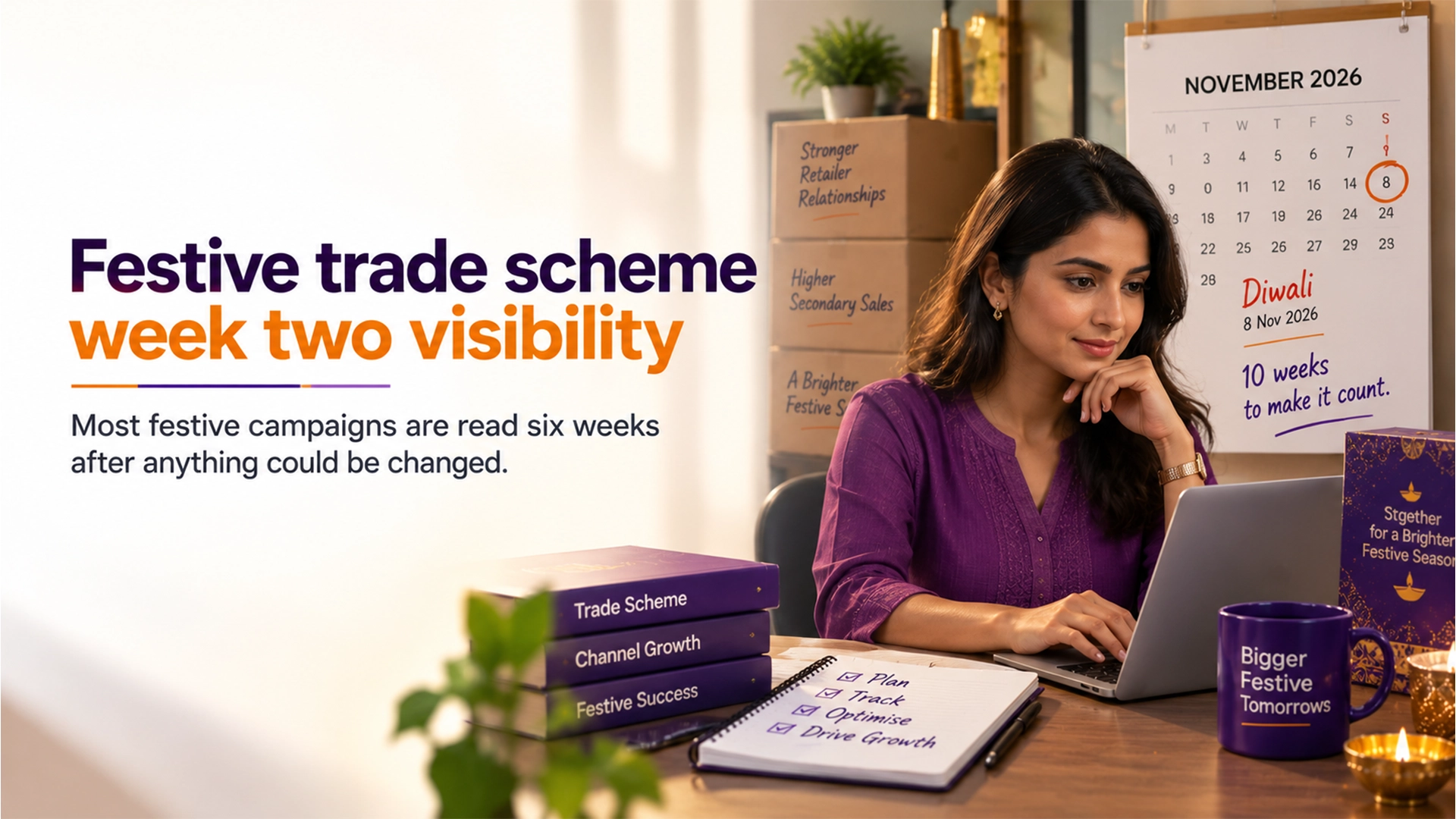
Your festive trade scheme India plan is probably already locked. Most brands close festive planning by the end of August, and with Diwali falling on Sunday, 8 November 2026, you have roughly ten weeks before the season decides your quarter for you.
Here is the uncomfortable part. Almost every festive trade scheme India brands run gets properly read in December. The distributor numbers come in, someone builds a deck, and the campaign gets declared a success or a disappointment six weeks after there was anything anyone could do about it. That is not a measurement problem. It is a design problem, and the window to fix it is now.
Before we get into this, here are a few relevant resources from Buyerr:
- Consumer Promotions — End-to-end festive campaign solutions
- Retail and On-Pack Promotions — Scale across outlets this festive season
- Trade Promotions — Retailer incentive design for festive
- Cashback and Digital Coupons — Instant UPI reward delivery
You can also explore: Festival Promotion Ideas and Timing Guide, How to Calculate Break-Even and ROI for Promotions, and QR Code Retail Promotion: 7 Steps to Scale Across 1,000 Outlets.
What we’ll cover in this blog:
- Why a festive trade scheme is a one-shot campaign
- The 7 essential checks to run before launch
- How to score your scheme before it goes live
- What to do with ten weeks left
Why a Festive Trade Scheme India Is a One-Shot Campaign
A regular quarterly scheme has slack in it. If August is soft, you push harder in September. The category keeps buying either way.
A festive trade scheme India brands run does not work like that. Demand compresses into a few weeks, retailers commit shelf space and working capital in advance, and the consumer buys once. If your scheme underperforms in Maharashtra during Navratri, there is no Maharashtra Navratri next month to make it up in.
So the only version of a festive trade scheme India brands can rely on is one you can see while it runs. Everything below is about making that possible before launch, because after launch you are stuck with whatever visibility you built.
Also Read: Festival Promotion Ideas and Timing Guide
The 7 Essential Checks Before Your Festive Trade Scheme India Goes Live
1. Write Down What Week Two Should Look Like
Pick one number and one threshold, and agree them before launch. Scans per thousand packs dispatched, redemption rate, enrolled retailers who have transacted at least twice — whatever genuinely reflects movement for your category.
Without a pre-agreed line, “week two looks a bit flat” is an opinion. Opinions do not survive a meeting with a national sales head in the middle of festive. A number that was signed off in September does.
2. Check How Fast Your Data Actually Arrives
This is the check most teams skip, and it quietly invalidates everything else.
Distributor secondary sales data typically reaches a brand three to four weeks after the sale. If your entire read on the festive trade scheme India depends on that feed, your first usable signal lands in the last week of the season. That is a post-mortem with a dashboard attached.
Anything you intend to act on has to report inside seven days. In practice that means instrumenting at the point of transaction itself, which is why QR-led mechanics have become the default for seasonal campaigns. The scan is the data point, and it exists the moment it happens.

3. Instrument Below the National Number
Aggregate figures are where problems go to hide. A national scheme tracking on plan can comfortably contain one state collapsing, one over-indexing, and general trade flat while modern trade carries the total.
Break your reporting down before launch, not after something looks wrong: region, town class, retailer grade, and SKU. Festive demand is regionally lumpy in India in a way that few other seasons are, and the pattern differs between Onam, Durga Puja, Dhanteras and Diwali itself. A single national line will not show you any of it.
4. Separate Participation From Movement
Sign-ups, scans and enrolments tell you the festive trade scheme India brands run was noticed. They do not tell you a single unit sold.
Track both, and treat the gap between them as your actual health metric. High participation with flat offtake usually means the reward is attractive but the effort to earn it is not connected to selling. That is a fixable design flaw if you catch it in week two, and an expensive line item if you catch it in December.
This is the difference between a scheme that pays for the sign-up and one that pays for the sell. When Häfele restructured rewards around sales milestones across 25,000-plus retailers, secondary sales grew 40%. The retailers were already there. What changed was what the reward was attached to.
Also Read: How to Calculate Break-Even and ROI for Promotions and Incentives
5. Watch Where People Drop Out of the Claim Journey
Map the full path before launch: scan, landing page, claim submitted, reward received. Then instrument each step.

If reward delivery is failing at 15%, your sales numbers will not show it in week two. It will surface in week five as retailer apathy and a WhatsApp group full of complaints, by which point you have lost both the season and a chunk of trade goodwill you spent years building.
Payout reliability is not a back-office concern during festive. It is the campaign. If you are running cashback and digital coupons, the UPI success rate is a marketing metric.
6. Pre-Approve the Lever You Will Pull
This is the check almost nobody completes, and it is the one that makes the other six worth doing.
You can only fix mid-season what you cleared before launch. So decide now which levers you are allowed to move without opening a new approval cycle:
- Reward value
- Milestone threshold
- A region-specific top-up
- A communication or field push
Then write down the trigger and the sign-off path. “If the west region is below X by day fourteen, the brand manager can release a top-up of up to Y without further approval.” Put it in the scheme document.
Without this, you get the worst outcome available: perfect visibility into a problem you are not authorised to solve.
7. Put a Name and a Time on the Review
A fifteen-minute check, weekly, one named owner. Not a distribution list. Not a shared dashboard nobody opens.
Unopened dashboards are the single most common reason a fixable festive trade scheme India was not fixed. The data existed. Nobody had it in their calendar.
Also Read: QR Code Retail Promotion: 7 Steps to Scale Across 1,000 Outlets
Score Your Festive Trade Scheme India

Count how many of the seven you can answer confidently today.
- Five or more: Week two is fixable. You have visibility, a threshold, and permission to act.
- Four or fewer: You are running blind until December. Worth spending two days now closing the gaps, because two days in September buys you the ability to change the outcome in November.
The checks that most commonly fail are numbers 2 and 6. Data lag and pre-approved levers are both unglamorous, neither shows up in a creative review, and together they decide whether your festive trade scheme India is a live campaign or a very expensive experiment you get to read about later.
What to Do With Ten Weeks Left
If your scheme is locked, you cannot change the mechanic. You can still change what you can see and what you are allowed to do about it.
Start with check 2. Find out how long your data genuinely takes to arrive, because that single answer tells you whether anything else on this list is achievable this season. Then do check 6, since it costs nothing but a conversation and a paragraph in a document.
If you are still finalising, there is more room. A thematic and seasonal campaign built on scan-level data reports from day one rather than week four, and the same infrastructure that delivers the reward captures the first-party consumer data you will want for next year’s planning. For channel-facing schemes, the equivalent applies to trade promotions where retailer-level visibility is what makes mid-season correction possible at all.
Festive is the one season where being right in December is worth nothing. Build the festive trade scheme India you can watch, and give yourself permission to change it while it still matters.
Running festive this year and unsure whether week two will be visible?
Talk to us and we will walk through your scheme before it goes live. For more on how Indian brands are running seasonal campaigns, follow Buyerr on LinkedIn.