The consumer who walks into a liquor store on a rainy Saturday evening in July is, in several measurable ways, the most valuable customer of the quarter.
They are not buying impulsively. They came out despite the rain, which means the decision to drink tonight was already made before they left home. They are buying for a considered occasion: a quiet evening, a small gathering, a deliberate choice about what to pour. They have time to look at the shelf. They will read the on-pack offer. They will scan a QR code if the reward makes sense. And they are more likely to trade up the price ladder than the summer impulse buyer who grabbed the first cold beer from a restaurant cooler on a hot afternoon.
The brands that understand this consumer use the monsoon quarter differently. Not as a quarter to protect, but as a quarter to build: stronger off-trade presence, better distributor relationships, higher-quality consumer data, and a promotional architecture ready to compound when the festive season opens in October.
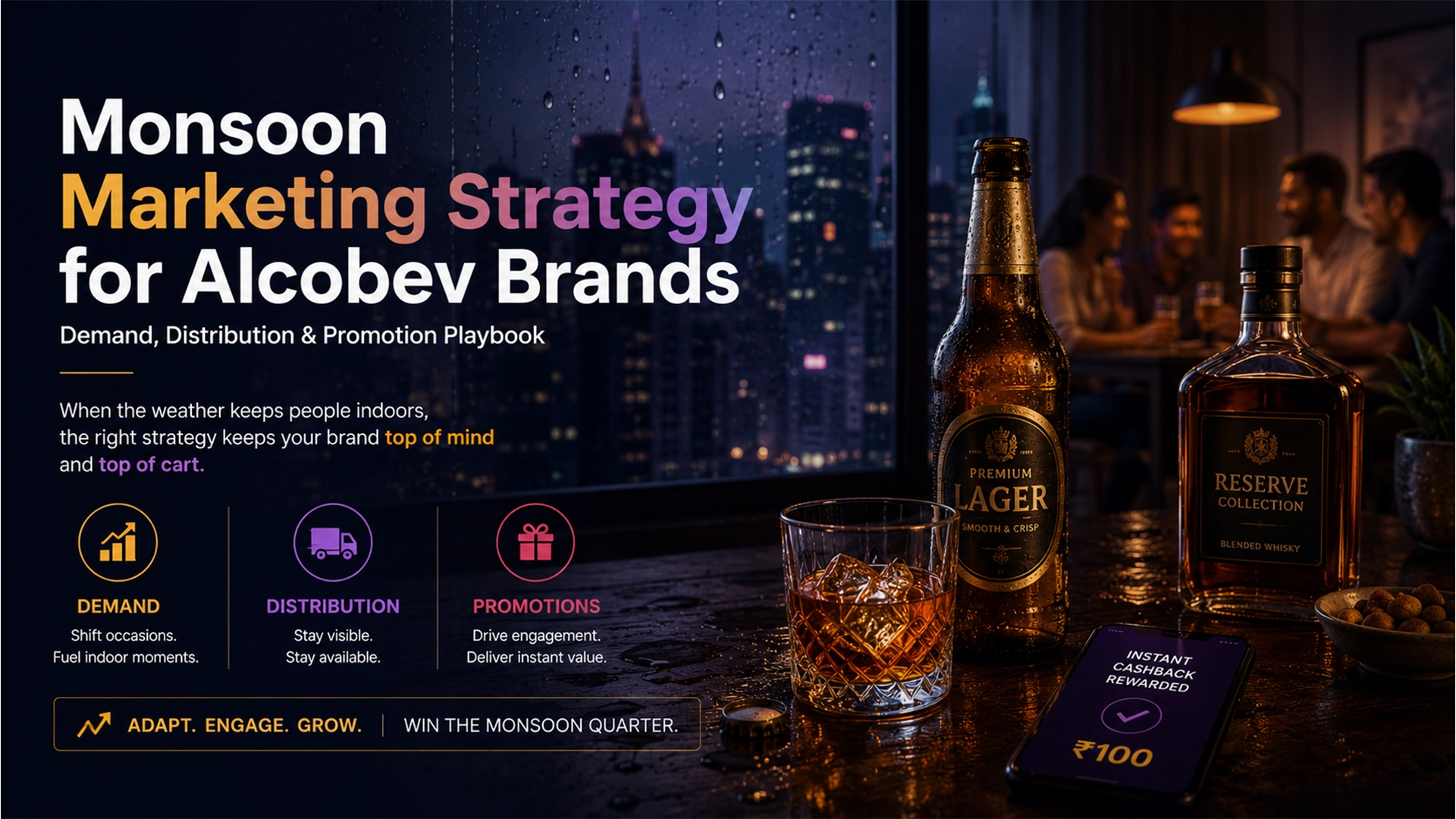
This is the planning guide for that approach: demand, distribution, and promotions, built specifically for the monsoon window.
Before we get into this, here are a few relevant resources from Buyerr:
- Consumer Promotions for FMCG and Alcobev Brands
- Retail and On-Pack Promotion Programs
- Thematic and Seasonal Campaign Solutions
- Cashback and Digital Coupon Solutions
- Experiential Rewards for Consumer Promotions
You can also explore:
- Festival Promotion Ideas and Timing Guide
- Trade Promotion Strategies That Move Inventory
- How Promotion ROI Analytics Helps Boost Your Campaign Performance
- Motivating Channel Partners: Incentives and Training
What we’ll cover in this blog:
- Reading demand correctly: beer vs. spirits in the monsoon quarter
- The distribution shift most brands miss
- On-trade vs. off-trade: where your monsoon budget should actually go
- The promotion mechanics that work when footfall is down
- Why a national plan does not work in monsoon India
- The monsoon playbook: a quick decision framework
1. Reading Demand Correctly: Beer vs. Spirits in the Monsoon Quarter
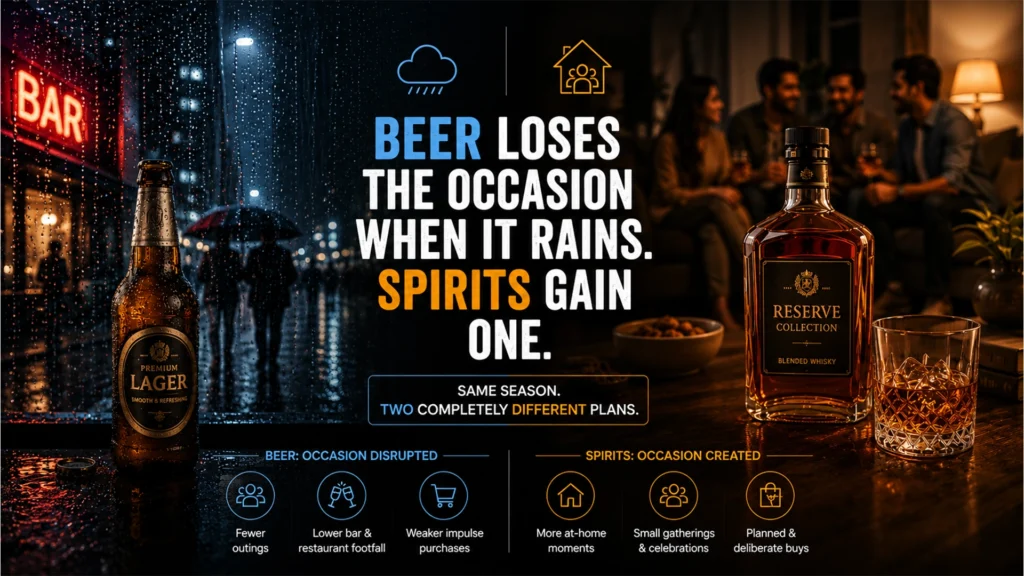
The first mistake in monsoon planning is treating the alcobev category as a single unit with a single problem. Beer and spirits do not experience the same monsoon. They face structurally different challenges, and the plans that follow from each need to be meaningfully different.
Beer’s challenge is occasion-based. The category is built on cold, social, out-of-home moments: a round at a bar, a quick drink after work, an impulse buy from a restaurant chiller. When it rains consistently, those moments compress. Footfall in bars drops. Restaurant covers fall. The impulse occasion at the retail chiller weakens because fewer people are stepping out. Industry data shows beer volumes can drop 30 to 40% in heavy-rain markets during peak monsoon months. In Q2 FY26, United Breweries reported a 65% decline in consolidated net profit, with their CEO directly attributing it to an unusually strong monsoon and flooding at three of their breweries. (Source: Business Standard, October 2025)
ICRA, in its FY2024-25 industry analysis, noted that Q1 is beer’s peak season, and any disruption in Q2, which overlaps with monsoon, has a compounding effect on the full fiscal year’s volume performance. (Source: ICRA AlcoBev Industry Report, March 2024)
Spirits sit in a more resilient position. Whisky, rum, and brandy are warm-drink categories with strong at-home consumption patterns. A drink at home after a long day, a small gathering on a rainy weekend evening, a deliberate purchase for the week ahead: these occasions are well-suited to monsoon conditions, not disrupted by them. IWSR’s March 2026 India market analysis noted that spirits and RTDs continued to grow through early 2025 even as beer faced significant headwinds, with India recording the highest total beverage alcohol consumption growth among 20 major global markets. (Source: IWSR, March 2026)
Within beer itself, the premium segment shows considerably more resilience than mainstream. During the same Q2 FY26 period where overall UBL volumes fell, their premium beer segment grew 17%. Separately, premium-and-above price bands grew 8% in volume in H1 2025, compared to 7% for alcohol overall. (Source: Beverage Daily, February 2026)
The practical implication is straightforward. A beer brand and a whisky brand should not share the same demand forecast, distribution plan, or promotional mechanic in June.
Also Read: Festival Promotion Ideas and Timing Guide
2. The Distribution Shift Most Brands Miss
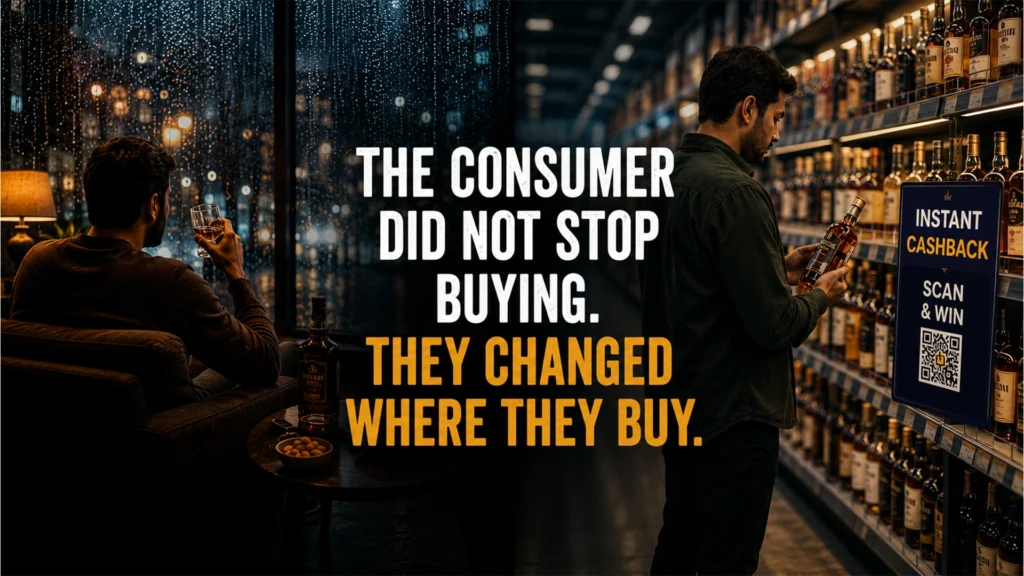
When social occasions compress and footfall drops, the consumer does not stop buying. They shift where they buy. The on-trade loses volume. The off-trade, specifically the retail liquor outlet and the home occasion, picks up share. This channel shift is consistent, predictable, and well-documented. It is also the shift that most brand distribution plans are slowest to accommodate.
Getting distribution right for monsoon requires a deliberate reset in April, before the season arrives. Three decisions matter most:
Right-size on-trade inventory. On-trade stock should be reduced to a relationship maintenance level, not a volume activation level.
Build off-trade depth before June. The off-trade retail outlet is where the monsoon consumer is shopping. Brands that enter the season with strong shelf presence, well-placed retail-level promotions, and stocked off-trade inventory protect their volumes better. AB InBev’s push to expand their in-store cooler network from 15,000 to 35,000 retail units was precisely this logic applied at scale. (Source: Exchange4Media, May 2025)
Shift SKU focus toward home consumption formats. Larger-format packs, multi-packs, and bundle configurations move better during monsoon because the consumer is buying for an evening rather than a single drink.
Also Read: Trade Promotion Strategies That Move Inventory
3. On-Trade vs. Off-Trade: Where Your Monsoon Budget Should Actually Go
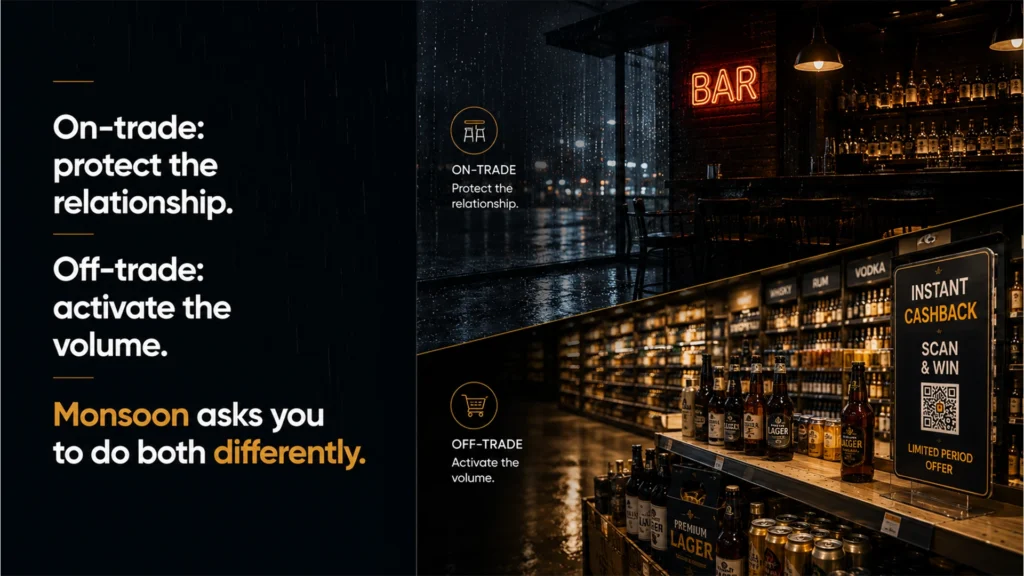
On-trade during monsoon: invest in relationships and capability, not volume activation. Bar staff training. Cocktail menu development. Product education sessions with outlet managers. In-store engagement programs that improve the quality of the consumer experience when consumers do step out.
Off-trade during monsoon: this is where the activation budget belongs. The monsoon consumer is at the off-trade outlet. On-pack promotions, cashback mechanics, bundle offers, and strong retail visibility meet the consumer in the channel where they are actually shopping.
The allocation shift most brands need to make: move 20 to 30% of activation spend from on-trade footfall mechanics toward off-trade consumer pull, and redirect remaining on-trade budget toward relationship and capability investment.
4. The Promotion Mechanics That Work When Footfall Is Down
On-pack assured rewards. An on-pack promotion with an assured reward works during monsoon because the deliberate purchaser, standing in a retail outlet on a rainy evening with time to look at the shelf, is in a considered mindset. Campaigns with assured prizes consistently outperform pure lottery mechanics on redemption rates. The mechanic works best when the reward is relevant to the monsoon occasion: a UPI cashback that arrives within hours, a streaming voucher for a night in, a food delivery discount to accompany the drink at home.
Instant UPI cashback. Platforms that enable real-time cashback disbursement via UPI eliminate the claim lag that historically eroded trust in cashback mechanics. For monsoon campaigns, a frictionless one or two-step redemption flow is the difference between a mechanic that works and one that gets abandoned halfway through.
Bundle mechanics for off-trade. The basket size at the off-trade liquor outlet during monsoon tends to be higher. Bundle offers — “buy two bottles, get a mixer” or “buy a case, get an assured gift” — align naturally with what the consumer is already inclined to do. “Your monsoon evening, sorted” creates occasion relevance that “Buy two, save 10%” cannot.
Experiential rewards for the at-home occasion. Virtual cocktail masterclasses, cocktail recipe kits paired with purchases, curated content linked to on-pack QR codes: these are experiential reward mechanics that extend the brand into the home occasion at low cost. They also generate first-party consumer data — phone number, preference, purchase frequency — that the brand carries forward into the festive season planning cycle.
5. Why a National Plan Does Not Work in Monsoon India
The monsoon does not arrive uniformly across India. Kerala receives heavy rainfall from early June. Karnataka and Goa follow through mid-June. Maharashtra typically peaks in July. Parts of North India, including Delhi, Haryana, and Punjab, see compressed monsoons that may not arrive until late June or early July.
A brand running a uniform national monsoon promotion from the first week of June is simultaneously over-investing in markets where the weather impact is already being felt and under-investing in markets where the season has not yet arrived.
A state-phased approach, even a broad one grouped into three or four geographic clusters, delivers meaningfully better returns. It allows activation budgets to be deployed in alignment with actual consumer behaviour in each market. For brands with strong channel partner and distributor infrastructure, the planning work required is modest relative to the return.
Also Read: How to Plan a High-Impact Consumer Promotion Campaign in India
6. The Monsoon Playbook: Quick Decision Framework
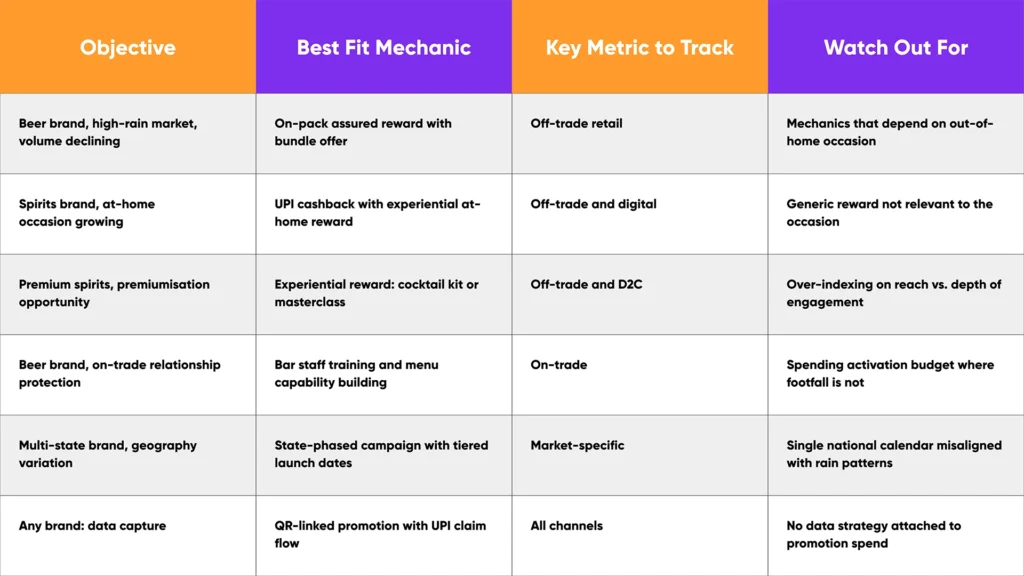
- If footfall is down, shift spend from on-trade activation to off-trade pull mechanics
- If the consumer is buying more deliberately, use assured rewards rather than blanket discounts
- If the occasion has moved indoors, make the reward relevant to the indoor occasion
- If you are a spirits brand, monsoon is a growth window for the at-home occasion: plan for it specifically
- If you are a beer brand, protect off-trade presence, invest in on-pack, and focus on the premium end of the portfolio
- If you have not built first-party data capture into your monsoon promotion mechanic, you are spending the quarter without learning anything from it
In Closing
The brands that come out of the monsoon in the strongest position for the festive season are not always the ones that lost the least volume. They are the ones that used the quarter purposefully: building off-trade depth, strengthening distributor and channel partner relationships, capturing consumer data through promotion mechanics, and arriving at October with a healthier trade pipeline and a clearer understanding of their consumer than they had in May.
The monsoon consumer is not a difficult consumer. They are a deliberate one. And deliberate consumers, given the right product, the right occasion framing, and the right reward mechanic, are exactly the consumers worth investing in. That is not a compromise position for a tough quarter. It is a strategic one.
- How to Plan a High-Impact Consumer Promotion Campaign in India
- Festival Promotion Ideas and Timing Guide
- How Promotion ROI Analytics Helps Boost Your Campaign Performance
- Experiential Rewards: Strategies to Create High-Impact Customer Experiences
- Trade Promotion Strategies That Move Inventory
- Motivating Channel Partners: Incentives and Training
Interested in building promotion mechanics that work through the monsoon quarter and compound into the festive season? Explore how Buyerr helps alcobev and FMCG brands run campaigns that drive pull even when footfall dips. Or get in touch directly to discuss your monsoon activation plan.
To explore more frameworks, write to us at [email protected] or follow our updates on LinkedIn.