Table of Contents
1. Why the Chemist Recommendation Is the Real OTC Conversion Lever
2. What Most Chemist Loyalty Programs Get Wrong
3. The Difference Between a Stocking Incentive and a Recommendation Incentive
4. What a Well-Designed Chemist Loyalty Program Actually Looks Like
5. How to Measure Whether Your Chemist Loyalty Program Is Driving Recommendation
6. Quick Decision Framework
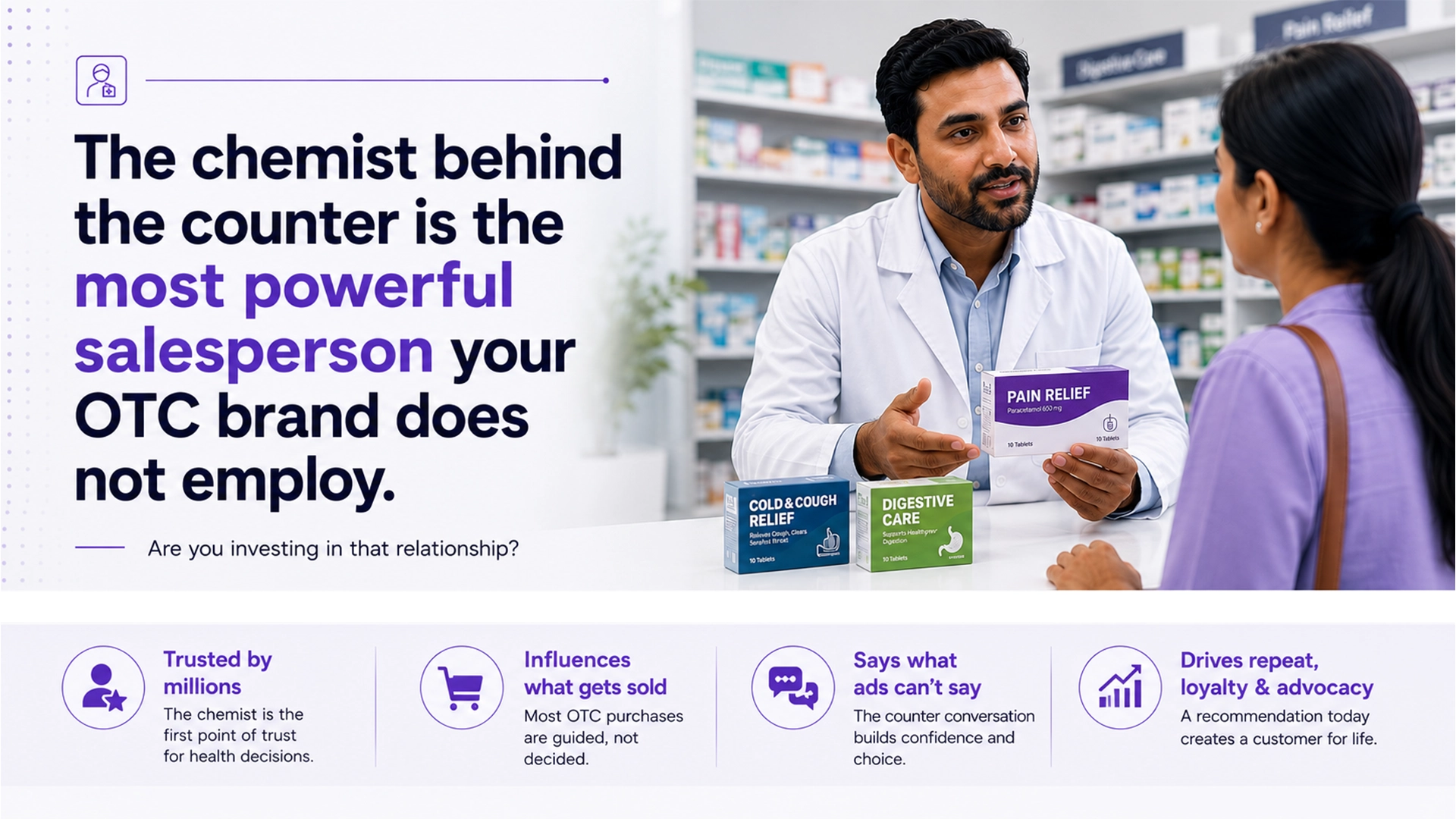
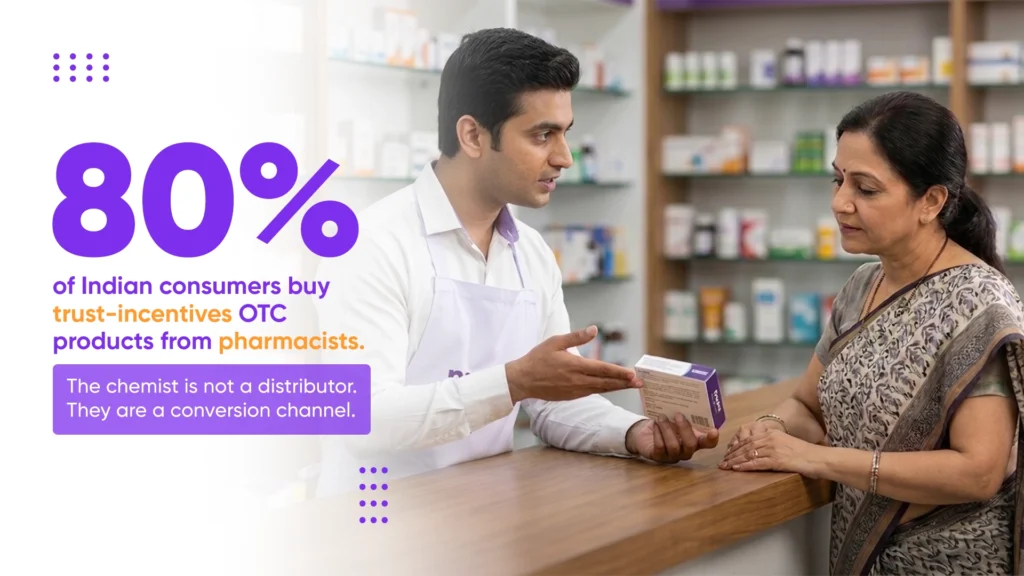
In India’s OTC market, the chemist loyalty program is not just a trade engagement tool — it is the most underleveraged brand-building asset most pharma companies own. When a consumer walks into a pharmacy asking for “something for acidity” or “something for a headache,” they are not always arriving with a specific brand in mind. Research by EY-Parthenon found that 80% of Indian consumers buy trust-intensive OTC products like pain relief from pharmacists rather than self-selecting online.
This makes the chemist relationship one of the highest-leverage investments an OTC brand can make. And yet most chemist loyalty programs in India are designed almost entirely around stocking behaviour: buy X strips, earn Y points. The program rewards the chemist for keeping inventory. It does nothing to influence what the chemist says when the next patient walks in. This blog is about the gap between the two, and how to close it.
Before we get into this, here are a few relevant resources from Buyerr: Channel Partner Program, Trade Promotions, Rewards and Incentives, In-Store Engagement, and Experiential Rewards.
1. Why the Chemist Recommendation Is the Real OTC Conversion Lever
India’s OTC market reached USD 11.4 billion in 2025 and is projected to grow at nearly 12% CAGR through 2034, driven by rising self-medication, growing health awareness, and a structural shift away from prescription-dependent purchasing. Eight out of the top ten pharma companies in India have already launched dedicated consumer healthcare portfolios in response.
In this environment, the chemist is not a passive distribution point. They are an active influence layer sitting between the brand and the consumer at the most critical moment: the purchase decision. India’s advertising regulations for drugs force OTC brands toward simpler claims, restricted messaging, and tighter labelling guidelines. What fills that gap is the chemist’s voice — delivered in person, at the counter, in response to a real health problem. That recommendation, delivered by someone the consumer trusts with their health, converts at a rate no television spot can match.
Also Read: Motivating Channel Partners: Incentives and Training
2. What Most Chemist Loyalty Programs Get Wrong
A typical chemist loyalty program in India looks something like this: order above a certain value each month and earn points. Accumulate enough points and redeem them for a prize from a catalogue. Field force visits track participation and remind chemists of pending redemptions.
The structure is transactional, and it is not without value. It incentivises the chemist to maintain stock levels and to prioritise your brand in their ordering decisions. What it does not do is change what the chemist says when a patient walks in. A chemist who has accumulated 500 points toward a ceiling fan is not thinking about your brand’s benefit claims at the counter.
Research by BI WORLDWIDE and KANTAR across the Indian pharmaceutical channel found that two-thirds of channel partners feel “trapped” in their brand relationships — they remain not out of genuine loyalty but because they lack a credible alternative. This is a structural indictment of how most chemist loyalty programs are designed. They create dependency, not advocacy. And dependency does not produce recommendation. The gap is a design problem, not a budget problem.
3. The Difference Between a Stocking Incentive and a Recommendation Incentive
The distinction is not complicated, but it is consistently missed in program design. A stocking incentive changes what a chemist orders. A recommendation incentive changes what a chemist says. These two behaviours are driven by different motivations, happen at different points in time, and respond to different kinds of rewards.
What drives stocking behaviour is margin and scheme economics. What drives recommendation behaviour is knowledge, confidence, and association. A chemist who knows Brand A’s antacid works faster for acidity will recommend Brand A not because they are being paid to but because they believe it is the right answer for the patient in front of them.
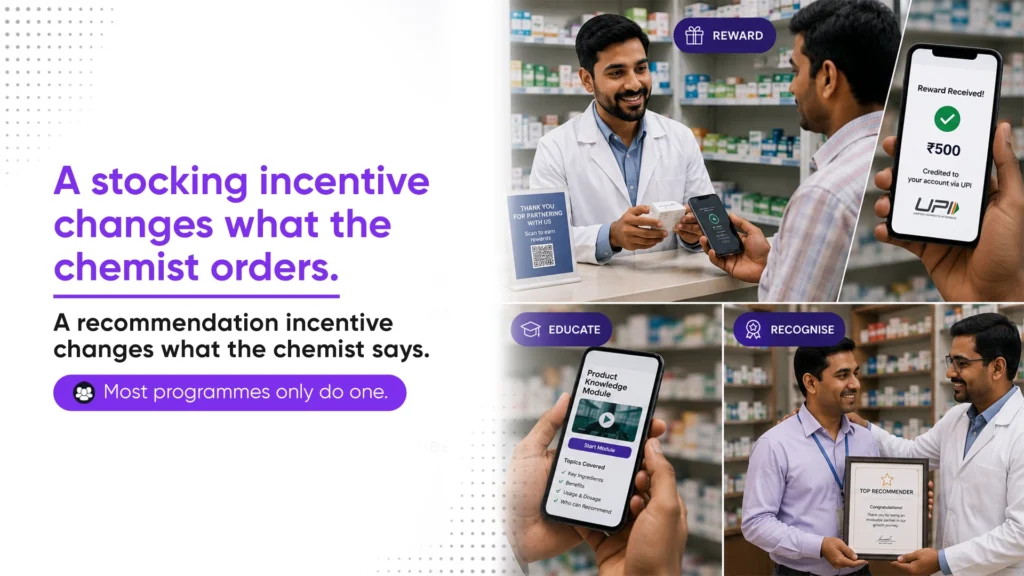
The best channel loyalty programs for OTC brands are not stocking programs or recommendation programs in isolation. They are architectures that layer both — with stocking mechanics as the foundation and recommendation-building elements as the superstructure that creates actual brand advocacy.
Also Read: Trade Promotion Strategies That Move Inventory
4. What a Well-Designed Chemist Loyalty Program Actually Looks Like
Building a chemist loyalty program that drives genuine counter recommendation requires designing across three dimensions simultaneously: rewards, education, and recognition. Most programs invest heavily in the first and almost nothing in the second and third.
Rewards: make them meaningful and relevant. The points-toward-a-catalogue model has two structural problems. First, the reward is deferred — sometimes by months — weakening the connection between the behaviour and the reward. Second, catalogue rewards are generic. Instant digital rewards disbursed via UPI within hours of a qualifying interaction outperform deferred catalogue rewards on both dimensions. For premium OTC brands, experiential rewards carry even more weight.
Education: the most underinvested element of chemist loyalty. A chemist cannot recommend what they do not understand. Embedding education into the loyalty program — brief product knowledge modules accessible via a WhatsApp-based program interface, short video explainers linked to QR codes on product shipper boxes, or a structured “certified recommender” status — creates a knowledge asset that compounds over time. In-store engagement and training are also the investments that distinguish a brand’s field force visits from a competitor’s.
Recognition: the element most programs skip entirely. Two-thirds of pharma channel partners in India feel unrecognised beyond their transactional value to the brand. Acknowledging a chemist’s participation milestone — a certificate, a personalised message, a “Top Recommender” status visible in the program interface — signals that the brand sees the chemist as a partner, not just a purchase point. That shift in perception drives recommendation behaviour more reliably than most incentive programs.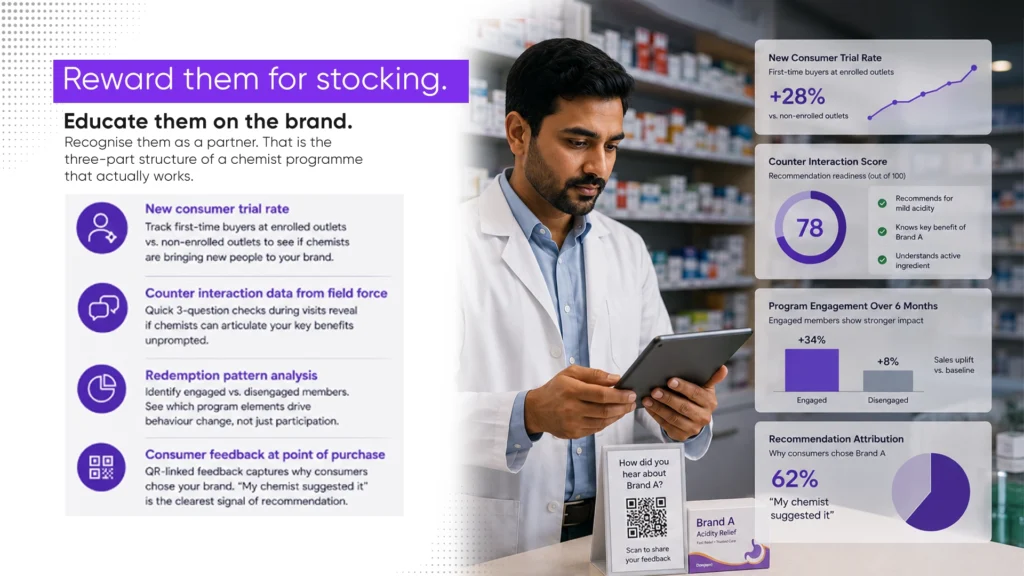
Also Read: Experiential Rewards: Strategies to Create High-Impact Customer Experiences
5. How to Measure Whether Your Chemist Loyalty Program Is Driving Recommendation
This is where most pharma brands have a measurement blind spot. The metrics most commonly used to evaluate a chemist loyalty program — secondary sales data, point redemption rates, and scheme participation numbers — measure stocking behaviour, not recommendation behaviour. Measuring recommendation requires a different set of signals.
- New consumer trial rate. Track first-time buyers at program-enrolled outlets versus non-enrolled outlets using digital promotion mechanics to get a direct read on whether the chemist is bringing new people to the brand.
- Counter interaction data from field force. A quick three-question check during each field visit creates a proxy for recommendation readiness that secondary sales data cannot provide.
- Redemption pattern analysis. Cohort analysis of engaged versus disengaged programme members, cross-referenced against secondary sales, reveals which elements are actually driving behaviour change.
- Consumer feedback at point of purchase. A QR-linked consumer interaction at the point of purchase, asking how they heard about the brand, directly captures recommendation attribution. “My chemist suggested it” is the clearest possible signal that the programme is working.
6. Quick Decision Framework for Your Chemist Loyalty Program
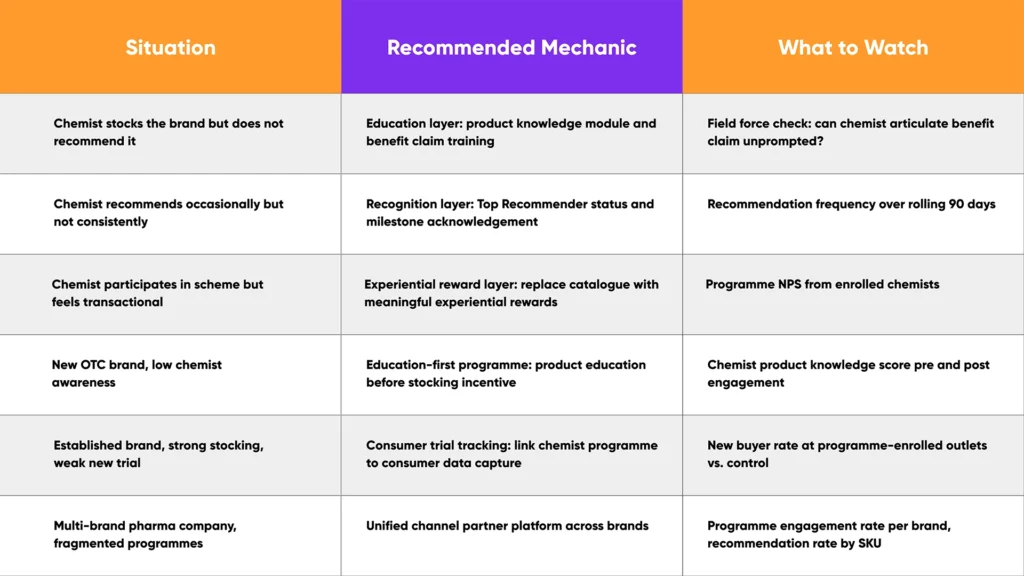
The fast decision rules: if your programme metrics are all secondary sales numbers, you are measuring stocking, not recommendation. If your rewards are deferred catalogue items, replace at least 50% with instant digital rewards. If your field force visits do not include a product education component, they are scheme reminder calls dressed as relationship visits.
In Closing
India’s OTC market is growing at 12% CAGR through 2034, driven by a consumer who is increasingly choosing to self-medicate, self-inform, and self-purchase. The brand that wins at the chemist counter is not necessarily the one with the most advertising spend or the most aggressive scheme structure. It is the one whose product the chemist understands best, trusts most, and associates with their own professional credibility.
The chemist loyalty program that drives OTC recommendation is not a more expensive version of the stocking programme — it is a structurally different one. Want to build a programme that drives OTC recommendation, not just stocking? Explore Buyerr’s channel partner and trade loyalty solutions, or get in touch directly to discuss your programme design. Follow Buyerr on LinkedIn for more insights on OTC trade engagement in India.