In a housing project, a residential development, or a commercial build, there is usually one person who decides which brand of pipe gets installed throughout the entire structure. It is not the architect, who specifies the material type. It is not the contractor, who approves the overall budget. It is the plumber, who stands at the site, reads the specification loosely, and reaches for the brand they trust.
That brand selection, multiplied across hundreds of meters of pipe, dozens of fittings, and multiple installations across multiple projects in a year, represents a significant volume of product specification that flows directly from one professional’s preference. The plumber does not buy a single unit and move on. They buy repeatedly, across jobs, across seasons, across years. And in a competitive piping, sanitaryware, or building materials category where several brands offer comparable quality at similar price points, the brand that has invested in earning the plumber’s loyalty tends to be the one they reach for without needing to think about it.
This is the commercial case for a plumber loyalty program. Not a one-quarter scheme, but a structured engagement architecture that makes your brand the plumber’s default.
Before we get into this, here are a few relevant resources from Buyerr:
- Channel Partner Program — Structured trade and influencer loyalty
- Trade Promotions — Incentive design for channel influencers
- Rewards and Incentives — Digital reward disbursement at scale
- Cashback and Digital Coupons — Instant reward disbursement
- Experiential Rewards — Build affinity beyond transactions
You can also explore:
- Motivating Channel Partners: Incentives and Training
- Innovative Loyalty Solutions to Enhance Influencer Engagement
- Loyalty Program Best Practices for Retail Brands
- Channel Incentive Models Compared: Points, Rebates, Spiffs and More
What we’ll cover in this blog:
- Why the plumber’s recommendation carries a different kind of weight
- The market context: why plumber loyalty matters more now
- What most plumber loyalty programs get wrong
- The reward mechanics that work specifically for plumbers
- Product knowledge as the hidden loyalty driver
- How to measure whether your program is driving real behaviour change
- Quick decision framework
1. Why the Plumber’s Recommendation Carries a Different Kind of Weight
The mechanic’s recommendation happens at a single service interaction. The plumber’s recommendation shapes an entire installation. When a plumber specifies a brand for a project, that decision covers every metre of pipe, every elbow, every T-junction, every valve, and every fixture across the entire scope of work. The volume implication of a single plumber’s brand preference is significantly larger than most brands account for in their channel planning.
There is also a trust dimension that is specific to this segment. When a homeowner or a small contractor asks a plumber “which brand should we use,” they are deferring entirely to the expert. The plumber’s recommendation carries the weight of professional accountability. If the pipe leaks, if the fitting fails, if the water heater underperforms, the plumber hears about it. This means the plumber only recommends a brand they genuinely trust. A loyalty program that builds genuine product confidence is not just driving a purchase decision, it is building the kind of professional trust that makes the recommendation feel earned rather than incentivised.
Industry data supports how powerful this influence is. When a plumber consistently installs a particular brand of fitting or pipe across their projects, the end customer becomes indirectly loyal to that brand as well, through the plumber’s repeated recommendation across home upgrades, renovations, and referrals. The plumber loyalty program, when designed well, creates a loyalty chain that extends from the professional to the end consumer without the brand needing to reach the consumer directly.
2. The Market Context: Why Plumber Loyalty Matters More Now
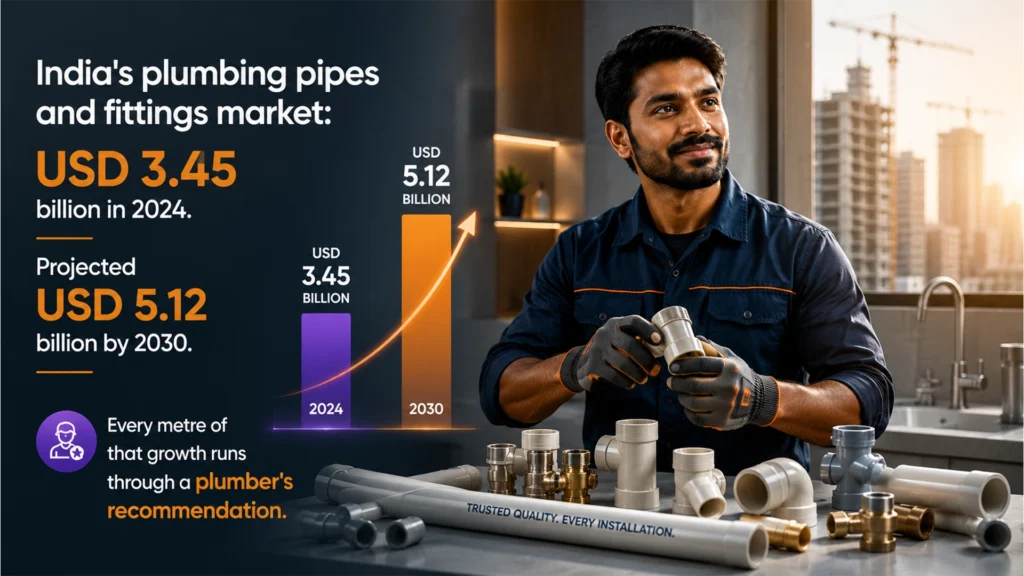
India’s plumbing and building materials category is in a strong growth phase. The India Plumbing Pipes and Fittings Market was valued at USD 3.45 billion in 2024 and is projected to reach USD 5.12 billion by 2030, growing at 6.8% CAGR. (Source: Intel Market Research, India Plumbing Pipes and Pipe Fittings Market, 2025) Government initiatives including the Jal Jeevan Mission and the Smart Cities Mission are driving large-scale infrastructure investment, while rapid urbanisation and real estate development are sustaining residential and commercial demand.
In bath fittings specifically, India’s market is expected to reach USD 11.49 billion in 2025, growing at 7.74% CAGR through 2030, with key players including Jaquar, Hindware, CERA Sanitaryware, and Parryware competing actively for plumber preference and specification. (Source: Mordor Intelligence, India Bath Fittings Market, 2025)
This growth is creating a market where the number of competing brands at every price point is increasing, the technical differences between brands are narrowing, and distribution is becoming more homogeneous. In this environment, the plumber’s brand preference is one of the few remaining sustainable differentiators. A brand that has 10,000 plumbers across its key geographies actively preferring and recommending its products has a distribution and advocacy advantage that is very difficult for a competitor to replicate quickly, regardless of their advertising budget or trade scheme generosity.
The brands that are building that advantage today are the ones investing in structured plumber loyalty programs with enough depth and consistency to build genuine professional relationships, not just transactional participation.
3. What Most Plumber Loyalty Programs Get Wrong
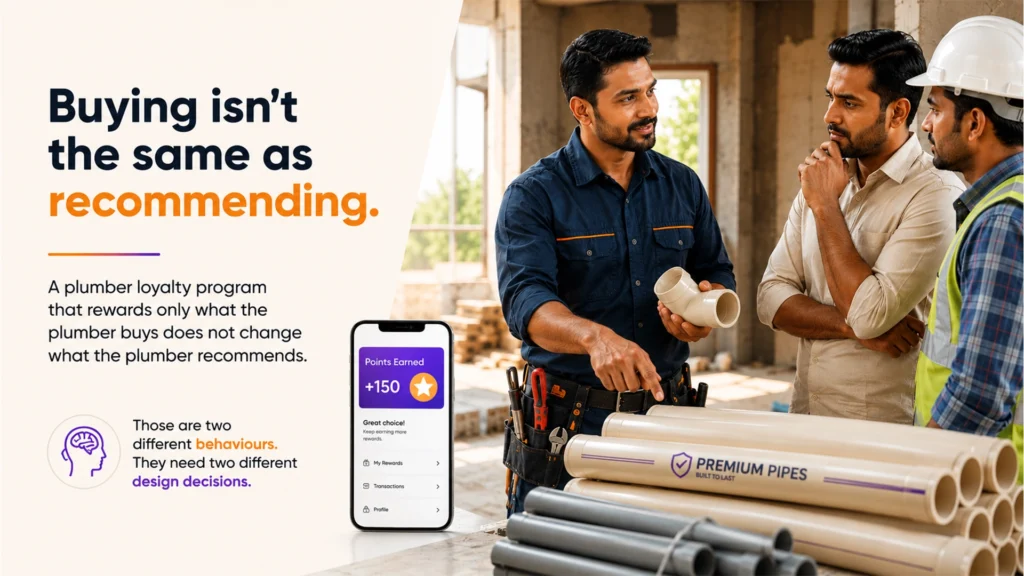
The most common failure mode in plumber loyalty programs is the same one that affects most trade influencer programs: the program rewards what the plumber buys, not what the plumber recommends.
A plumber earns points for purchasing a quantity of pipes or fittings. They accumulate those points over a quarter. They redeem them for something from a catalogue. The brand tracks redemption rates and calls the program a success. What it cannot track, and what the program does nothing to change, is whether the plumber is actively specifying the brand to contractors, homeowners, and site supervisors who have not yet made a purchase decision.
The second failure is complexity at onboarding. A plumber working across multiple sites in a day does not have the patience for a multi-step registration process, document upload requirements, and a two-week verification wait before they can earn their first reward. Programs that lose participants at onboarding are not just losing those plumbers. They are establishing a reputation in the plumber community for being difficult to work with, which spreads faster through word-of-mouth than any communication the brand sends.
The third failure is reward irrelevance. A plumber who spends their working hours on sites, carrying tools, crawling into tight spaces, and solving installation problems is not primarily motivated by a vacation package or a kitchen appliance. They are motivated by tools that make their work easier, professional recognition that elevates their standing in their community, and direct financial rewards that arrive without delay. A plumber loyalty program that offers rewards aligned with what the plumber actually values sees meaningfully higher engagement than one that treats the plumber as a generic promotional target.
4. The Reward Mechanics That Work Specifically for Plumbers
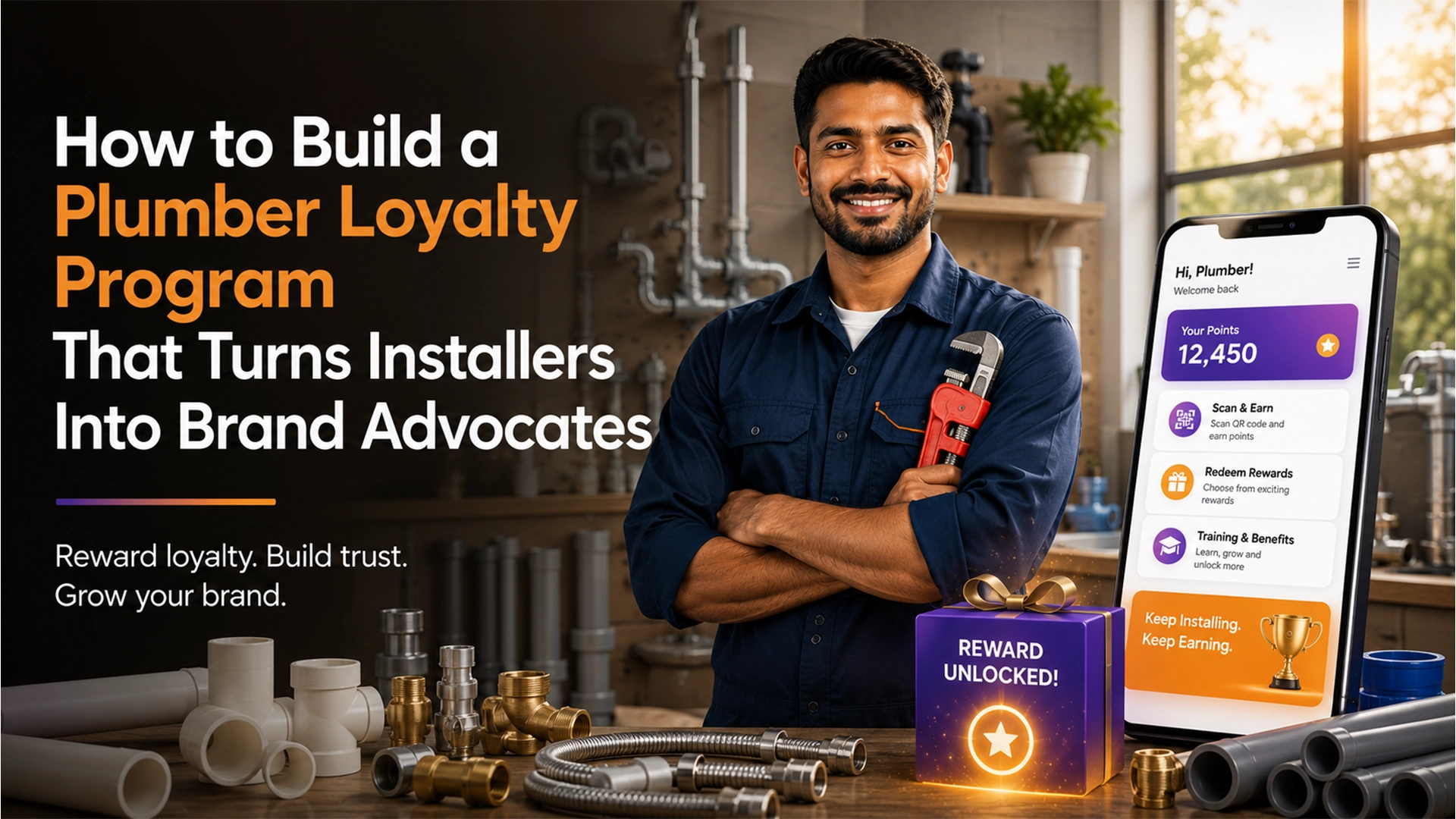
QR scan-based instant cashback. The most effective entry mechanic for a plumber loyalty program in India is the simplest one: a QR code on the product packaging that the plumber scans at the point of purchase, resulting in a cashback credited to their UPI account within minutes. No invoice uploads. No middleware. No waiting. The plumber scans, earns, and receives. This immediacy is not a convenience feature. It is the mechanic that makes the program feel trustworthy rather than aspirational. A plumber who receives a cashback within five minutes of scanning has already decided the program works. One who is told to wait for verification will disengage before the verification arrives.
Research on plumber program participation suggests that 84% of plumbers are more likely to stay with a brand that offers a loyalty programme, and 66% say the ability to earn incentives directly influences their purchasing decisions. (Source: Industry research on plumber loyalty programme participation) The threshold for participation is low. The threshold for sustained participation is determined entirely by how frictionless the first reward experience is.
Tiered recognition mechanics. A plumber who has been in a program for six months should feel like a more valued partner than one who joined last week. Tiered structures, where consistent participation unlocks Silver, Gold, or Platinum status with progressively better rewards and recognition, create a sense of professional progression within the brand’s ecosystem. A plumber who has reached Gold tier is not just earning more points. They are associating their professional identity with the brand’s recognition of their expertise and loyalty. This is the emotional layer that transforms a transaction program into a relationship program.
Professional tool rewards. The most-preferred reward type among trade influencers including plumbers is consistently professional tools: pipe cutters, pressure gauges, fitting tools, and safety equipment that improve the quality and speed of their daily work. Brands that offer these as high-tier redemption options are rewarding the plumber in a way that compounds their professional capability. Every time the plumber uses the tool they earned through a brand’s program, they are reminded of that brand. The reward becomes a daily touchpoint that advertising cannot replicate. Experiential rewards and professional development opportunities also perform well for senior, experienced plumbers who value learning and skill building alongside financial incentives.
Referral mechanics for network expansion. The plumber community in India is relationship-dense. Plumbers know other plumbers. They recommend colleagues for jobs they cannot take. They share program information within their networks when they trust the program. A referral mechanic that rewards a plumber for introducing another plumber to the program, and gives both plumbers a reward when the referred plumber completes their first qualifying purchase, uses the network dynamics of the trade community to expand the brand’s reach in a way that field force visits alone cannot achieve.
| Reward Mechanic | Best For | Engagement Depth | Ideal For |
|---|---|---|---|
| QR scan instant cashback | Trial, trust building, habit formation | Medium | All plumber segments |
| Tiered recognition program | Long-term retention and identity building | High | Established plumbers with consistent volume |
| Professional tool rewards | Emotional connection and daily brand recall | Very High | Experienced plumbers with high project volume |
| Training and certification rewards | Knowledge building and advocacy quality | Very High | Plumbers across all experience levels |
| Referral mechanics | Network expansion and community trust | High | Well-networked, senior plumbers |
| Project-based milestones | Large-scale installation specification | Very High | Commercial and infrastructure plumbers |
5. Product Knowledge as the Hidden Loyalty Driver
The most underinvested element of most plumber loyalty programs is product education. A plumber who understands why a brand’s CPVC pipe performs better in hot water applications, or why a particular fitting design reduces the risk of leakage over time, is a qualitatively better recommender than one who simply prefers the brand because of a cashback scheme.
This matters because the plumber’s recommendation to a homeowner or a site supervisor is not just “use this brand.” It is often a technical explanation: “this material handles the water pressure in your building better” or “this fitting design is easier to install and less likely to fail.” A plumber who can give that explanation confidently is making a recommendation that the customer is far more likely to follow than one delivered without context.
Product knowledge linked to the plumber loyalty program, delivered through short video modules accessible via WhatsApp, completion-based certification rewards, or brief in-person training sessions facilitated by the field force, creates an advocacy capability that a scheme alone cannot build. When a plumber earns a certification through a brand’s program, they associate their professional credibility with the brand’s product knowledge. That association is durable in a way that points balances are not.
The Indian Plumbing Association, with over 10,000 members representing every segment of the building industry, has consistently emphasised the importance of knowledge standards in the plumbing profession. (Source: Indian Plumbing Association, 2023) Brands that align their loyalty program with this professional development orientation, rather than positioning the program purely as a financial incentive, find that their most engaged participants are also their most effective brand advocates.
6. How to Measure Whether Your Program Is Driving Real Behaviour Change
The metrics that most brands track for a plumber loyalty program, redemption rate, points issued, and active participants, measure engagement with the program. They do not measure whether the program is changing what plumbers recommend.
Project-level specification tracking. For brands selling to construction projects, a plumber who registers a large-scale installation through the program, a housing complex, a commercial building, or an infrastructure project, is providing the brand with visibility it would otherwise never have. Tracking the number of enrolled plumbers who register project-level specifications, and the volume associated with each, gives a direct read on how far the program’s influence is reaching beyond individual product purchases.
Recommendation attribution. A simple question at the consumer end of the transaction, captured through a QR-linked consumer interaction or a brief digital survey, asking homeowners and contractors “how did you first hear about this brand?” and “did your plumber recommend it?” creates direct attribution data for the plumber loyalty program. When a significant proportion of consumer brand awareness traces back to plumber recommendation, the program is working.
Cohort retention across quarters. A plumber loyalty program that retains 70% of its active participants from one quarter to the next is building a sustainable advocacy base. One that sees 50% drop-off after the first scheme period is delivering acquisition without retention, which is the most expensive outcome the program can produce. Multi-quarter retention analysis, broken down by tier and geography, tells the brand which program elements are sustaining engagement and which are not.
First-party data quality. Every plumber interaction in the program generates data: location, purchase patterns, product preferences, project types, and engagement frequency. Brands that build structured first-party data capture into the plumber loyalty program come out with a geographic and behavioural map of their professional installer network that informs distribution decisions, new product launch targeting, and future program design. Brands that do not come out with a redemption report and no actionable intelligence.
7. Quick Decision Framework
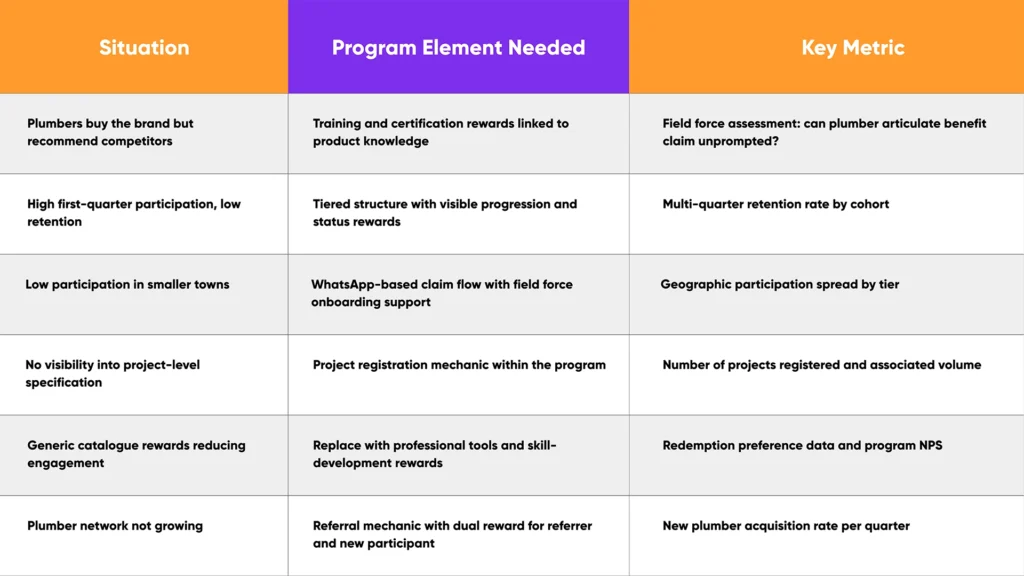
The fast decision rules for any plumber loyalty program:
- If your program rewards only purchase volume, add a recommendation quality metric and a knowledge component before the next scheme period
- If onboarding takes more than three steps or 24 hours, simplify it before the program loses participants at the start line
- If your rewards are generic catalogue items, introduce professional tools and training access as priority redemption options
- If you have no project-level visibility, add a project registration mechanic to capture large-scale specification events
- If program participation varies significantly by geography, your onboarding journey is not working for lower-connectivity markets and needs a WhatsApp or IVR alternative
In Closing
Market share in pipes, fittings, sanitaryware, and building materials does not shift because of advertising spend or retailer promotions alone. It shifts when the plumber standing at the site reaches for a brand without thinking twice, and keeps doing it, project after project, season after season.
India’s plumbing market is growing at 6.8% CAGR toward USD 5.12 billion by 2030, driven by urbanisation, housing construction, and government infrastructure investment. (Source: Intel Market Research, 2025) In that expanding market, the brands building durable positions are the ones investing in the professional relationships that determine what gets specified and installed, not just what gets stocked.
A well-designed plumber loyalty program is not a marketing initiative. It is a distribution and specification strategy. The plumber who considers your brand their professional default is worth more than any single trade campaign, because their preference compounds across every project they work on for as long as they trust you.
If you found this useful, these related reads may also be worth your time:
- Motivating Channel Partners: Incentives and Training
- Innovative Loyalty Solutions to Enhance Influencer Engagement
- Loyalty Program Best Practices for Retail Brands
- Experiential Rewards: Strategies to Create High-Impact Customer Experiences
- Gamification in Loyalty and Promotions: What Works?
- Channel Incentive Models Compared: Points, Rebates, Spiffs and More
Want to build a plumber loyalty program that drives genuine specification and brand advocacy? Explore Buyerr’s channel partner and trade loyalty solutions, or get in touch directly to discuss your program design.
To explore more frameworks, write to us at [email protected] or follow our updates on LinkedIn.