There is a moment in every vehicle service interaction that most automotive and lubricant brands never see, and rarely plan for. The vehicle owner says: “Use whatever you think is best.” The mechanic nods, turns to the shelf, and picks a brand. In that moment, months of advertising spend, distribution investment, and promotional planning either pay off or they do not, depending entirely on what the mechanic reaches for.
This is the conversion moment that a well-designed mechanic loyalty program is built around. Not the billboard. Not the digital campaign. The hand that reaches for the product at the point of service.
India’s automotive aftermarket is one of the most influencer-dependent sales environments in any category. With over 5 million workshops and garages operating across the country, mechanics are the single most powerful recommendation channel for lubricants, spare parts, batteries, filters, and tyres. The brands that understand this invest in the mechanic relationship as a core commercial strategy. The ones that do not spend heavily on consumer advertising and wonder why their workshop-level market share is not moving.
Before we get into this, here are a few relevant resources from Buyerr:
- Channel Partner Program — Build structured trade and influencer loyalty
- Trade Promotions — Incentive design for channel influencers
- Rewards and Incentives — Digital reward disbursement at scale
- Experiential Rewards — Build affinity beyond transactions
- Loyalty Solutions — Channel and trade loyalty architecture
You can also explore:
- Motivating Channel Partners: Incentives and Training
- Innovative Loyalty Solutions to Enhance Influencer Engagement
- Loyalty Program Best Practices for Retail Brands
- Experiential Rewards: Strategies to Create High-Impact Customer Experiences
What we’ll cover in this blog:
- Why the mechanic is the most powerful brand influencer in automotive aftermarket
- What most mechanic loyalty programs get wrong
- The three things a well-designed mechanic loyalty program must do
- Reward mechanics that work for mechanics
- Making the program accessible across digital and offline channels
- How to measure whether your program is actually working
- Quick decision framework
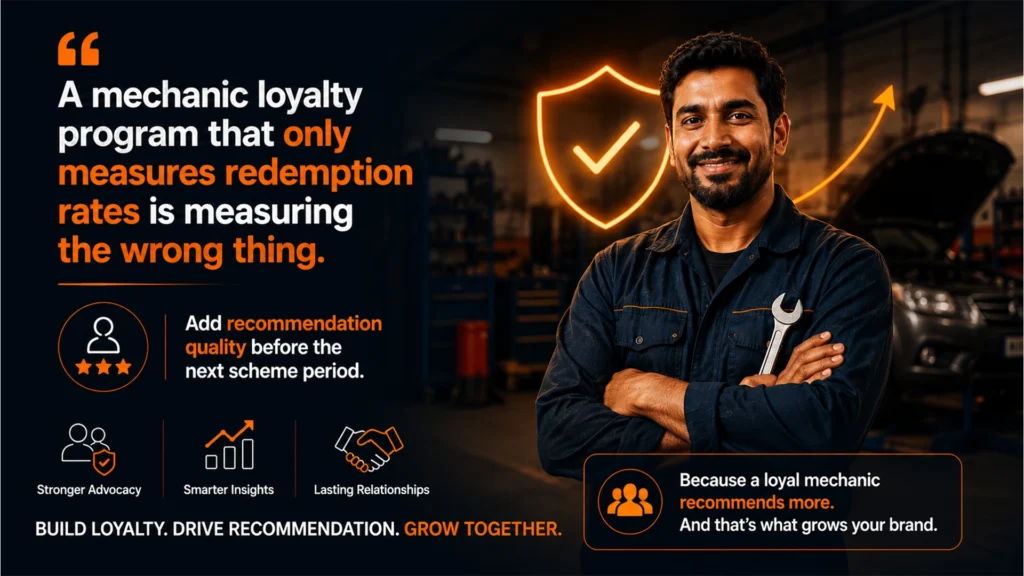
1. Why the Mechanic Is the Most Powerful Brand Influencer in Automotive Aftermarket
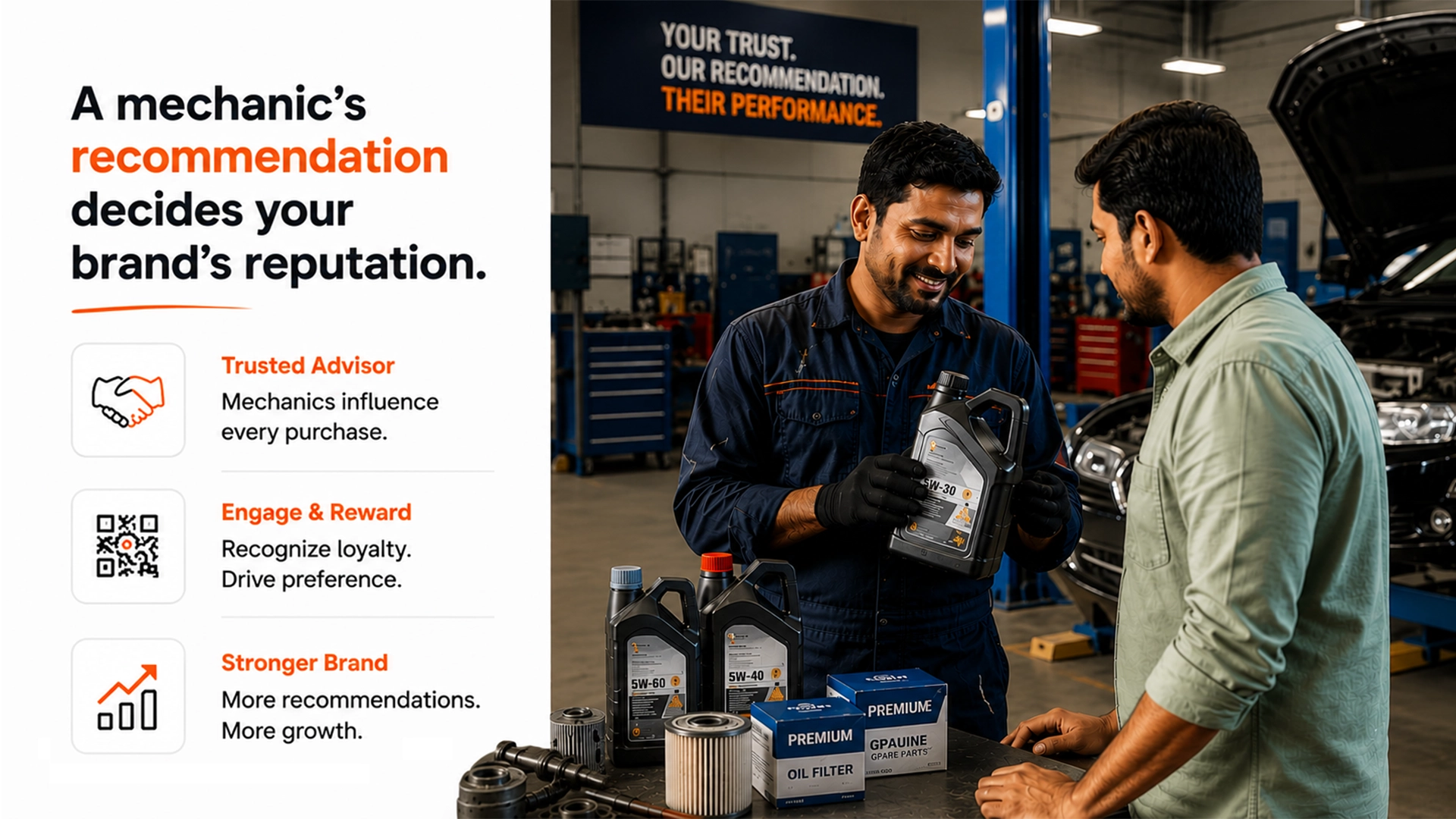
In most consumer categories, the brand reaches the consumer directly through advertising, in-store display, or digital targeting. In the automotive aftermarket, there is almost always a person in between: the mechanic. That person is trusted completely by the vehicle owner, especially for decisions involving engine oil grades, spare part specifications, and product quality. The vehicle owner hands over the keys and defers to the expert.
This makes the mechanic the highest-leverage point of brand influence in the entire category. Not the distributor, not the retailer, not even the end consumer. The mechanic’s recommendation, delivered at the point of service in response to a direct question or an open brief, is the moment that drives actual product selection.
What complicates this is that the mechanic has no direct commercial relationship with the manufacturer. They buy through distributors and retailers. They have no contractual obligation to recommend any particular brand. And in a market where multiple competing lubricant or spare parts brands offer broadly similar products at similar price points, the mechanic’s recommendation defaults to familiarity, habit, and most recently, to whoever last gave them a reason to prefer their brand.
This is the problem a mechanic loyalty program is designed to solve. Not just incentivising purchase behaviour, but building the kind of brand association that determines what a mechanic reaches for when the vehicle owner says nothing at all.
2. What Most Mechanic Loyalty Programs Get Wrong
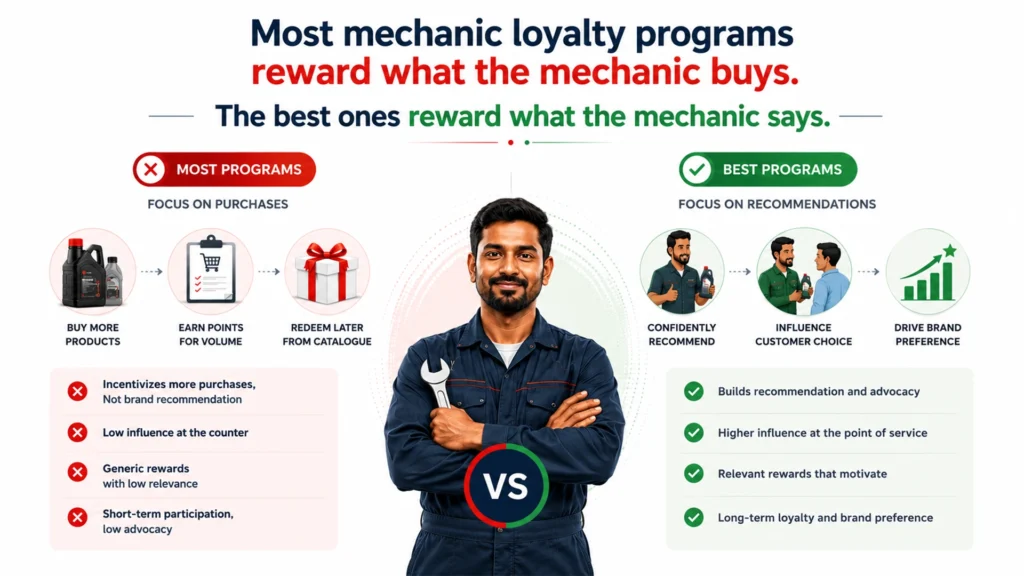
The majority of programs running in the Indian automotive aftermarket today share a structural flaw: they are designed to reward volume, not advocacy.
A mechanic earns points for purchasing a certain quantity of a lubricant or spare part. They accumulate points over a quarter. They redeem those points for something from a catalogue at the end of the period. The brand celebrates participation rates and moves on to the next scheme.
What this does: it incentivises the mechanic to order more. What it does not do: it does nothing to influence what the mechanic says at the counter, how confidently they recommend the product, or whether they proactively suggest the brand when a vehicle owner gives them a choice.
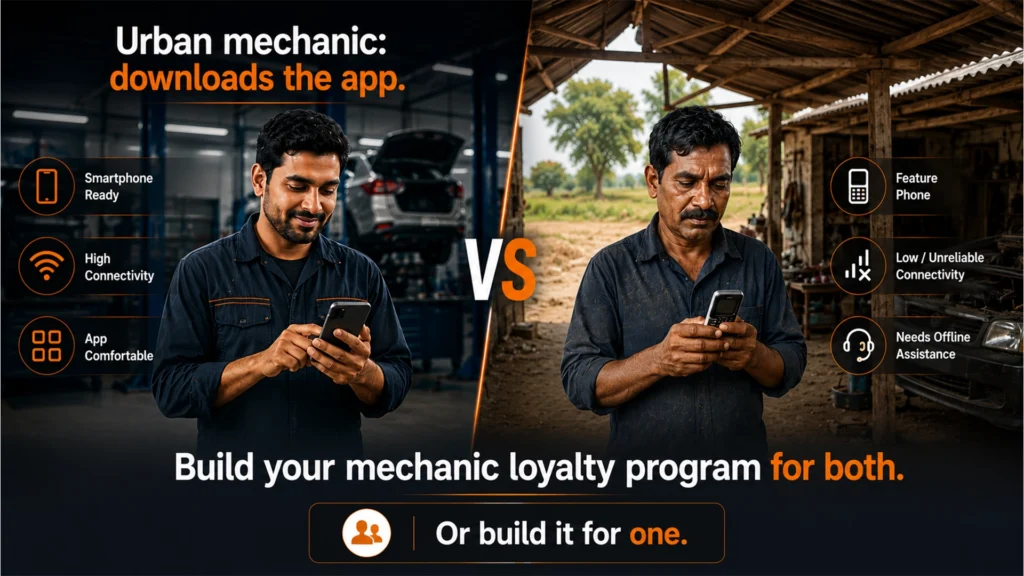
The second problem is accessibility. Many mechanic loyalty programs are designed for a digitally fluent urban mechanic with a smartphone, reliable internet, and the patience to navigate an app. India’s mechanic network extends deep into Tier 2 and Tier 3 towns, where connectivity is inconsistent and technology adoption varies significantly. A program that requires app download and registration before the first reward is available will lose the majority of its potential participants before they have even started.
The third problem is reward relevance. A ceiling fan, a mixer-grinder, or a television may appeal to some mechanics. But a mechanic who spends 10 hours a day working on vehicles is often more motivated by a professional tool upgrade, a skill development opportunity, or a cashback that arrives instantly in their account. The gap between what the brand offers and what the mechanic actually values is where most programs lose their engagement.
3. The Three Things a Well-Designed Mechanic Loyalty Program Must Do
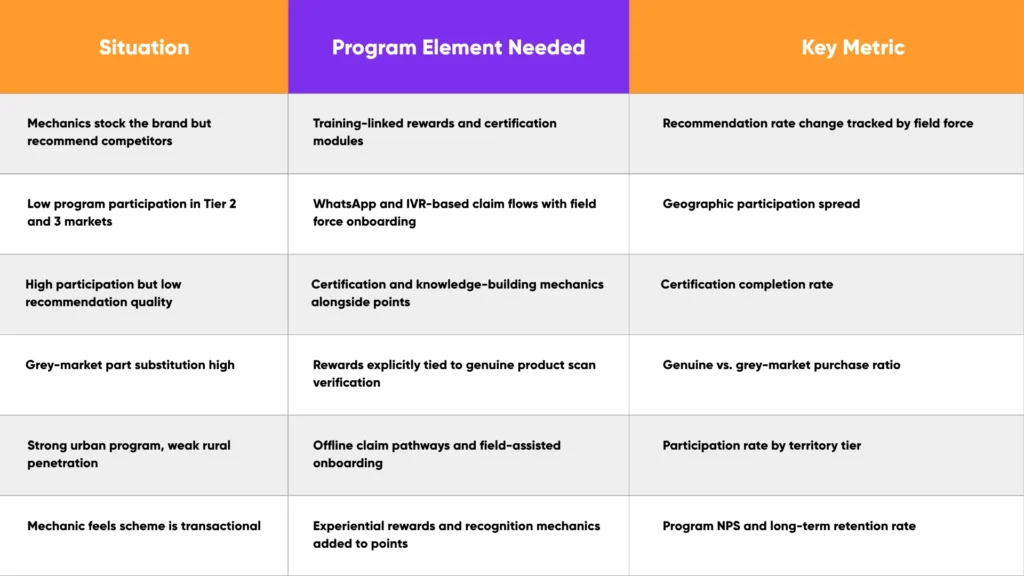
Build knowledge, not just purchase habit. A mechanic who understands why a product is technically superior to alternatives is a genuinely better recommender than one who is simply paid to push it. When a customer asks “which oil should I use,” a mechanic with product knowledge gives a confident, specific answer. A mechanic without it either defaults to the familiar or deflects the question. Training linked to the mechanic loyalty program, whether through short certification modules, WhatsApp-based learning, or workshop sessions, creates a knowledge asset that compounds over time. The mechanic who completed the brand’s technical training six months ago is still making better recommendations today.
Create emotional connection, not just transactional participation. The most effective mechanic loyalty programs in the Indian market combine financial rewards with recognition elements that make the mechanic feel like a valued partner rather than a point-of-sale tool. Milestone acknowledgements, certified mechanic status, event invitations, and public recognition within the program community all create an emotional association with the brand that a points-based catalogue cannot replicate alone. When a mechanic considers themselves a part of a brand’s professional network, their recommendation at the counter becomes a statement of professional identity, not just a commercial habit.
Generate first-party data at the last mile. Every mechanic who scans a QR code, completes a purchase verification, or claims a reward is generating data that most automotive brands have historically had no visibility into: tertiary sales, actual product usage at the workshop level, geographic demand patterns, and workshop-level purchase frequency. A mechanic loyalty program that captures this data systematically gives the brand something it cannot get from distributor reports: a direct read on what is actually being used at the point of service.
4. Reward Mechanics That Work for Mechanics
Not all reward structures produce the same outcome. For a mechanic loyalty program specifically, the mechanics that perform best share a common trait: they feel immediately relevant to the mechanic’s professional life.
QR scan-based instant rewards. A mechanic who purchases a product, scans the code on the pack, and receives a cashback in their UPI account within minutes has experienced a complete, satisfying reward loop. The immediacy is the point. Instant digital reward disbursement converts a routine purchase into a positive brand interaction, and the mechanic associates that positive feeling with the brand, not with a quarterly catalogue redemption that arrives weeks later. This mechanic is then more likely to scan the next pack, and the one after that.
Tiered programs with meaningful milestone rewards. A flat points structure with no visible progress is easy to disengage from. A tiered mechanic loyalty program, where a mechanic can see that they are two purchases away from a Silver status that unlocks better rewards, creates forward momentum. The mechanic is not just making a purchase decision. They are tracking their progress toward something. Brands that use Ashok Leyland’s approach, rewarding consistent engagement with tools, branded merchandise, and exclusive training access, report stronger long-term participation than those running flat cash schemes.
Training-linked rewards. Rewarding a mechanic for completing a product knowledge module with bonus points or a direct incentive serves two purposes simultaneously: it builds the advocacy capability the brand needs and it gives the mechanic a skill that has value beyond the loyalty program itself. This is the structure that programs like Mobil’s Mechanic Unnati use to create depth of engagement that far outlasts a standard purchase scheme. A mechanic who has earned a certification through a brand’s program considers that brand part of their professional identity.
Referral mechanics. A mechanic who refers another mechanic to the program and receives a reward when the referred mechanic makes their first qualifying purchase is simultaneously growing the brand’s program base and deepening their own engagement. Referral mechanics work well in the mechanic community because workshops often cluster in areas and mechanics know each other. Word-of-mouth within the mechanic network is faster and more trusted than any brand communication.
| Reward Mechanic | Best For | Engagement Depth | Measurement |
|---|---|---|---|
| QR scan cashback | Immediate trial and habit formation | Medium | Scan rate, redemption completion |
| Tiered points program | Long-term participation and status building | High | Tier progression, retention rate |
| Training-linked rewards | Knowledge building and advocacy quality | Very High | Certification completion, recommendation rate |
| Referral incentives | Program expansion and network growth | High | New mechanic acquisition rate |
| Professional tools as rewards | Emotional connection and professional identity | Very High | Redemption preference data |
| Experiential rewards | Brand affinity beyond transactions | Very High | NPS, long-term repurchase rate |
5. Making the Program Accessible Across Digital and Offline Channels
India’s mechanic network is not uniform. A workshop in Bandra and a garage in a small town in Bihar are both part of the same brand’s aftermarket, but they operate with completely different levels of digital literacy, connectivity, and time availability for program interactions.
A mechanic loyalty program that assumes smartphone ownership, reliable data connectivity, and comfort with app-based interactions will succeed in urban markets and fail everywhere else. Given that Tier 2 and Tier 3 markets often represent the highest volume of product usage, this is a significant limitation to accept.
The programs that achieve broad participation across India’s diverse mechanic base are the ones designed with multiple access pathways. A WhatsApp-based reward flow that works on any smartphone without requiring app installation. An SMS verification option for feature phone users. An IVR-based claim process for mechanics who are not comfortable typing on a screen. A field force touchpoint where the brand representative can assist with onboarding during a regular visit.
The in-store and field engagement layer matters more for mechanic programs than for almost any other channel loyalty format. The mechanic who would never independently download an app will participate enthusiastically when a brand representative sits with them for five minutes at the workshop and walks them through the first scan. That first positive experience, especially when it ends with a reward arriving in their account immediately, converts a sceptic into a participant.
Connectivity-resilient design, lightweight landing pages, offline claim options, and WhatsApp-based journeys extend the reach of the mechanic loyalty program beyond the digitally comfortable minority and into the mass of the mechanic network that actually drives volume.
6. How to Measure Whether Your Program Is Actually Working
Most mechanic loyalty programs are measured on the wrong metrics. Participation rate and points redeemed tell you how many mechanics are in the program. They do not tell you whether the program is changing what those mechanics recommend.
The metrics that matter for a mechanic loyalty program:
Recommendation rate change. Field force visits should include a structured check on whether enrolled mechanics can articulate the brand’s key product benefit unprompted. A three-question conversation at each visit, tracked over time, gives a direct read on whether the program is building advocacy capability or just purchase compliance.
Tertiary sales visibility. If the program includes a QR scan or invoice verification at the point of mechanic purchase, the brand gains direct visibility into actual product usage at workshop level. Comparing tertiary sales velocity in program-enrolled workshops versus non-enrolled ones is the clearest available measure of program impact on real-world product movement.
Genuine parts versus grey-market substitution rate. For spare parts brands specifically, a well-designed mechanic loyalty program should reduce the rate at which mechanics substitute grey-market alternatives. Tracking the ratio of enrolled mechanic purchases toward genuine parts over time measures the program’s impact on one of the category’s most commercially significant problems.
Cohort retention across scheme periods. A mechanic who participates in quarters one, two, three, and four is building a genuine habit. A mechanic who participates once and drops off represents acquisition cost with no sustained return. Tracking multi-quarter retention across the mechanic cohort reveals whether the program is building long-term relationships or just a series of one-time transactions.
First-party data completeness. The first-party data generated by every mechanic interaction in the program has commercial value beyond the mechanic segment itself. How complete and actionable is the data being captured? Phone number, location, purchase date, product purchased, and redemption behaviour together create a profile that informs distributor decisions, field force deployment, and future program design.
7. Quick Decision Framework
The fast decision rules for any mechanic loyalty program:
- If your program measures only points redeemed, add a recommendation quality metric immediately
- If the program is app-only, add a WhatsApp or SMS pathway before the next scheme period
- If rewards are generic catalogue items, introduce professional tools and training access as preferred redemption options
- If you have no tertiary sales visibility, the QR scan mechanic is the fastest way to build it
- If participation drops after the first quarter, the onboarding experience or the first reward moment needs to be redesigned
In Closing
The mechanic is not a passive participant in the automotive brand ecosystem. They are the most active and most trusted recommendation channel at the point where purchase decisions are actually made. A well-designed mechanic loyalty program does not just incentivise that participation. It shapes it, deepens it, and makes it durable.
The brands that run effective mechanic loyalty programs come out with three things competitors cannot easily replicate: a network of mechanics who understand and advocate for the product, a first-party data asset covering actual workshop-level usage, and a relationship that holds when a competitor launches a higher-margin offer to the same mechanic next quarter.
That is the commercial case for investing in the mechanic relationship properly. Not as a scheme that runs for a quarter, but as a program architecture that builds over time.
If you found this useful, these related reads may also be worth your time:
- Motivating Channel Partners: Incentives and Training
- Innovative Loyalty Solutions to Enhance Influencer Engagement
- Loyalty Program Best Practices for Retail Brands
- Experiential Rewards: Strategies to Create High-Impact Customer Experiences
- Gamification in Loyalty and Promotions: What Works?
- Channel Incentive Models Compared: Points, Rebates, Spiffs and More
Want to build a mechanic loyalty program that drives genuine recommendation rather than just transactional participation? Explore Buyerr’s channel partner and trade loyalty solutions, or get in touch directly to discuss your program design.
To explore more frameworks, write to us at [email protected] or follow our updates on LinkedIn.