The hardest part of a large-scale retail promotion is not the mechanic. It is not the reward structure, the creative, or even the budget conversation. It is the inch between the QR code retail promotion printed on the pack and the consumer’s phone camera, and everything that has to work correctly in that moment for the campaign to deliver what was promised in the planning deck.
Most brands discover this after the fact. The promotion launches, the trade team is activated, the packs are on shelf. Then the scan data comes in thin. A retailer in Lucknow calls to say the code isn’t working. Someone notices that one outlet in Delhi has generated 400 scans in 48 hours on a product that sold 60 units. The UPI cashback isn’t hitting accounts as fast as it should. And the person who approved the campaign brief is now managing a very different set of conversations than the ones they planned for.
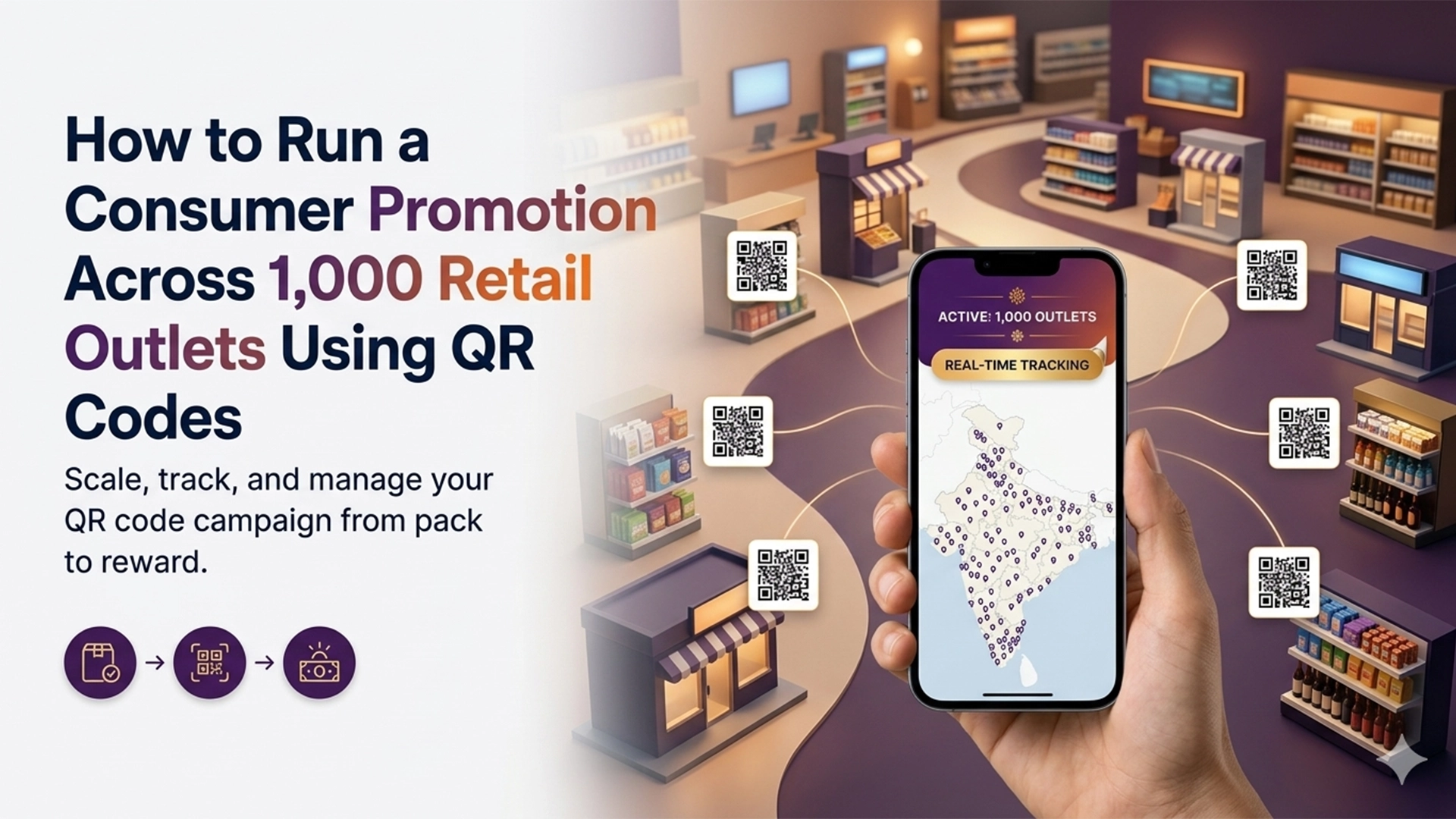
None of this is inevitable. Running a consumer promotion across 1,000 retail outlets with QR codes is entirely achievable as a scalable, trackable, cost-efficient operation. But it requires making the right decisions before a single pack goes to print, not after the campaign is live and the problems are already compounding.
This is a practical guide to building it correctly from the start. Scale, track, and manage your QR code retail promotion from pack to reward.
Before we get into this, here are a few relevant resources from Buyerr:
- Consumer Promotions — End-to-end campaign solutions
- Retail & On-Pack Promotions — Scale across outlets
- Cashback & Digital Coupons — Instant UPI reward disbursement
- 1st Party Data & Consumer Insights — What your promotion captures
- Gamified Promotions & Contests — Add an engagement layer
You can also explore:
- How to plan a high-impact consumer promotion campaign in India
- How Promotion ROI Analytics Helps Boost Your Campaign Performance
- How to Calculate Break-Even and ROI for Promotions and Incentives
- The 7 Most Effective Consumer Promotions for B2C Brands
What we’ll cover in this blog:
- Why scale is the real problem, not the idea
- What a QR-based promotion actually looks like end-to-end
- What you need to set up before printing a single code
- Making it work across 1,000 outlets
- Where QR promotions break down at scale and how to fix them
- The data your promotion collects is the second campaign
- A quick decision framework before you go live
1. Why Scale Is the Real Problem, Not the Idea
A QR code promotion is conceptually clean. Consumer buys the product, scans a code, gets a reward. Three steps. Fully digital. Trackable in theory.
The complexity arrives the moment you multiply that by 1,000 outlets across three states, with four pack variants, two languages, and a consumer base that ranges from a 22-year-old in Bengaluru to a 48-year-old kirana shopper in Gorakhpur. What reads as a clean three-step mechanic on a brief becomes a genuinely intricate operational challenge on the ground.
Most retail promotion campaigns that underperform at scale don’t fail because the mechanic was wrong. They fail because the infrastructure behind the mechanic was not designed to handle the reality of Indian retail: patchy connectivity, retailer non-compliance, fraud at the outlet level, and reward delays that quietly erode consumer trust before the campaign has found its feet.
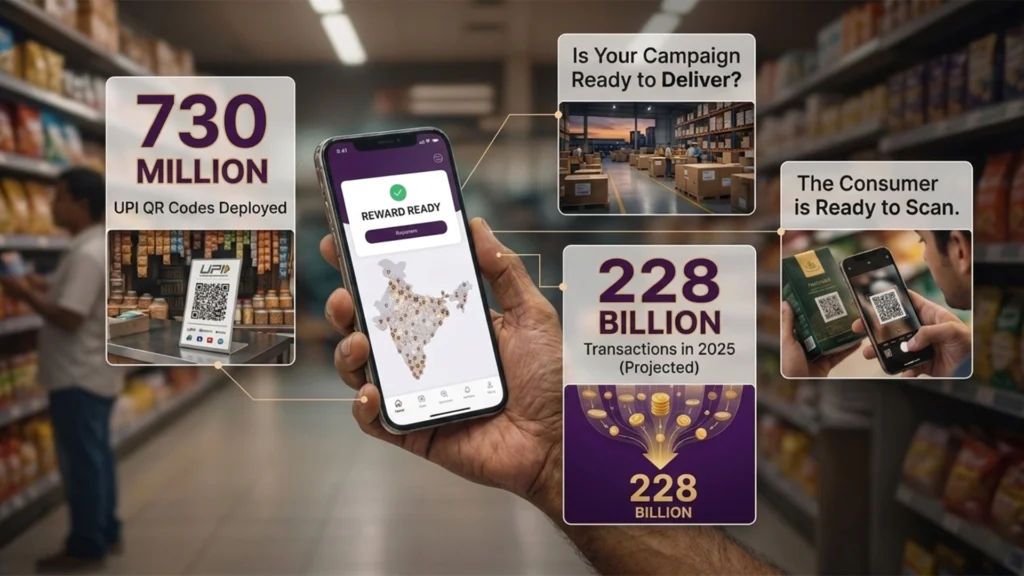
India’s QR scanning behaviour, at this point, is not the barrier. Over 730 million UPI QR codes are deployed across the country. Consumers in kirana stores, modern trade, and everything in between are comfortable scanning. The question is whether the brand’s campaign infrastructure can hold up on the other side of that scan.
2. What a QR-Based Promotion Actually Looks Like End-to-End
Before getting into setup decisions, it helps to walk the full consumer journey when a QR promotion is built correctly.
A consumer picks up a product at a kirana store in Pune. There is a QR code on the pack, clearly labelled, with one simple instruction: “Scan to win ₹25 cashback instantly.” They scan it with their phone camera. No app download needed. A lightweight landing page opens in their browser, asks for their UPI ID or phone number, and within minutes the cashback is in their account. No long form. No verification call. No waiting.
That is the experience from the consumer’s side. From the brand’s side, a campaign dashboard shows how many scans have happened, in which geographies, on which pack variants, and at what time of day. An outlet in Agra showing 300 scans in three hours is flagged automatically. Reward disbursement is running in real time. The trade team can see outlet-level performance without a single phone call to the field.
This is what a well-built QR-based consumer promotion looks like when everything has been designed correctly. Getting there starts well before the packs are printed.
3. What You Need Before Printing a Single Code
This is the stage most brands underinvest in. The pack deadline is close, the promotion has been approved, and the QR code feels like a printing detail. It is not.
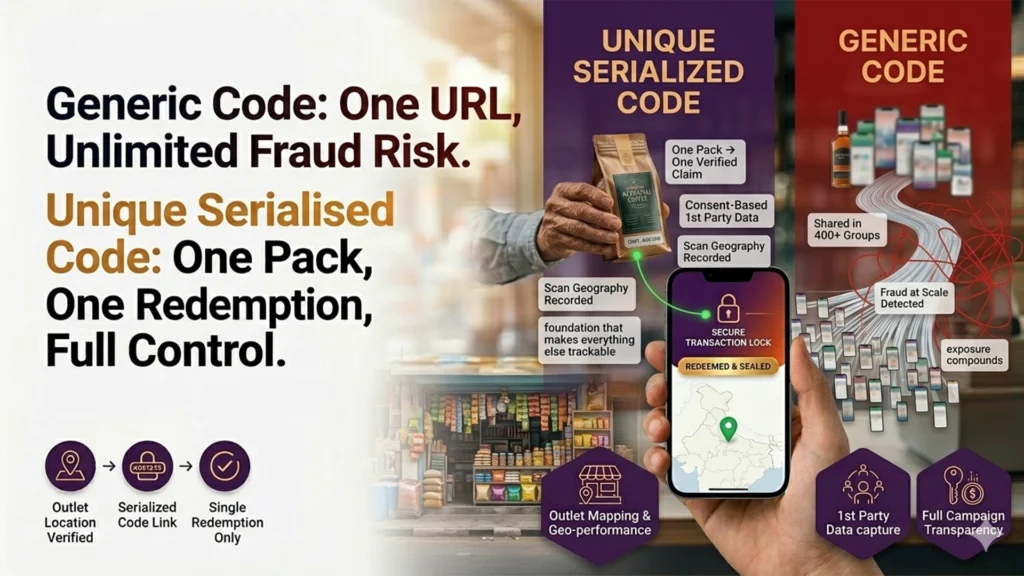
Unique versus generic codes. This is the single most important technical decision in a QR promotion. Generic codes, where every pack carries the same URL, are easy to generate and impossible to control. A consumer or retailer can photograph the code once and share it widely. One physical pack can generate hundreds of fraudulent redemptions. For a ₹25 cashback campaign running across a million packs, that exposure compounds fast.
Unique serialised codes, where each pack carries a code linked to exactly one valid redemption, solve this at the root. Each code can only be claimed once. Subsequent scan attempts are blocked. The system records which pack was scanned, in which geography, and at what time. This is the foundation that makes everything else trackable.
The redemption journey. Before the code is finalised, the complete consumer journey needs to be mapped, built, and tested. What does the consumer see on scan? How many fields do they fill? How quickly does the reward arrive? If the answer to that last question involves days rather than minutes, the campaign needs to be redesigned before it launches.
Indian consumers in 2026 have been shaped by UPI to expect money in their account almost immediately. A cashback that arrives after a five-day verification cycle does not feel like a reward. It feels like a broken promise. Platforms built for instant UPI cashback disbursement are the operational baseline now, not an upgrade.
Outlet mapping. If the promotion is running across 1,000 outlets, the campaign needs to know which 1,000 outlets those are: by name, location, and outlet type, before launch. This enables geo-level performance tracking, helps the sales team identify and address underperforming areas mid-campaign, and allows scan data to be cross-referenced against actual sales numbers at the outlet level. Without this mapping, all you have are national scan totals with no understanding of what is driving them.
Also Read: How to Plan a High-Impact Consumer Promotion Campaign in India
4. Making It Work Across 1,000 Outlets
The infrastructure is in place. The codes are printed. Now the campaign has to work in the field, which is where the gap between planning and reality tends to surface.
Retailer enablement is not optional. A QR promotion depends entirely on the retailer displaying the product correctly, keeping the code visible and unspoiled, and being able to answer a basic consumer question about whether the offer is genuine. Counter sales managers and retail staff are the final touchpoint between the campaign and the consumer. If they don’t understand the mechanic, they will not advocate for it.
A single-page retailer communication in the local language, explaining what the offer is and how it works, determines whether packs are displayed face-front or placed behind a competitor’s product. Brands that run structured retailer incentive programs alongside their consumer-facing QR campaigns consistently see better display compliance and higher scan rates, because the trade layer and the consumer layer are working in the same direction.
Phase the launch, don’t go national on day one. Launching simultaneously across all 1,000 outlets means that any systemic issue — a code batch that won’t scan, a UPI disbursement delay, a landing page that times out under load — affects the entire campaign instantly. A phased launch, starting with 150 to 200 outlets in one region, stress-tests the full system before scale. It also creates a window to resolve field-level issues before they become a national problem.
Real-time performance visibility. A campaign running across 1,000 outlets without live scan data is running blind. Dynamic QR codes with geography-level analytics show the trade team where engagement is strong and where it isn’t, within 24 hours. If one state is generating 10 times the scan volume of another on the same campaign, the team needs to know that in week two, not in the post-campaign debrief. This is what enables mid-campaign decisions rather than post-mortem ones.
5. Where QR Promotions Break Down at Scale and How to Fix Them
Even well-built campaigns hit problems. The most common ones are predictable, which means they are preventable.
Fraud at the outlet level. Generic codes are a fraud magnet, but even serialised codes can be gamed if validation logic is weak. A retailer scanning unsold packs to claim multiple cashbacks, or a consumer discovering that a code works more than once: both are scenarios that brands encounter on large campaigns. Serialised single-use codes, combined with device fingerprinting to flag unusual patterns and velocity limits per outlet, address the majority of fraud attempts before they compound into a material cost problem.
Connectivity gaps in Tier 2 and Tier 3 markets. Not every outlet in a 1,000-store network has reliable mobile internet. A consumer who scans a code in a low-connectivity area and sees a blank screen will not try again. Campaigns designed to work on slow connections, with lightweight landing pages and WhatsApp-based redemption as an alternative flow, perform meaningfully better in smaller markets. These are often the highest-volume geographies for FMCG and consumer brands, so designing for them is not a secondary consideration.
Physical code obstruction. Price stickers placed over QR codes, packs stored facing the wrong direction, and codes obscured by shelf placement are common and ongoing issues. A brief field check, or a photo audit mechanism where sales reps confirm display compliance weekly, catches these before they run undetected for half the campaign window.
6. The Data Your Promotion Collects Is the Second Campaign
Every scan is a data event. Phone number, purchase location, pack variant, time of day, scan frequency: a well-structured QR promotion captures all of this as a natural by-product of the redemption flow. For most brands, this data is the most durable thing the campaign produces, and it is the thing most planning conversations spend the least time on.
A consumer who scans a QR code and claims a cashback has provided verified, consent-based, first-party data. Not a panel estimate. Not a modelled audience segment. An actual buyer, at a real store, on a specific date. That information, captured and structured correctly, feeds the next campaign, the festive season targeting, the regional planning review, and the understanding of which SKUs are actually moving in which markets.
Brands that build first-party data capture into the QR promotion mechanic from the outset leave the campaign with two things: a sales uplift number and a consumer database. Brands that don’t leave with just the number. In 2026, with third-party data becoming less reliable and media costs rising, the database is the more durable asset of the two.
Consumer research capabilities can compound this further, turning raw redemption data into structured insight about purchase behaviour, pack preferences, and geographic demand patterns that inform decisions well beyond the campaign window.
Also Read: How to Calculate Break-Even and ROI for Promotions and Incentives
7. Quick Decision Framework Before You Go Live
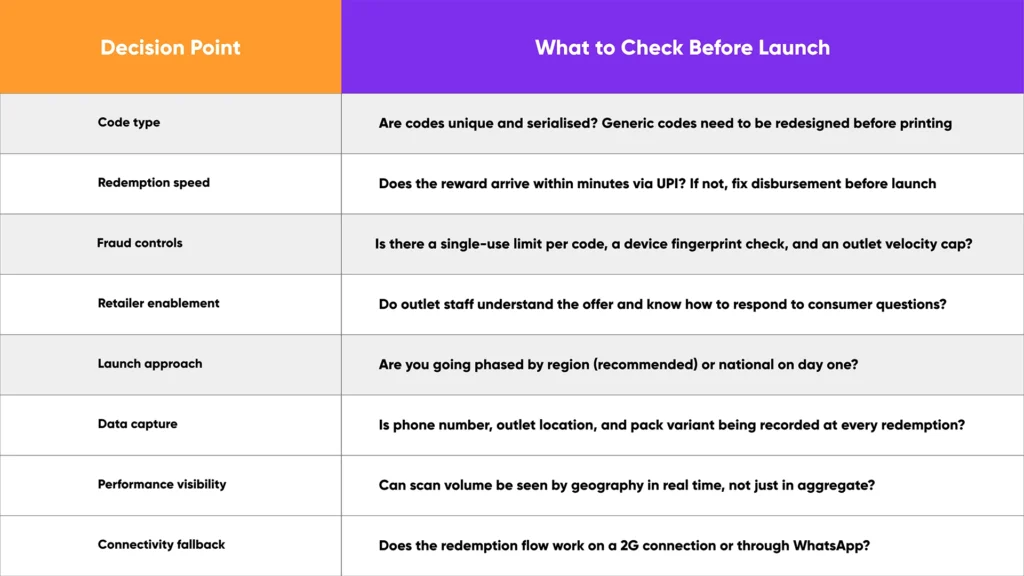
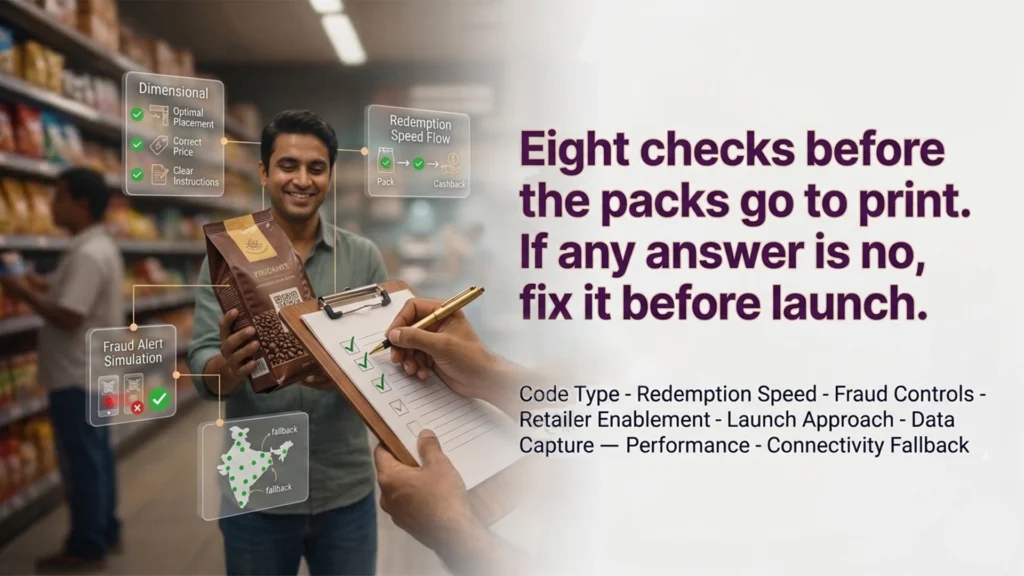
The fast rule: if any of these eight checks produces a no, or a not sure, resolve it before the packs go to print. Post-print changes are expensive. Post-launch fixes are more so. Post-campaign regret is the most expensive of all.
In Closing
Brands that have run QR-based promotions across 1,000-plus points of sale, with unique serialised codes and real-time UPI disbursement built into the infrastructure, have demonstrated that 97% reward fulfilment rates are achievable. That is not an aspirational benchmark. It is the operational outcome of building the system correctly before the campaign goes live.
The QR code on the pack is the consumer’s entry point. What happens after the scan — how quickly the reward arrives, how cleanly the data is captured, how visible the performance is to the team managing it — is entirely within the brand’s control. Getting that right is not a technology problem. It is a planning and design problem, and it is almost always solved in the weeks before launch, not during it.
If you found this useful, these related reads may also be worth your time:
- How to Plan a High-Impact Consumer Promotion Campaign in India
- How Promotion ROI Analytics Helps Boost Your Campaign Performance
- Gamification in Loyalty and Promotions: What Works?
- Emerging Trends in Consumer Promotions and Loyalty in 2026
- Trade Promotion Strategies That Move Inventory
- Loyalty Program Best Practices for Retail Brands
Want to run a QR-based consumer promotion across your retail network? Explore how Buyerr manages end-to-end QR promotion campaigns from code generation to real-time reward disbursement. Or get in touch directly to discuss your campaign.
To explore more frameworks, write to us at [email protected] or follow our updates on LinkedIn.