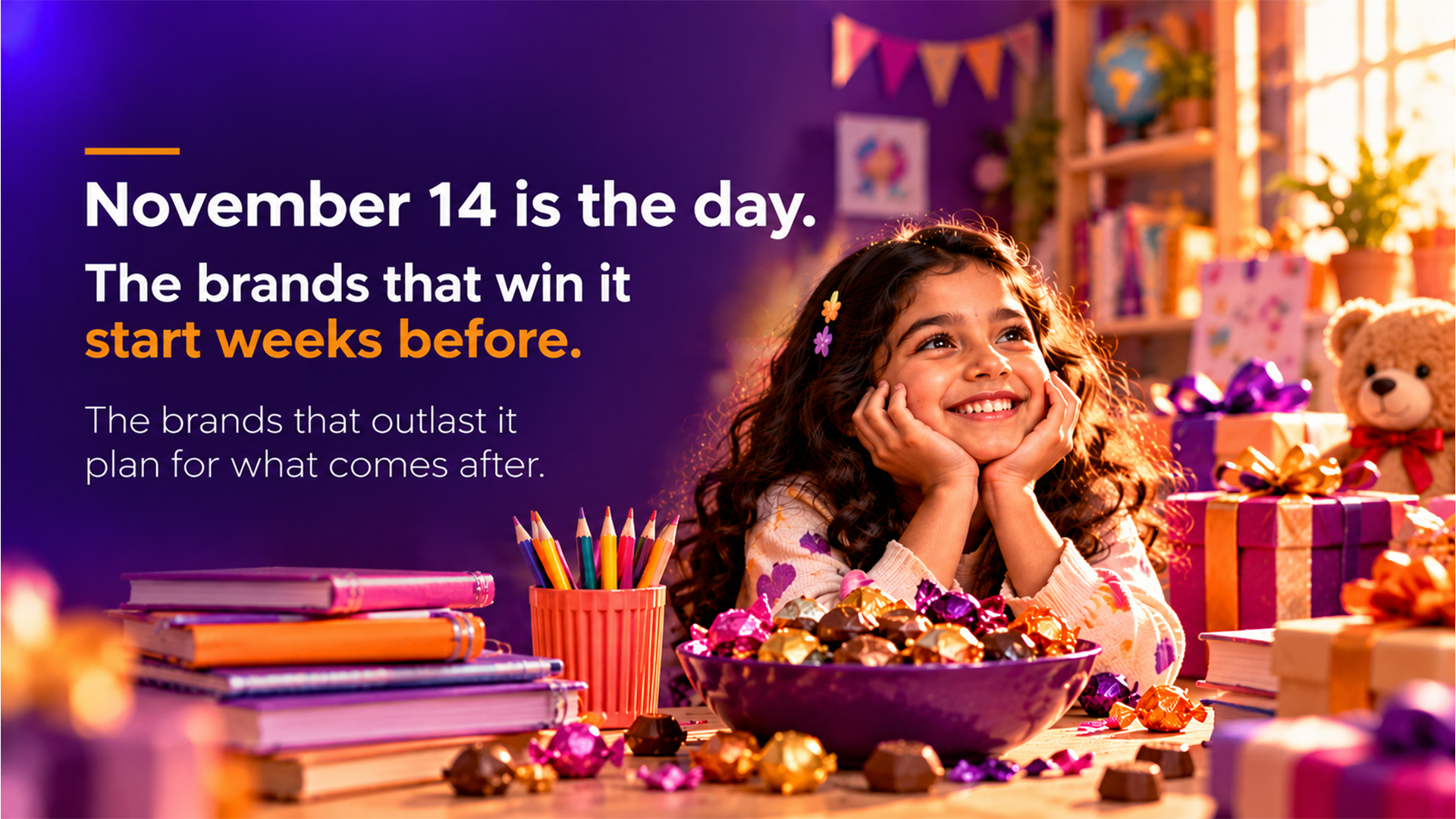
Children’s Day marketing India is not a one-day event — it is the single highest-leverage consumer acquisition moment between Diwali and Christmas for confectionery and stationery brands. Most brands post a film, write a caption, and brief an influencer. By November 16, the campaign is functionally over. This playbook is for the brand that wants something to show in January that a content campaign cannot produce.
Consider this a planning calendar. If you are four to five weeks before November 14, start at the Design Week and work through every section. Two to three weeks out, jump to the Build Week. In the final week before November 14, go directly to the Final Six Days. Wherever you are entering this playbook, the section that matters most for long-term commercial return is the one most brands skip entirely: November 15 onwards. That is where a one-day Children’s Day campaign becomes a loyalty programme that runs through December, January, and beyond.
Before You Begin: Buyerr’s Children’s Day Marketing India Solutions
- Consumer Loyalty — Build lasting brand relationships
- Gamified Promotions and Contests
- On-Pack and Retail Promotions
- Experiential Rewards
- Cashback and Digital Coupons
- 1st Party Data and Consumer Insights
Also Read: Gamification in Loyalty and Promotions: What Works?
Why Children’s Day Marketing India Needs a Playbook, Not Just a Campaign Brief
India’s confectionery market is USD 4.78 billion in 2025, growing at 5.60% CAGR through 2031. Chocolate alone dominates at 54.1% of the candy market, with Mondelez holding 58% of the chocolate confectionery segment. In that kind of competitive density, a content campaign on November 14 produces brand recall for approximately the length of a scroll.
A loyalty mechanic launched on November 14 and designed to run through December produces repeat purchase behaviour that carries into the new year. The difference between effective Children’s Day marketing India campaigns and forgettable ones is not budget. It is planning lead time. And that lead time starts now.
1. October 12–19: The Design Week — Where Children’s Day Marketing India Begins
This is the week most teams skip. Do not skip it. The question to answer before anything else: what happens after November 14? If the answer is “nothing — it is a one-day campaign,” stop and redesign. A Children’s Day marketing India campaign with no post-campaign mechanic is a media spend with no compounding return. The content posts on the day, the engagement peaks on the day, and by November 16 you are back to baseline with no new consumer data, no new loyalty relationships, and nothing to build on before Christmas.
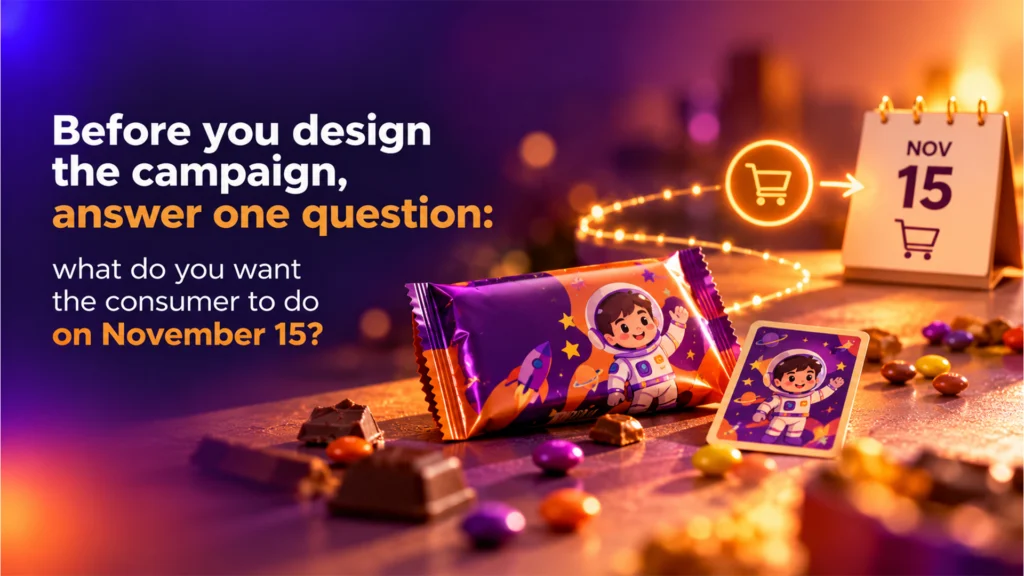
The design question is: what do you want the consumer to do on November 15? For a confectionery brand, the honest answer should be: buy the product again. Not share a post. Not tag a friend. Buy the product again. Everything in the campaign mechanics should flow from that answer.
This week, decide three things. These decisions define the quality of your Children’s Day marketing India outcome more than any single spend decision you will make between now and November 14.
1. The mechanic. The options that work for confectionery and stationery brands in Children’s Day marketing India activations are:
- A collectible series, where each purchase unlocks a new character, sticker, or digital item from a defined set. The child who has 3 of 8 characters has a concrete reason to buy again. Kinder Joy has built its entire repeat purchase architecture on this principle. Ferrero’s CMO has noted that “the element of surprise turns a simple treat into an interactive experience families enjoy together.” Explore how Buyerr’s gamified promotions can power this mechanic.
- A QR-linked scan and earn, where the consumer scans the pack, lands on a lightweight page, enters a phone number, and earns points toward a reward. Every scan generates a data event: which product, which geography, which household, at what frequency. For a confectionery brand with almost no direct consumer data, this is commercially transformative.
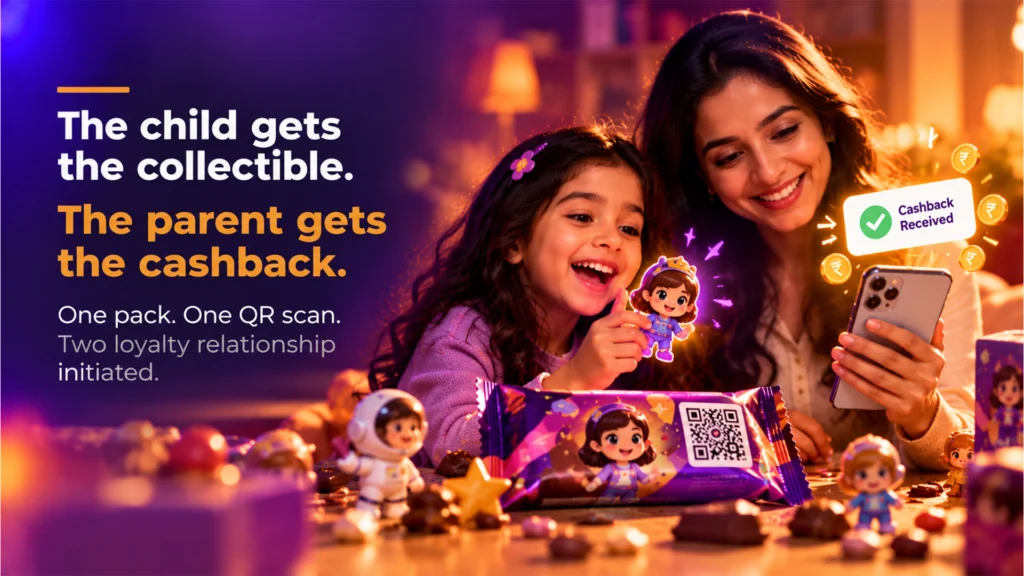
- A dual reward mechanic, where the child receives something fun — a digital character, a sticker, a game unlock — and the parent receives something rational: a UPI cashback, a dining voucher, or a family experience credit. The child’s excitement drives the purchase. The parent’s cashback removes their resistance. Both are addressed in one interaction.
2. The window. How long does the mechanic run? A collectible series should run at least 30–45 days to allow a household to complete it across multiple purchases. A points programme should run through December 31 to capture the Christmas gifting window. A dual reward mechanic can run as long as the brand wants: the infrastructure is set up once and it runs.
3. The data objective. What three questions do you want to answer on December 31 that you cannot answer today? Which geographies are your highest repeat-purchase households? Which SKUs drive the most loyalty enrolments? What is the average purchase frequency of an enrolled household versus an unenrolled one? Define these now. They determine what you capture in the redemption flow.
2. October 20–31: The Build Week
The mechanic is designed. Now it needs to exist. Children’s Day marketing India campaigns that work at retail scale require every element of this infrastructure to be in place before the first consumer sees the activation.
For the on-pack QR: The code needs to be unique and serialised per pack — not a generic URL every pack shares. A unique code per unit, linked to a single redemption, prevents fraud, enables outlet-level attribution, and produces data that a generic code structurally cannot. This is a printing and packaging decision that must be made before the first pack goes to production. If your November production run is already locked, use an in-store activation card or shelf card as the scan vehicle for this cycle, with the on-pack version ready for the next run. Buyerr’s on-pack promotion solutions are built for exactly this.
For the redemption flow: Design it for a ten-year-old using a parent’s phone on 2G connectivity. Three steps maximum: scan, enter number, receive confirmation. If it takes longer than 90 seconds from scan to reward confirmation, expect high drop-off. The child’s patience for a complex claim process is shorter than the parent’s — and the child is the one demanding the scan happen right now at the shop counter.
For the reward: Instant UPI cashback to the parent’s number should arrive within minutes, not days. A digital collectible or game unlock should appear on screen within the same 90-second window. Deferred rewards that say “we’ll credit you within 5 business days” are functionally invisible to the confectionery impulse purchase consumer. The reward has to arrive in the moment or the moment is lost.
For stationery brands: The build week looks slightly different. The loyalty mechanic here is often creativity-led — a platform where children submit drawings or craft projects and earn points or recognition. Build the submission platform now. Test it on a device an actual child would use. The most common failure mode for creativity campaigns is a submission form that takes four minutes to complete on a mobile browser. If it takes four minutes, it will not be completed by the child standing in front of it.
Also Read: QR Code Retail Promotion: 7 Steps to Scale Across 1,000 Outlets
3. November 1–7: The Pre-Launch Week in Children’s Day Marketing India
The campaign does not start on November 14. It starts this week. This is the single most important timing insight any Children’s Day marketing India brief should carry. By November 14, every confectionery brand’s social feed, every WhatsApp group, and every kirana shop notice board is covered in Children’s Day content. The brand that launched its activation on November 7 has a week of clear air before the noise arrives.
The trade communication. The retailer needs to know the Children’s Day marketing India promotion exists before the consumer does. A kirana owner who has not been told about the QR mechanic on the pack cannot answer the child’s question about why nothing is happening when they scan it. A one-page retailer brief in the local language — explaining the offer, the QR mechanic, and what to tell a consumer who asks — goes out this week via the sales team and via WhatsApp broadcast. 96% of Indian retailers prefer WhatsApp for scheme communications. Use that channel.
The parent pre-enrolment. If the brand has any existing consumer database, a WhatsApp or email communication goes to that audience this week: “Something special is coming for Children’s Day. Enrol now and get bonus points on your first purchase after November 7.” The consumer who enrols before November 14 is in the loyalty programme before the campaign peaks — meaning their November 14 purchase is not a first interaction but a continuation of one that has already started.
The field force briefing. Every trade marketing representative covering confectionery or stationery outlets needs to know the Children’s Day marketing India campaign, the mechanic, the retailer brief, and what good activation looks like. A shop where the promotional material is displayed correctly and the retailer has been briefed will outperform an unbriefed shop by a measurable margin. This briefing happens this week, not on November 14 morning.
4. November 8–13: The Final Six Days of Children’s Day Marketing India
The campaign is live in the trade. The consumer activation builds from here.
November 8–10: Paid media, if the brand is running it. Parent-targeting on digital platforms with the dual-reward message: fun for the child, cashback for you. The creative should show the specific reward the parent receives, not just the product. “Your child gets the chocolate. You get ₹20 back.” is a more honest and more converting message than a generic Children’s Day greeting with the product in frame.
November 11–12: Influencer or creator content, if it is part of the plan. The brief for this content is specific: show the scan mechanic working. Not just the product. Show the QR being scanned, show the reward arriving, show the child’s reaction to the collectible unlock. User-generated demonstration of the mechanic works better than produced brand content for confectionery audiences because it is legible and trustworthy in a way that polished creative is not.
November 13: Retailer compliance audit. Check your top 30 outlets. Are the promotional materials visible? Is the QR mechanic accessible on shelf? Is the product placed at child eye level? A physical audit of 30 outlets on the day before launch costs almost nothing and identifies problems that would otherwise go undiscovered until December’s data review.
5. November 14: Children’s Day Marketing India — The Day Itself
Three things matter on the day of your Children’s Day marketing India activation. In this order.
First: Reward delivery speed. The single metric that determines whether this Children’s Day marketing India campaign builds loyalty or just generates a day of engagement. If a child scans at 11am and the reward has not arrived by 11:05am, the mechanic has failed regardless of what the campaign brief says. Have someone monitoring the reward delivery pipeline in real time today. Not tomorrow. Today.
Second: Scan data by the hour. Which geographies are scanning? Which SKUs? Which outlets are producing the highest volumes? If a specific market is significantly outperforming expectations by midday, the field team can be redirected to support that geography. If a specific outlet cluster is showing zero scans despite confirmed product placement, something is wrong with the mechanic at that location and it needs to be diagnosed before end of day.
Third: The parent communication trigger. When a child scans and the parent’s number is captured, a WhatsApp message goes immediately to the parent confirming what was earned and showing the points balance. The parent who receives this message on November 14 is now aware of the programme. The child did not need to explain it. The brand communicated it directly. This is the moment the loyalty relationship with the parent begins — not when the parent decides to engage, but when the brand reaches them first.
6. November 15–30: The Children’s Day Marketing India Loyalty Window
This is the two-week period that most Children’s Day marketing India campaigns do not plan for — and where most loyalty programmes are actually built.
The consumer who bought on November 14 and had a positive reward experience is, right now, the brand’s most receptive audience. The reward arrived. The child is happy. The parent has the programme in their WhatsApp. The next purchase is the one that determines whether November 14 produced a loyalty relationship or a one-time transaction.
- If the brand launched a collectible series, the child already knows they have 1 of 8 characters. They want the next one. The second purchase does not need a separate campaign to motivate it. The series motivates it. The brand’s job is to ensure the product is available in the channels where the household shops.
- If the brand launched a points programme, a WhatsApp message goes out on November 20 to everyone who enrolled on November 14: “You’re 150 points away from your next reward. Here’s how to get there.” This is not a generic campaign message — it is a personalised message based on the specific consumer’s points balance. M&M’s Fun Club loyalty programme delivered a 77% increase in customer retention and nearly doubled repeat purchase revenue by sustaining exactly this kind of regular, personalised engagement between purchases.
- If the brand launched a dual reward mechanic, the parent who received a cashback on November 14 receives a follow-up on November 21: “Your child is 2 purchases away from completing the series. Your next purchase also earns ₹20 back.” The parent’s rational incentive is restated. The child’s emotional incentive is referenced. Both motivators are active simultaneously.
- For stationery brands, this window is the creative portfolio window. Children who submitted a drawing or craft project during the Children’s Day campaign receive a personalised response: their submission acknowledged, their points confirmed, and an invitation to submit again for the next round. The brand is not just a product manufacturer at this point. It is a platform for the child’s creative expression — a brand relationship depth that a chocolate bar cannot easily replicate.
Also Read: Festive Season Loyalty Campaign India: 5 Proven Principles
7. December: What the Children’s Day Campaign Data Tells You
By December 1, the Children’s Day marketing India campaign has produced a dataset that no amount of advertising spend can generate: verified, consented, first-party data on actual household buyers. Read this data before the Christmas planning cycle begins.
Which geographies produced the highest enrolment rate? If a specific Tier 2 market outperformed the national average on scan rate, that market deserves a Christmas campaign allocation it might not have received in a geography-agnostic media plan.
Which SKUs drove the most loyalty enrolments? If the ₹10 candy pack produced more scans per rupee than the ₹50 chocolate bar, that is information about which price point is driving your high-frequency household buyers versus occasional purchasers. Plan your January trade scheme around this.
What is the repeat purchase rate of enrolled households versus unenrolled ones? This is the number that answers the fundamental question: did the Children’s Day marketing India loyalty mechanic change consumer behaviour? If enrolled households show a measurably higher purchase frequency in November and December than unenrolled ones, the mechanic is working and deserves to be scaled. If the difference is minimal, the reward value or communication cadence needs adjustment before the next campaign window.
India’s loyalty market is projected to grow from USD 4.3 billion in 2025 to USD 17 billion by 2035 at 16.1% CAGR. The confectionery and stationery brands that build first-party data capture into their Children’s Day mechanics in 2026 will arrive at Children’s Day 2027 with a verified audience of last year’s buyers and a loyalty relationship they did not have to rebuild from zero.
8. January and Beyond: The Long Game in Children’s Day Marketing India
Here is what most confectionery and stationery brands running Children’s Day marketing India campaigns do not plan for. And what separates a loyalty programme from a campaign.
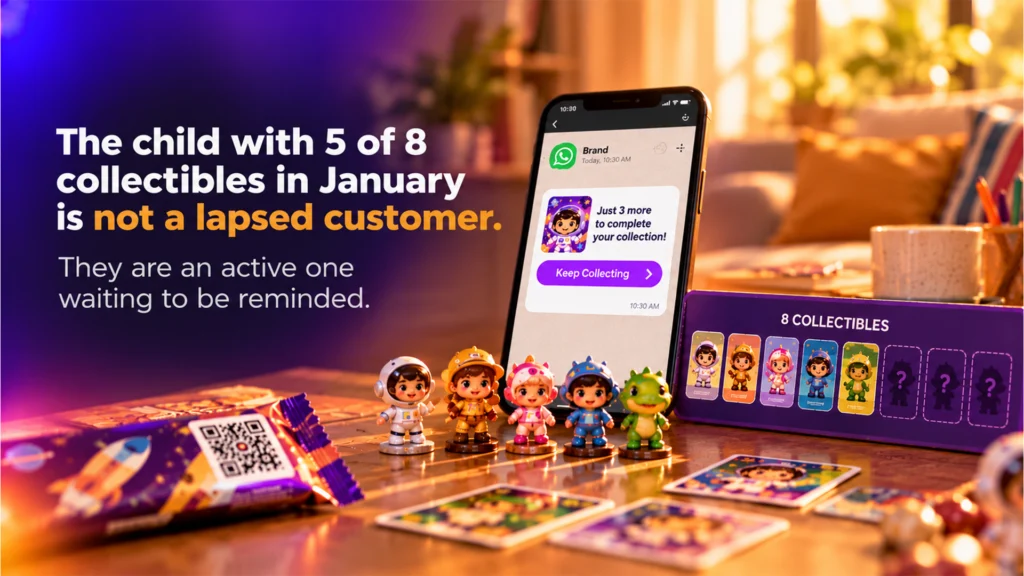
In January, the child who collected 5 of 8 characters in November still has 3 empty slots. The parent who earned 400 points in November and December is 100 points from a reward tier. These consumers are already engaged. The brand does not need to reacquire them. It needs to stay present.
A January communication to the households enrolled during Children’s Day — referencing their specific progress and offering a January purchase as the path to completing their goal — costs almost nothing to send. It activates a consumer who has already demonstrated willingness to engage. And it generates a January purchase in a month when confectionery sales are historically soft.
This is what the Children’s Day marketing India investment is actually worth. Not the November 14 engagement numbers. The January purchase rate of enrolled households. The March re-engagement of lapsed members ahead of Holi. The August back-to-school loyalty communication that references the creativity programme launched on Children’s Day and invites the child to submit again.
One well-designed loyalty mechanic, launched on November 14, can run productively for twelve months if the infrastructure is built and the communication cadence is maintained. The brands that consistently win at Children’s Day marketing India do not think about November 14 as a campaign. They think about it as the annual enrolment moment for a relationship that runs all year.
Related Reads
- Gamification in Loyalty and Promotions: What Works?
- Emerging Trends in Consumer Promotions and Loyalty in 2026
- Loyalty Program Best Practices for Retail Brands
- Festival Promotion Ideas and Timing Guide
- How to Plan a High-Impact Consumer Promotion Campaign in India
Planning a Children’s Day marketing India campaign with a loyalty mechanic behind it? Explore Buyerr’s consumer promotions solutions or get in touch directly to design the right mechanics for your brand. You can also follow Buyerr on LinkedIn for more insights on loyalty and promotions in India.