Every October, a well-run festive season loyalty campaign India brands build does something that the discount-first alternative cannot: it converts the season’s highest consumer traffic into year-round buyers. Brands spend enormously to bring consumers in during this window. Discounts deepen. Advertising CPMs rise because every brand is bidding simultaneously. India’s festive advertising spend rose 12–14% in the 2025 season alone. And by the second week of November, the season is effectively over.
Here is the part most post-mortems do not address honestly. A significant proportion of consumers acquired during the festive window on heavy discounts will not come back in January. Not because the product was wrong. Because the relationship was built entirely on a discount that no longer exists. The brand offered a transaction. The consumer took it. When the transaction ended, so did the relationship.
This is why the brands that consistently win across multiple festive seasons are not the ones with the deepest discounts. They are the ones that use the festive window to build something that outlasts it: a genuine, data-backed loyalty relationship that compounds from Navratri through Diwali and into the following year. A festive season loyalty campaign India brands design correctly produces this outcome. This blog is about how to build that.
Before we get into this, here are a few relevant resources from Buyerr:
- Consumer Loyalty — Build lasting consumer relationships
- Loyalty Solutions — Channel and consumer loyalty architecture
- Experiential Rewards — Build brand memory beyond transactions
- Gamified Promotions and Contests
- Cashback and Digital Coupons — Instant reward delivery
- 1st Party Data and Consumer Insights
You can also explore: Loyalty Program Best Practices for Retail Brands, Emerging Trends in Consumer Promotions and Loyalty in 2026, Gamification in Loyalty and Promotions: What Works?, and Festival Promotion Ideas and Timing Guide.
What we’ll cover in this blog: Why the discount-led festive acquisition model is commercially unsustainable. What loyalty members actually spend compared to non-members. How to design a festive season loyalty campaign India brands can sustain. The specific mechanics that work for different brand types. How to use festive first-party data to make every subsequent campaign smarter. And how to measure whether the loyalty campaign actually worked, or just made the season look good.
The Discount Trap Most Festive Season Loyalty Campaigns India Brands Must Avoid
The festive season creates a specific kind of consumer: highly purchase-ready, deal-sensitive, and actively comparing options across multiple brands simultaneously. 93% of Indian consumers shopped online during Diwali 2025. Online retail grew 14–15% year on year. The sheer scale of festive consumer activity makes it look like any brand that shows up with an offer will win.
What the post-season data consistently reveals is more complicated. 74% of Indian shoppers in 2025 expected brands to deliver value, entertainment, and clarity beyond couponing. The consumer who buys during Diwali because of a 30% discount is not the same consumer as the one who buys because they feel a genuine brand relationship. The first consumer is waiting for the next discount before they come back. The second consumer is likely to return regardless.

Most festive campaigns spend the majority of their budget on acquiring the first type and almost nothing on converting them into the second type. The alternative is not to stop acquiring during festive. It is to design the acquisition mechanic so that it simultaneously initiates a loyalty relationship. This is the structural shift that brands running an effective festive season loyalty campaign India have made.
Also Read: Loyalty Program Best Practices for Retail Brands
Why the Numbers Make the Festive Season Loyalty Campaign India Case Obvious
Before getting into design mechanics, it helps to be clear about why this is worth doing.

Active loyalty program members generate 12–18% more incremental revenue each year than non-members. Companies with strong loyalty initiatives see an average ROI of 4.8X on the loyalty program itself. The average program generates 5.2X its cost in revenue. Loyalty is not a cost centre. It is a revenue multiplier, and the festive season is the highest-leverage moment to activate it because the consumer’s purchase intent is already at its annual peak.
Customers who actively redeem rewards spend 3.1X more annually than non-redeeming members. Getting a consumer to make their first reward redemption during the festive window is not just a campaign mechanic. It is the activation of a spending behaviour that compounds across the following year. India’s loyalty market is growing at 18.3% annually. The consumer infrastructure for a festive season loyalty campaign India brands run is ready. The question is whether the brand’s campaign design is ready to use it.
The Four Consumer Types Arriving at Your Festive Season Loyalty Campaign India

Not everyone who engages with a festive season loyalty campaign India brands run is in the same place in their relationship with the brand. Designing as though they are is the most consistent loyalty campaign design error.
Existing loyal members. These are the brand’s most valuable consumers. During the festive window, they deserve something that feels like recognition rather than just a bigger discount. Early access to offers, exclusive member-only products or bundles, and personalised communications that reference their purchase history all signal that the brand sees them as a known individual rather than a seasonal transaction. This group should never receive the same communication as a cold audience.
Lapsed members. Consumers who were once engaged but have not purchased in 60–90 days. The festive window, with its elevated purchase intent, is the highest-probability moment to re-engage this segment. The right mechanic is a re-engagement hook that references the relationship: “You haven’t been in for a while. Your points are waiting for you. Here’s something for Diwali.”
New acquirers. Consumers buying for the first time during the festive window. This is the group most brands over-invest in and under-convert into genuine loyalty. An instant enrolment mechanic at checkout, points credited on the first purchase, and a clear communication about what those points unlock in the post-festive period are the three moves that convert a first-time festive buyer into an enrolled loyalty member before they leave the purchasing moment.
Gifters. A specific and commercially important consumer type during Diwali who is often invisible in loyalty design because the product ends up with someone who is not the buyer. A loyalty programme that rewards the gifter for their purchase, not the recipient, keeps the commercial relationship with the person who controls the spend.
Also Read: Emerging Trends in Consumer Promotions and Loyalty in 2026
5 Proven Principles for a Festive Season Loyalty Campaign India That Works
There is no single mechanic that works universally across brand types, categories, and consumer segments. But there are design principles that consistently produce better post-festive retention than campaigns built purely around seasonal discounting.
Principle 1: Make Loyalty Enrolment the Gateway to the Best Offer

The most common festive season loyalty campaign India design puts the loyalty enrolment after the discount: the consumer takes the deal, and then is invited to join the program. The conversion from this sequence is predictably low because the consumer has already received what they came for.
The more effective sequence is: “Register and unlock 15%. Scan to access cashback. Members get early access pricing.” The loyalty enrolment is the mechanic through which the consumer accesses the offer, not a separate CTA tacked onto the post-purchase thank-you screen. This single design decision changes the conversion rate from first-time buyer to enrolled loyalty member dramatically, and it changes the quality of what the brand captures: not just a sale, but a verified consumer profile with consent to communicate.
Principle 2: Reward the Second Purchase, Not Just the First
A festive discount that applies to the first purchase rewards trial. A loyalty mechanic that offers enhanced points or a cashback on the second purchase within 30 days rewards the behaviour the brand actually needs: repeat purchase. A double-point mechanic creates a forward-facing incentive. The consumer who earns 200 points on their first festive purchase and sees that they need 300 more to unlock a meaningful reward has a reason to come back before the points expire. That reason does not exist if the loyalty mechanic ends at first purchase.
Principle 3: Use the Festive Window to Build the Member Tier That Retains Through the Slow Months
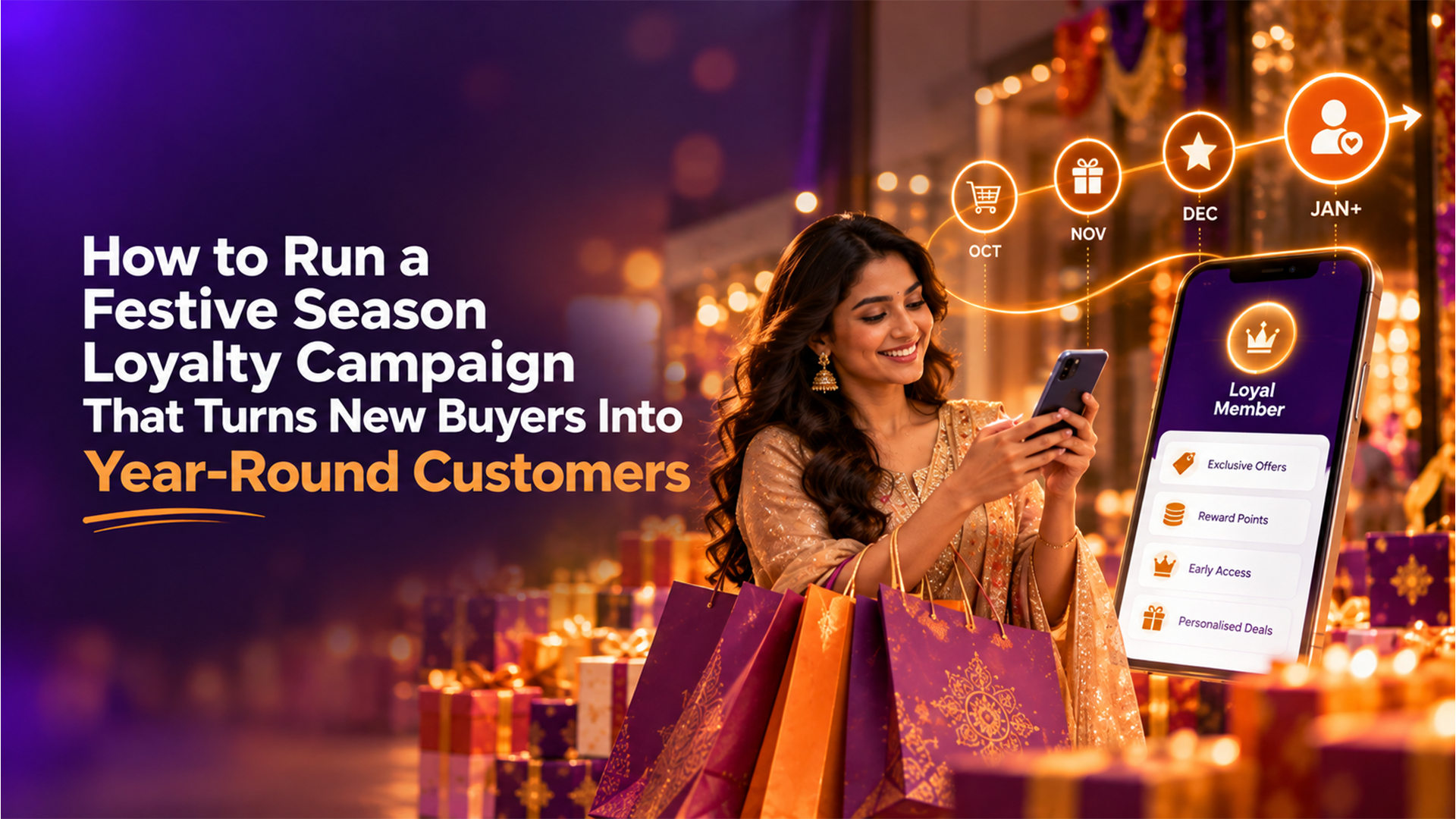
India’s festive season peaks in October–November. January and February are notoriously weak months for most consumer categories. A consumer who reaches Silver tier during the festive window has a concrete reason to maintain their purchase frequency in January: protecting or upgrading their tier status. This tier-anchored retention is far more durable than a seasonal discount. Design the festive season loyalty campaign India as the primary tier-building opportunity, and the tier mechanics will do retention work through the slow months without requiring a separate campaign.
Principle 4: Make the Reward Feel Like the Occasion
A generic points credit on a festive purchase is a loyalty mechanic. An experiential reward that fits the Diwali occasion is a brand memory. 78% of consumers expressed a preference for experiential rewards over mere discounts in 2025. A reward that fits the celebration — a dining voucher for a festive family meal, a movie ticket for a Diwali film night, a wellness credit for the day after the festivities — creates a brand association that a points balance cannot.
Principle 5: Gamify the Journey, Not Just the Reward
Gamification in loyalty programs works during the festive season for a specific reason: the consumer has elevated leisure time, elevated social engagement, and elevated receptivity to brand interactions that feel playful rather than transactional. A festive season loyalty campaign India that includes a “spin the wheel,” a daily puzzle, or a festive quiz, with each interaction earning points toward a meaningful reward, creates the daily brand touchpoint that keeps the loyalty program front of mind through the nine days of Navratri and the buildup to Diwali.
Also Read: Gamification in Loyalty and Promotions: What Works?
By Brand Type: Mechanics That Fit Your Festive Season Loyalty Campaign India
For FMCG brands selling through retail: A QR code on the pack that the consumer scans at the point of purchase to enrol in the loyalty program and earn points on that specific product creates a direct brand-to-consumer relationship without requiring the retailer’s participation. This is the first-party data that most FMCG brands are spending enormously on media to approximate, available as a by-product of a well-designed on-pack loyalty mechanic.
For D2C brands with direct consumer access: Mechanics that work best include a member-exclusive early access window that begins 10 days before the public sale, a points multiplier on purchases during the first 48 hours, a referral mechanic that rewards both the referrer and the new member for bringing someone into the festive season loyalty campaign India, and a post-Diwali “Year-End Status Challenge” that gives members close to a tier threshold a specific target to hit before December 31.
For retail brands and large chains: Use the festive window, when purchase intent and basket size are both elevated, to accelerate member acquisition and tier progression. A consumer who upgrades from Bronze to Gold during Diwali is a meaningfully different customer in February than one who remained at Bronze.
Also Read: How to Plan a High-Impact Consumer Promotion Campaign in India
The First-Party Data Prize in a Festive Season Loyalty Campaign India
Every loyalty interaction during the festive window generates data. Not modelled data or panel estimates. Verified, consented, first-party data from real consumers who just bought a real product: phone number, purchase date, product purchased, reward selected, whether they redeemed, how quickly they redeemed, whether they came back within 30 days.
This data is, commercially, the most durable output of the festive season loyalty campaign India. The sales uplift matters for this quarter. The database matters for every quarter after it. The brand that designs its festive season loyalty campaign India with DPDP compliance built in is simultaneously building a higher-quality data asset, because the consumer who explicitly consents to share their data is a more reliable data point than one whose information was collected through an opaque permissions flow.
Three Metrics That Actually Measure Whether Your Festive Season Loyalty Campaign India Worked
Repeat purchase rate of new festive enrollees at 60 and 90 days. This is the single most direct measure of whether the festive season loyalty campaign India converted acquisition into retention. A new member who bought during Diwali and made a second purchase before January 15 is the outcome the campaign was designed for. Track this cohort specifically and compare it to new buyers who did not enrol.
Average order value: loyalty members versus non-members during the festive window. Loyalty members typically outspend non-members by 31% per purchase. If your festive window data does not show a meaningful AOV difference, either the reward structure is not motivating enough to change spending behaviour, or the member base is not sufficiently segmented from the discount-driven acquisition audience.
Post-festive NPS from enrolled members versus general customers. NPS measured specifically from the festive loyalty cohort, compared to non-member buyers from the same period, is a leading indicator of referral activity and organic brand growth that standard festive post-mortems consistently miss.
The Post-Diwali Retention Window Every Festive Season Loyalty Campaign India Should Use
The consumers who bought during the festive peak are, in the fortnight after Diwali, at their most receptive to a brand communication that acknowledges the festive relationship and extends it into the following months.
A “Year-End Status Push” communication sent to members who are close to their next tier threshold in November activates spending behaviour in the months when most consumer categories slow down, by connecting the purchase incentive to a status the member is already motivated to achieve.
A personalised “Thank You for Your Diwali Loyalty” communication that tells the consumer specifically what they earned, redeemed, and contributed during the festive window, along with a preview of what their loyalty status unlocks in the coming year. 72% of consumers say loyalty programs make them more likely to spend with their preferred brand.
A post-festive referral mechanic targeted specifically at new enrollees who joined during the festive window. A consumer who has just had a positive first loyalty experience is at their highest-ever likelihood to refer someone else to the brand.
Before the Season Begins: What Needs to Be Ready
Most festive season loyalty campaign India executions fail because the mechanics were decided correctly but the infrastructure was not ready in time.
- Is the loyalty enrolment flow the gateway to the offer, or a separate CTA? If separate, redesign before launch
- Is there a segment-specific communication plan for existing members, lapsed members, new acquirers, and gifters? If one message goes to all four, the relevance is wrong for three of them
- Does the reward arrive within 24–48 hours of the qualifying action? If not, the connection between behaviour and reward is too weak to drive repeat behaviour
- Is first-party data being captured at enrolment with DPDP-compliant consent? If not, the data asset is not legally sound
- Is there a post-festive re-engagement plan already designed before the season begins? If not, it will not be built in November when the team is in post-campaign review mode
- Is there a specific metric tracking new festive enrollees at 60 and 90 days post-season? If not, there is no way to know whether the festive season loyalty campaign India actually worked
In Closing

90 million Indian shoppers participated in just the first 11 days of the Diwali 2025 sales window, spending approximately ₹7,000 each on average. The consumer traffic the festive season generates is extraordinary. What the brand does with that traffic, whether it converts it into a one-time transaction or the beginning of a measurable loyalty relationship, is entirely within the brand’s control.
A well-designed festive season loyalty campaign India built around enrolment as the access gate, reward mechanics that incentivise the second purchase, tier design that creates post-festive retention, and first-party data capture that makes next year’s campaign smarter from day one is not a more expensive festive strategy than the discount-led alternative. It is a more productive one.
The festive window opens once a year. The festive season loyalty campaign India builds, when designed correctly, stays open all year round.
Related reads:
- Loyalty Program Best Practices for Retail Brands
- Emerging Trends in Consumer Promotions and Loyalty in 2026
- Gamification in Loyalty and Promotions: What Works?
- Festival Promotion Ideas and Timing Guide
- How to Plan a High-Impact Consumer Promotion Campaign in India
- Festive Trade Loyalty Program India: 7 Proven Strategies
- Navratri Gifting Campaign India: 7 Ideas Beyond the Discount
Planning your festive season loyalty campaign India and want to build the mechanics that convert new buyers into year-round customers? Get in touch with Buyerr to explore consumer loyalty and seasonal campaign solutions. Follow our updates on LinkedIn.