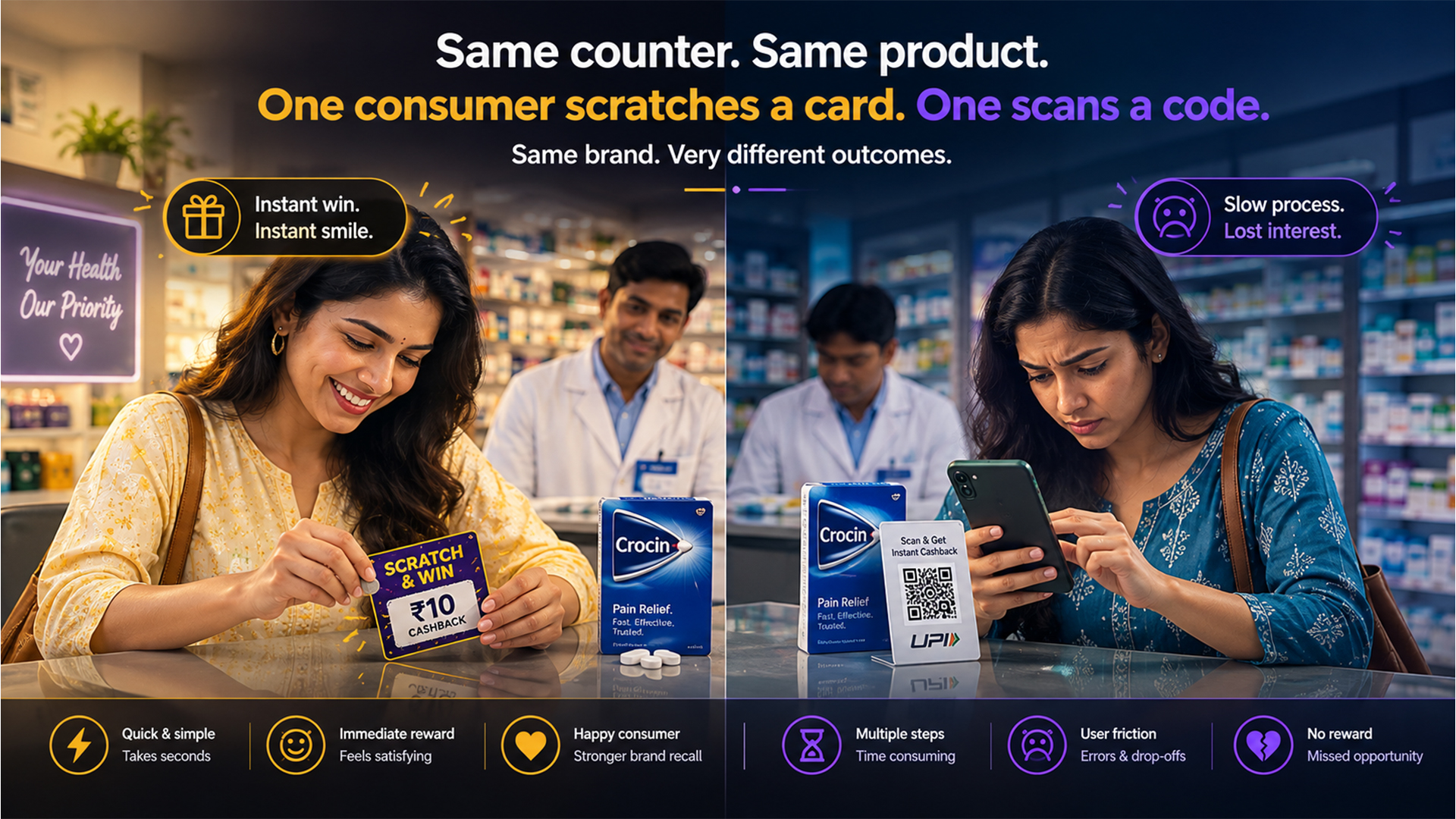
Choosing the right OTC promotion mechanic India brands run at the chemist counter can make the difference between a campaign that changes consumer behaviour and one that disappears into the bag with the purchase. Picture a chemist counter in Lucknow at 11am on a Tuesday. A woman buys a pack of Crocin. The pharmacist drops a scratch card into the bag. She scratches it at the counter. Wins ₹10. Smiles. Leaves.
Now picture the same counter, same product, different mechanic. She scans a QR code on the pack. A page loads slowly. Asks for her UPI ID. She types it wrong. Tries again. Closes the browser. Leaves.
Same consumer. Same OTC product. Two completely different promotion outcomes. This is not a question of which mechanic is better in theory. It is a question of what actually happens when a real consumer tries to use it.
Before we go further, a few relevant resources from Buyerr:
- Consumer Promotions — OTC and pharma campaign solutions
- Cashback and Digital Coupons — Instant UPI reward delivery
- Retail and On-Pack Promotions — Scale across chemist outlets
- Gamified Promotions and Contests
- 1st Party Data and Consumer Insights
You can also explore: How to Calculate Break-Even and ROI for Promotions, Gamification in Loyalty and Promotions: What Works?, and Emerging Trends in Consumer Promotions and Loyalty in 2026.
In this blog: Two consumer journeys. Three real differences. One clear guide for choosing the right OTC promotion mechanic India brands can deploy.
Two Journeys. One Decision.
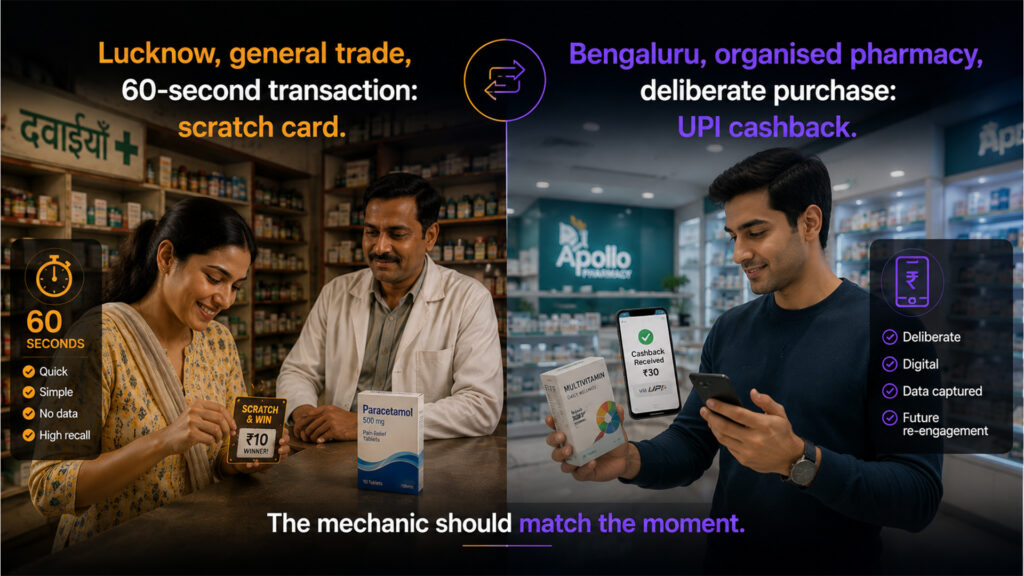
Let us stay in that Lucknow chemist for a moment, because the scratch card scenario above is not a failure story. It is, in fact, a success.
The woman scratched. She engaged. She had an emotion at the point of purchase that she would not have had otherwise. And she is slightly more likely to remember that brand name the next time she is standing at the same counter with a headache. That is the scratch card’s entire value proposition, and it is real.
It does not need connectivity. It does not need a smartphone. It does not require the consumer to trust a brand enough to hand over her phone number. It asks nothing except the willingness to scratch. In a general trade chemist in Lucknow, Gorakhpur, Patna, or a thousand similar markets, that is an enormous advantage. Because 88% of India’s retail pharmacies are unorganised local chemists where the average transaction is brief, the consumer is often in discomfort, and the dwell time before a purchase decision is made is counted in seconds, not minutes.
The scratch card meets this consumer where she is. The right OTC promotion mechanic India brands choose must start with this reality.
Now move the same scenario to a different setting. It is 9pm in Koramangala, Bengaluru. A 28-year-old buys a vitamin supplement from an Apollo Pharmacy. There is a QR code on the pack. He scans it while walking to his car, enters his UPI ID in under 20 seconds, and receives a ₹30 cashback notification before he has reached the parking lot.
He has had a direct brand interaction. He has given the brand his phone number, his UPI ID, and verified proof that he is a real buyer of this specific product in this specific geography. That data does not disappear. It feeds the brand’s next campaign. It tells the marketing team that there is a verified 28-year-old supplement buyer in South Bengaluru who can be re-engaged in four weeks with a follow-up offer. The scratch card cannot do this. It never could.
Also Read: How to Plan a High-Impact Consumer Promotion Campaign in India
3 Differences That Actually Determine the Right OTC Promotion Mechanic India Brands Choose
Here is where most brand planning conversations go wrong: they compare the two mechanics on the wrong variables. They compare prize value. They compare cost per redemption. They compare “excitement.”
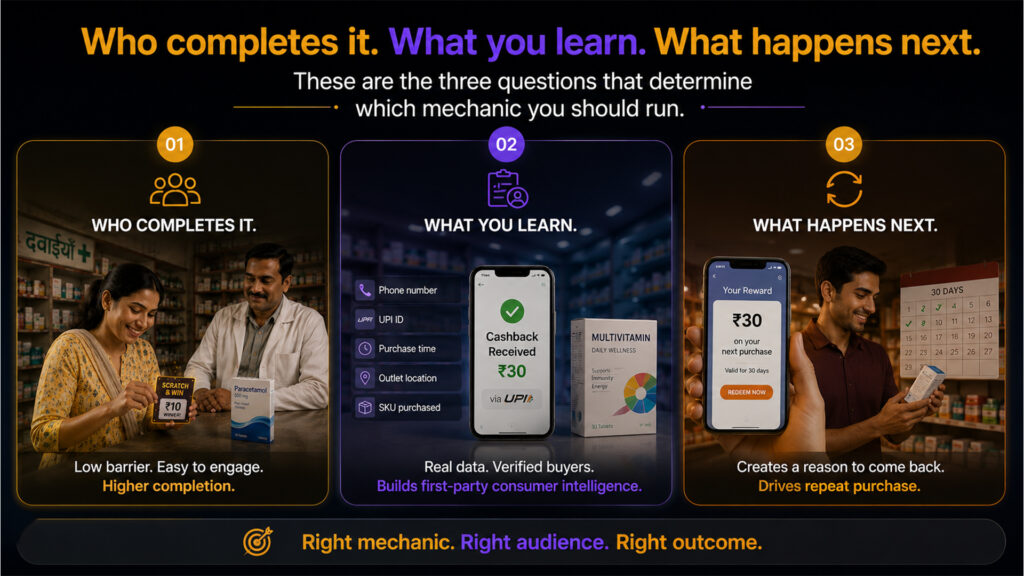
The three differences that actually determine which OTC promotion mechanic India brands should use are: who completes the reward, what you learn from them, and what they do next.
1. Who Completes the Reward
A scratch card is completed by almost everyone who opens the pack and finds one. The barrier is near zero. Scratch it, see the prize, done. A UPI cashback is completed only by consumers who have a smartphone, have UPI installed, are willing to enter their details, and encounter no friction in the loading process. In urban modern trade, this completion rate is high. In semi-urban general trade across India’s 500,000-plus independent chemists, this rate drops sharply.
This is not a criticism of UPI cashback. UPI processed 228.3 billion transactions in 2025, growing 29% year on year, and now accounts for 84% of India’s digital payments. The infrastructure is there. But it is not uniformly there. And an OTC promotion that achieves a 12% redemption rate when it needed 35% to break even has a mechanic problem, not a media problem.
2. What You Learn From Them
A scratch card tells you nothing about the person who used it. Zero. Anonymous. The brand spent money, the consumer received a reward, and the brand knows only that some number of cards were scratched.
A UPI cashback redemption is a data event. Phone number. UPI ID. Purchase timestamp. Outlet location if outlet-mapped. SKU purchased. This is the consumer’s verified identity as a buyer of your product. Run a three-month OTC campaign with 50,000 UPI redemptions and you have a first-party consumer database of 50,000 real, verified buyers who you can re-engage, re-target, and serve better over time.
54% of Indian consumers wait for a promotion before purchasing. The ones who engage with your cashback are telling you exactly who they are and when they buy. That is worth building on.
3. What They Do Next
This is the least discussed and most commercially significant difference. A scratch card interaction is complete the moment the consumer scratches it. There is no thread connecting that moment to the next purchase. The incentive is finished. The engagement is over.
A UPI cashback can be structured with a forward-facing mechanic. Offer ₹15 on the first purchase and ₹30 on the second within 30 days. The consumer who has already completed one claim knows the process, trusts the reward, and has a concrete reason to buy again. This is why UPI cashback mechanics are structurally better at driving repeat purchase, and why scratch cards — despite their emotional advantage at the first purchase — rarely move the needle on repeat behaviour.
Also Read: Gamification in Loyalty and Promotions: What Works?
When to Use Which OTC Promotion Mechanic India Brands Should Choose: No Hedging
Use a Scratch Card If:
- You are launching into Tier 2 and Tier 3 general trade where connectivity is unreliable
- You need to execute quickly, within four to six weeks, without building a digital redemption infrastructure
- Your consumer skews older or less digitally fluent
- Your budget does not accommodate a digital platform
- You want a one-time trial spike and are not prioritising data or repeat purchase
- Your OTC category is bought impulsively — analgesics, antacids, cold relief — where the purchase is brief and emotional rather than considered
Use UPI Cashback If:
- You are running a campaign in urban or semi-urban organised trade
- You need first-party consumer data for future targeting and re-engagement
- You want the promotion to drive a second purchase, not just a first one
- You are launching a new OTC product where the ₹20–30 cashback meaningfully de-risks a consumer’s first trial of an unfamiliar product
- Your category is considered and health-driven — supplements, vitamins, diagnostic products — where the consumer has more time and more deliberate intent
- You want real-time campaign visibility: which geographies are redeeming, which SKUs, at what frequency. A scratch card gives you none of this. A cashback platform gives you all of it
Use Both Simultaneously If:
- You are running a national campaign across geographies with different digital maturity levels
- Design the UPI cashback for organised retail and metro-adjacent general trade
- Design the scratch card for deep Tier 3 and unorganised chemist networks
This is not indecision. It is channel-appropriate execution. The OTC promotion mechanic India brands choose should fit the channel, not the other way around. Many OTC brands that have tried to force a single national UPI mechanic into rural general trade have learned this the expensive way.
One Thing to Try If Budget Allows:
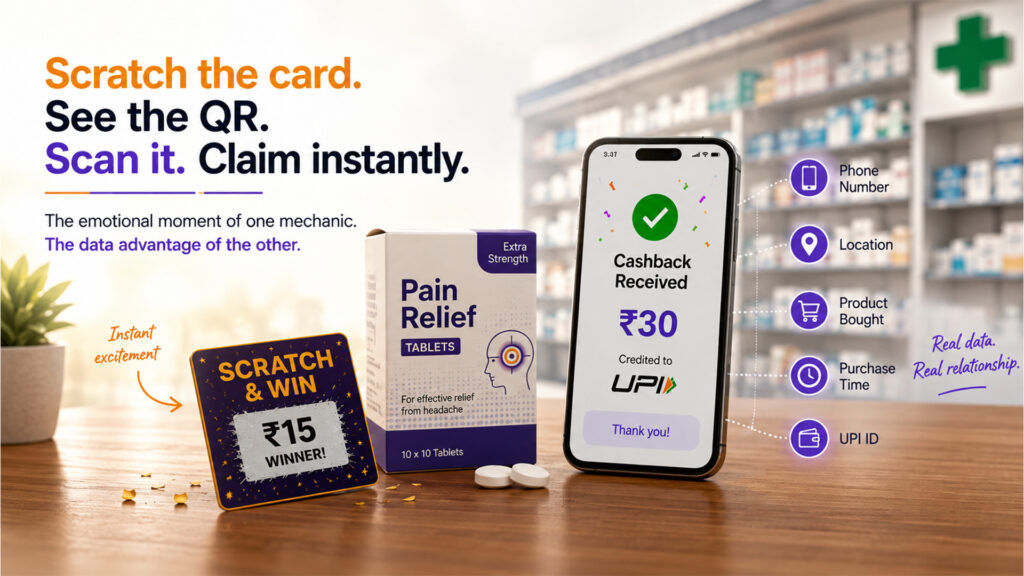
A scratch card that reveals a QR code. The consumer scratches at the counter, gets the excitement of the reveal, and then scans the code to claim digitally. You get the emotional advantage of the scratch at the moment of purchase and the data advantage of the digital claim on the backend. The pack design needs to accommodate it. The claim flow needs to be genuinely simple. But this combination produces outcomes neither mechanic achieves alone.
The OTC market in India is growing at 7.24% CAGR, with brands across categories actively experimenting with mechanic combinations to find what works across India’s heterogeneous retail landscape.
Also Read: How to Calculate Break-Even and ROI for Promotions and Incentives
The Question Nobody Asks, But Should
Most OTC brand teams ask: “Which mechanic will get more redemptions?”
The better question is: “Which OTC promotion mechanic India brands deploy will tell us more about who is buying, so the next campaign is smarter than this one?”
A scratch card optimises the moment. A UPI cashback optimises the relationship. 72% of consumers say a well-designed promotion makes them more likely to buy from that brand again. But the mechanic has to survive the moment first — which is why geography, channel, and consumer profile matter before anything else.
Choose accordingly. And then build on what you learn.
In Closing
The right OTC promotion mechanic India brands choose is not a universal answer. It is a function of the channel, the geography, the consumer, and what the brand needs to learn from the campaign. Scratch cards win in markets where simplicity and immediacy matter. UPI cashback wins where data, repeat purchase, and real-time visibility matter. And the combination wins where budget and campaign architecture allow for both.
Related reads:
- How to Plan a High-Impact Consumer Promotion Campaign in India
- Gamification in Loyalty and Promotions: What Works?
- Emerging Trends in Consumer Promotions and Loyalty in 2026
- How to Calculate Break-Even and ROI for Promotions and Incentives
Deciding on the right OTC promotion mechanic India brands should run for your next campaign? Get in touch with Buyerr to explore consumer promotion solutions that fit your channel. To explore more frameworks, write to us at [email protected] or follow our updates on LinkedIn.