
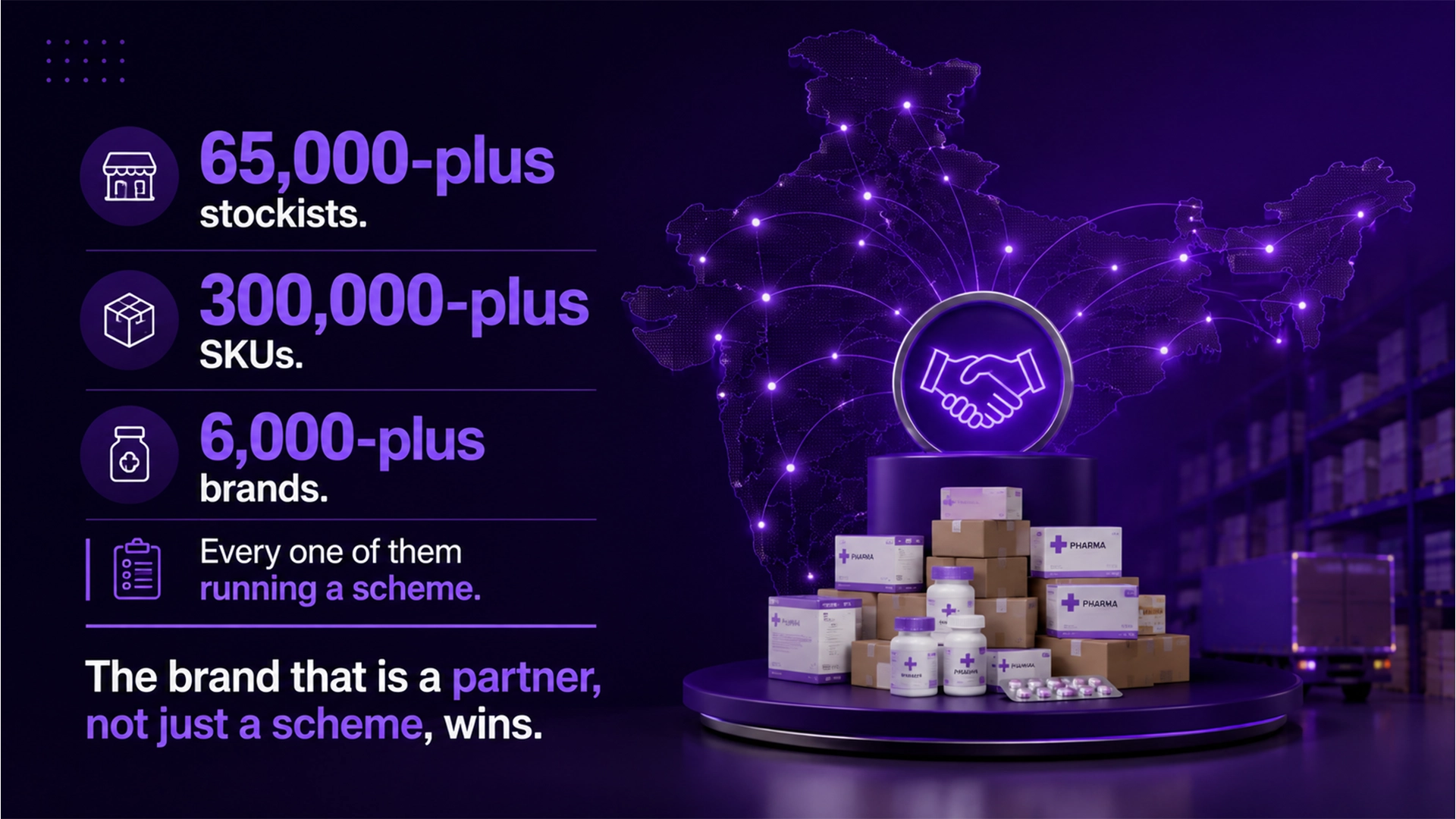
Pharma distributor incentive program India — the stockist is everyone’s target and almost nobody’s genuine partner. India has 65,000-plus stockists handling 300,000-plus SKUs across 6,000-plus brands. The average stockist simultaneously works with anywhere between 5 and 50 different manufacturers. Every one of those manufacturers is running a scheme. Every one of them wants to be the stockist’s priority SKU when a retailer calls. And almost all of them are trying to achieve that through some variation of the same tool: a margin arrangement and a quarterly volume scheme.
The brand that changes this dynamic — by designing a pharma distributor incentive program India stockists see as a structured commercial partnership rather than a margin arrangement — earns a disproportionate share of loyalty in a market saturated with undifferentiated schemes.
This is a practical planning guide for doing exactly that. Not a conceptual argument for why incentives matter, but a walkthrough of how to design a stockist and distributor incentive program that changes actual channel behaviour, rewards the right activities, and produces commercial outcomes that a flat margin scheme cannot.
Before we get into this, here are a few relevant resources from Buyerr:
- Trade Promotions — Incentive design for pharma channel partners
- Channel Partner Program — Structured distributor and stockist loyalty
- Loyalty Solutions — Channel loyalty architecture for pharma brands
- Rewards and Incentives — Digital reward disbursement at scale
- Cashback and Digital Coupons — Instant UPI reward delivery
You can also explore: Motivating Channel Partners: Incentives and Training, Trade Promotion Strategies That Move Inventory, How to Calculate Break-Even and ROI for Promotions, and Loyalty Program Best Practices for Retail Brands.
What we’ll cover in this blog:
- Why the stockist is pharma’s most contested and least differentiated channel relationship
- Why most distributor incentive programs produce compliance, not advocacy
- The slab-based incentive structure that actually changes distributor behaviour
- What to incentivise beyond volume
- How to design for India’s geographic diversity
- What a working program looks like in measurement
- A quick pre-launch checklist
1. Why the Stockist Is Pharma’s Most Contested Channel Relationship
The stockist sits at the most commercially significant inflection point in the entire Indian pharma distribution chain. They receive stock from the manufacturer through the C&F agent, extend credit to retailers, manage returns and expiries, and determine — in the daily flow of retailer orders — which products get prioritised, which brands get pushed when a generic alternative exists, and which SKUs end up in the back of the warehouse waiting for the next field representative’s visit.
Sales, promotion, and distribution costs constitute as much as 8% of revenue for India’s pharma companies. A significant portion of that investment flows toward the stockist and distributor network. And yet, despite this investment, a BI WORLDWIDE India and KANTAR study found that two-thirds of pharma channel partners in India feel “trapped” in their brand relationships, remaining not out of loyalty but out of the absence of a better alternative.
Feeling trapped is not the same as being loyal. A stockist who prioritises your brand because they have no compelling reason to switch is one competitive scheme away from changing their behaviour entirely. A stockist who prioritises your brand because your channel partner program genuinely rewards their performance, recognises their consistency, and gives them a transparent commercial relationship is a structurally different kind of partner.
The organised stockist segment currently commands 10% of India’s pharma distribution market share and is projected to grow to 25–30% by 2030. As organised stockists grow, the sophistication of the incentive programs that engage them needs to grow with them. A flat quarterly scheme designed for an unorganised, relationship-based stockist network will not hold the attention of a professionally managed distribution operation that tracks its own margin analytics and compares incentive structures across its manufacturer portfolio.
Also Read: Motivating Channel Partners: Incentives and Training

2. Why Most Pharma Distributor Incentive Programs Produce Compliance, Not Advocacy
Only 19% of pharma companies globally say their current incentive compensation plans are highly effective. An extraordinary 89% are actively redesigning them. The redesign imperative is real and urgent. The question is what most brands are redesigning toward, and whether the new design will produce meaningfully different outcomes.
Most pharma distributor incentive programs India brands run share three structural limitations that prevent genuine channel advocacy.
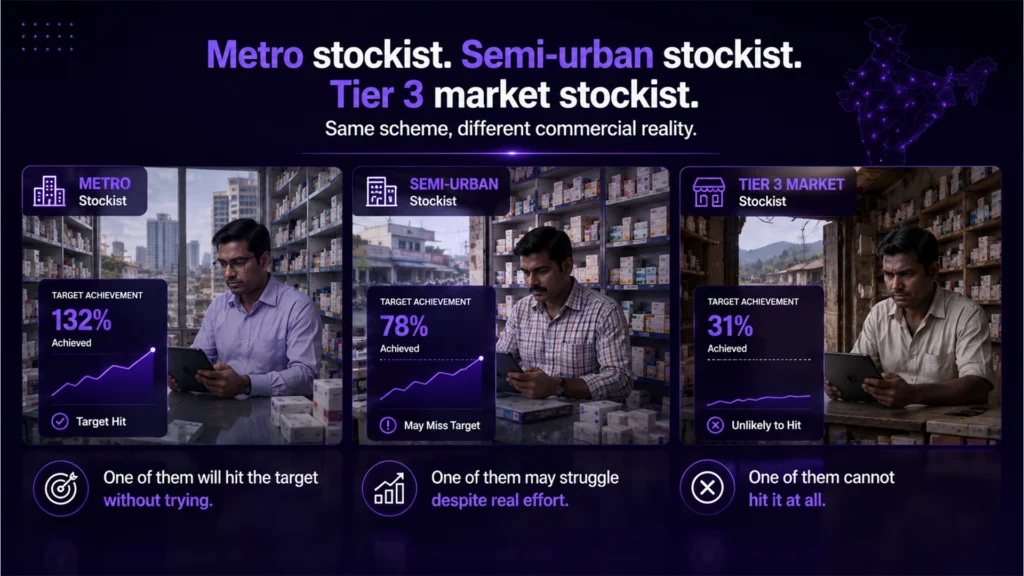
Uniform targets across heterogeneous geographies. India’s pharma market is not one market. The product mix, price sensitivity, doctor engagement dynamics, and retail density in a semi-urban district in Rajasthan are structurally different from those in a well-penetrated urban market in Pune. A national scheme that sets identical targets for both creates a dynamic where the urban stockist consistently hits their target without meaningfully changing behaviour, while the Rajasthan stockist consistently misses targets despite strong effort and execution. Over time, this disengages exactly the network the brand needs to build in growth markets.
Volume-only incentive logic. A scheme that rewards only total purchase volume tells the stockist one thing: order more. It does not tell them which SKUs to push, which retailers to develop, which new geographies to open, or how to prioritise between competing brands when a retailer places a mixed order. Volume-only incentives produce higher primary sales without necessarily improving secondary sales, retail penetration, or SKU mix. The commercial outcome that matters — product moving from retailer to patient — is entirely outside the incentive’s scope.
Deferred and opaque reward settlement. Pharma retailers enjoy 16–22% margin on branded medicines, and stockists operate on similarly thin margins with 30–45 day credit cycles as the norm. In this margin environment, a quarterly scheme that settles weeks after the period closes creates a reward experience that is too delayed to change in-period behaviour. The stockist cannot adjust their prioritisation decisions based on a reward they will receive in three months.
Also Read: Trade Promotion Strategies That Move Inventory
3. The Slab-Based Incentive Structure That Actually Changes Distributor Behaviour
A slab-based pharma distributor incentive program India brands can sustain moves beyond flat schemes by creating a tiered structure where the reward rate increases as the distributor crosses successive performance thresholds. The principle is straightforward: the first slab covers baseline behaviour, the second rewards incremental effort, and the third rewards exceptional performance. Each threshold is set relative to the individual stockist’s historical baseline rather than a national planning average.
Slab 1: Base participation. The stockist achieves their historical average purchase volume for the quarter, adjusted for any known market changes. This slab earns a basic reward rate — cashback as a percentage of qualifying purchases, or a fixed point value per unit. The threshold is achievable for the broad base of the network. Its purpose is to capture participation, not to drive incremental volume. Without a Slab 1 threshold that the majority of stockists can reach, the program immediately loses the mid-tier network that most brands need to engage before the high performers.
Slab 2: Incremental push. The stockist achieves 115–120% of their historical baseline across the full qualifying SKU set. This slab earns a meaningfully higher reward rate — typically 1.5 to 2 times the Slab 1 rate. The threshold is achievable with conscious effort: the stockist needs to actively push the brand’s products at retail, prioritise the brand in mixed retailer orders, and avoid stock-outs. This slab is where the trade promotion produces genuinely incremental volume, because it requires behaviour change rather than simply continuing existing purchasing patterns.
Slab 3: Advocacy and growth. The stockist achieves 130–140% of baseline, expanded retail coverage, and minimum volume across all focus SKUs. This slab earns the highest reward rate and may include experiential rewards, recognition, or exclusive access benefits alongside the financial incentive. The experiential rewards at this tier — recognition at a brand event, priority access to new product launches, exclusive training or certification — serve a different function than the cashback in lower slabs. They create an emotional association with the brand that purely transactional rewards cannot produce.
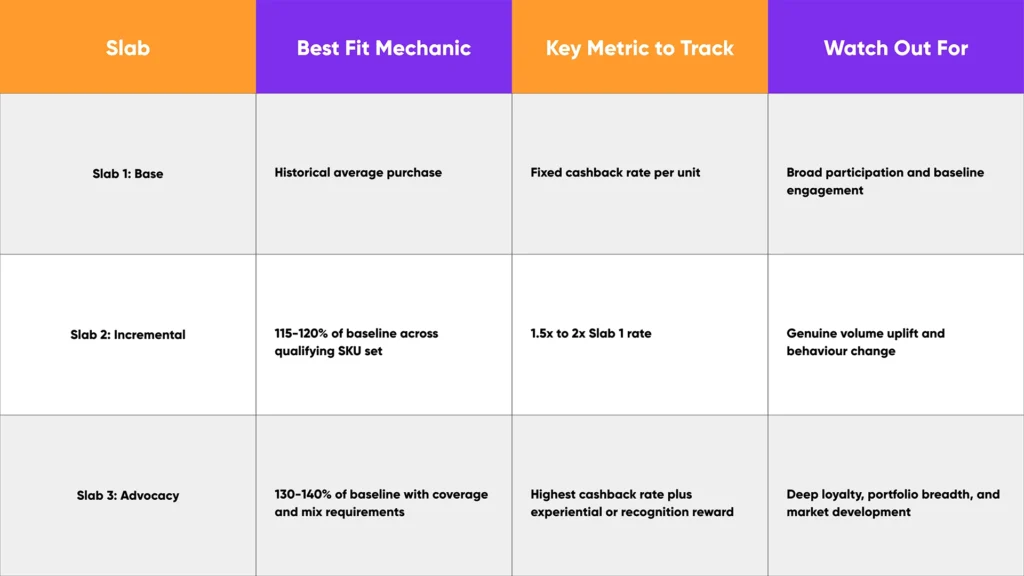
The critical design principle: every threshold must be set from individual stockist historical baselines, not from national planning targets. A slab structure calibrated to what a stockist has actually demonstrated they can achieve produces a program that is simultaneously more motivating and more commercially efficient.
4. What to Incentivise Beyond Volume
Total purchase volume is the easiest metric to incentivise and often the least useful one to optimise in isolation. A stockist who increases primary purchase volume without improving secondary sales is loading inventory, not building market presence. The most effective pharma distributor incentive program India deployments reward three behaviours beyond volume that directly drive commercial outcomes.
Outlet expansion. A stockist who adds verified new retail outlets to their active distribution base is growing the brand’s market reach in a way that volume alone cannot measure. Incentivising net new outlet additions — defined as chemists who purchase at least twice in a 90-day window — with a tiered reward per outlet added and retained, drives geographic penetration that compounds over multiple scheme cycles.
SKU portfolio breadth. A stockist who sells across the full qualifying SKU range is a more resilient commercial partner than one who sells one SKU in high volume. When that one SKU faces a competitive promotion or a supply disruption, the single-SKU stockist’s value drops to near zero. Portfolio breadth requirements within the slab structure — where Slab 3 requires minimum volume across defined SKU categories — incentivise the stockist to develop the full range rather than concentrating on their easiest-selling product.
Training and product knowledge participation. A stockist who understands the clinical and commercial positioning of the brand’s key products is a more effective advocate with retailers. Rewarding participation in product knowledge sessions, digital training modules, or certification programs within the loyalty program structure creates a knowledge asset that compounds across every retailer interaction the stockist has. This is particularly important for OTC and branded generic categories where the stockist’s recommendation influences the chemist’s stocking and dispensing decisions.
Also Read: How to Calculate Break-Even and ROI for Promotions and Incentives
5. How to Design for India’s Geographic Diversity
India’s pharma distribution landscape is not uniform, and a pharma distributor incentive program India brands apply that ignores this produces exactly the inequity and disengagement that static national schemes have been producing for decades.
Market maturity variation. A stockist in a well-penetrated metro territory operates in a market with dense retail coverage, high prescription volumes, and significant competition from other stockists carrying the same brand. A stockist in a developing semi-urban market in Tier 2 or Tier 3 India operates with lower retail density, lower prescription volumes, and often more exclusive arrangements with the brand. Setting identical slab thresholds for both misaligns the incentive with the commercial reality. Target calibration from historical baselines at the territory level, rather than national averages, is the minimum requirement for geographic equity.
Monsoon and seasonal variation. India’s pharma category is significantly seasonal. Anti-infective volumes spike in monsoon. Cardiovascular and respiratory products have distinct winter patterns. A scheme that runs uniformly across four calendar quarters without accounting for seasonal demand patterns will systematically reward stockists in high-season quarters and penalise them in low-season ones, regardless of their actual effort or performance relative to market conditions.
Regulatory variation by state. India’s pharmaceutical distribution environment varies significantly across states: pricing controls, association-mandated commissions on new launches, drug licensing requirements, and GST compliance complexity all differ. A distributor incentive program that does not account for state-level regulatory context will create compliance risks that the brand’s legal and finance teams will flag before the first scheme disbursal. In many states, new product launches require commissions to chemist associations before the product can be made available in pharmacies. These structural costs need to be factored into the incentive’s financial model before the program is designed.
Buyerr’s channel partner loyalty architecture is built to handle this geographic complexity, enabling territory-level target calibration, state-specific scheme variations, and real-time reward tracking across a distributed stockist network without requiring the brand’s trade marketing team to manually manage 65,000 individual relationships.
6. What a Working Pharma Distributor Incentive Program Looks Like in Measurement
The metrics that most pharma brands track for their distributor incentive programs — total primary sales and scheme claim rates — measure scheme participation. They do not measure whether the program is producing the commercial outcomes it was designed for.
A working pharma distributor incentive program India brands should benchmark produces measurable changes in four areas that primary sales data alone cannot reveal.
Secondary sales velocity by territory. Program-enrolled stockists should show measurably faster secondary sales velocity than non-enrolled stockists in comparable territories. If enrolled stockists are buying more from the brand but secondary sales are not improving, the program is incentivising loading rather than sell-through. This distinction is the most important commercial diagnostic for any pharma incentive program.
SKU mix improvement. The proportion of enrolled stockists achieving Slab 3 portfolio breadth requirements should increase over successive scheme cycles. If the portfolio breadth metric is static, the slab structure’s mix incentive is not working and needs to be recalibrated.
New outlet additions by enrolled stockists. The number of verified new retail outlets added by program participants, measured quarterly, is a direct read on whether the outlet expansion mechanic is driving genuine market development or just being claimed on outlets that were already active.
Slab progression rates. The proportion of enrolled stockists moving from Slab 1 to Slab 2 across successive quarters is the leading indicator of engagement quality. A program where 80% of participants sit permanently in Slab 1 has calibrated its Slab 2 threshold too high or its Slab 1 reward too generously. Promotion ROI analytics that track slab progression alongside commercial outcomes allow the brand to recalibrate thresholds mid-program rather than waiting for the post-cycle debrief.
Additionally, every stockist interaction in a well-designed program generates first-party channel data: territory performance, SKU movement patterns, outlet-level engagement, and stockist purchase behaviour. Brands that build structured data capture into the incentive program architecture come out of each cycle with a commercial intelligence asset that feeds the next program’s design. Instant UPI cashback disbursement creates a direct feedback loop between qualifying behaviour and visible reward — which is what makes the data meaningful in real time.
Also Read: Loyalty Program Best Practices for Retail Brands
7. Before Your Pharma Distributor Incentive Program Launches: Quick Checklist
- Are targets set from individual stockist historical baselines or from national planning assumptions? If national, recalibrate before the program goes live
- Does the slab structure reward behaviour beyond total purchase volume? If not, add outlet expansion and SKU mix requirements to Slab 2 and Slab 3
- Are geographic and seasonal variations built into the target structure? If not, the program will systematically advantage some markets and disadvantage others
- Does the reward arrive within the scheme period or after it closes? If after, the reward cannot influence in-period behaviour. Move to real-time or milestone-based disbursement
- Is secondary sales data being used to validate scheme claims? If only primary sales are tracked, the program is measuring the wrong commercial outcome
- Does the program include non-volume incentive elements? Training participation, outlet expansion, and product knowledge all belong in a well-designed slab structure
- Is there a digital wallet or real-time progress tracker for the stockist? If not, the stockist cannot make in-period decisions based on their scheme status
In Closing
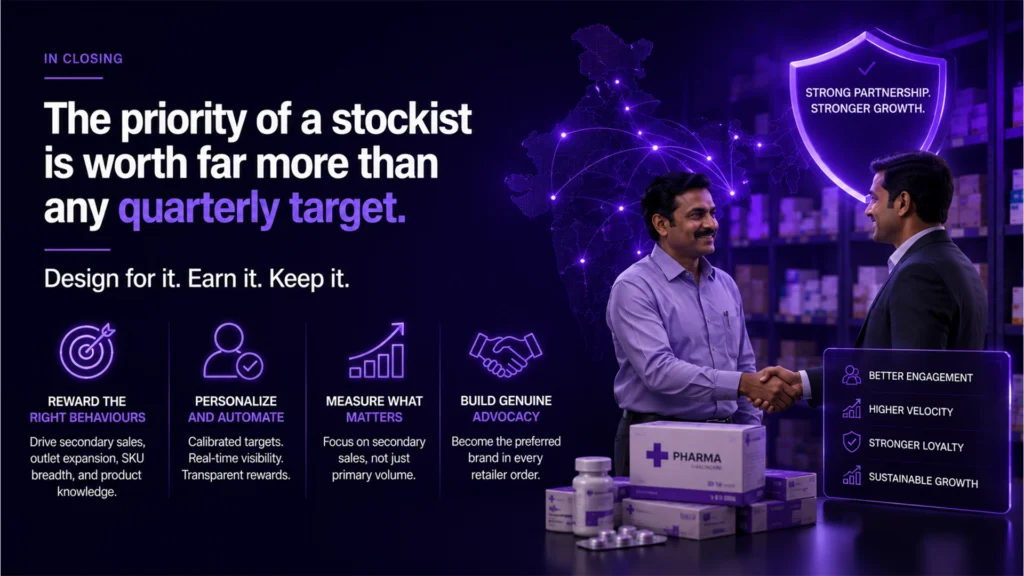
India’s pharma stockist network is one of the most commercially significant and most consistently underinvested channel relationships in any industry. 65,000-plus stockists simultaneously handle products from dozens of manufacturers, all running versions of the same scheme, all competing for the same stockist attention, and almost none of them building the kind of differentiated commercial relationship that produces genuine advocacy rather than passive compliance.
A well-designed pharma distributor incentive program India brands build using slab-based mechanics is not a more expensive version of a flat scheme. It is a structurally different approach that connects rewards to the specific behaviours that drive commercial outcomes: secondary sales velocity, outlet expansion, SKU portfolio breadth, and product knowledge depth. When it is calibrated from individual baselines, delivered with real-time visibility, and measured against secondary rather than primary sales, it changes how the stockist prioritises the brand in the daily flow of retailer orders.
That priority is worth far more than any quarterly volume threshold. And it is available to the pharma brand willing to design for it.
If you found this useful, these related reads may also be worth your time:
- Motivating Channel Partners: Incentives and Training
- Trade Promotion Strategies That Move Inventory
- How to Calculate Break-Even and ROI for Promotions and Incentives
- How Promotion ROI Analytics Helps Boost Your Campaign Performance
- Loyalty Program Best Practices for Retail Brands
- Gamification in Loyalty and Promotions: What Works?
Want to design a pharma distributor incentive program India stockists that produces genuine channel advocacy rather than passive compliance? Get in touch with Buyerr to discuss your program design. To explore more frameworks, write to us at [email protected] or follow our updates on LinkedIn.