
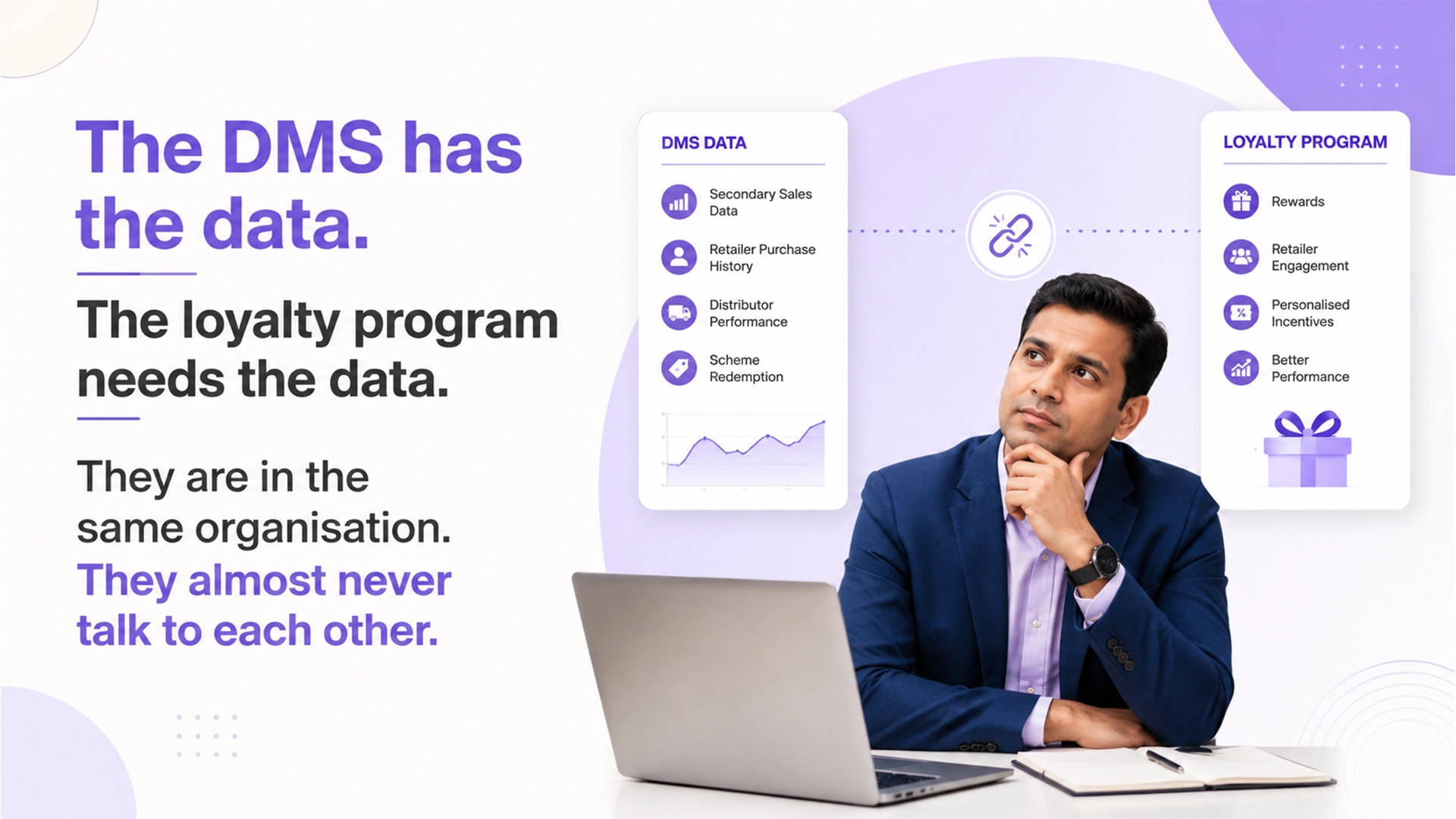
Pharma DMS retailer loyalty program India — the data to build it is already sitting inside your organisation. The DMS runs continuously, collecting secondary sales data, outlet-level purchase history, distributor performance, and scheme redemption patterns. It contains, in most mid-to-large pharma companies, everything needed to design a retailer loyalty program that is targeted, automated, and genuinely responsive to actual channel behaviour.
The paradox is that most pharma companies run their retailer loyalty programs on spreadsheets, field force manual tracking, and quarterly settlement cycles, while the data infrastructure that could power something far more effective sits two departments away and is used primarily for compliance reporting and MIS decks.
This is not a data problem. It is a connection problem. And this blog is about how to close it.
Before we get into this, here are a few relevant resources from Buyerr:
- Channel Partner Program — DMS-connected retailer loyalty
- Trade Promotions — Automated incentive design for pharma channels
- Loyalty Solutions — Channel loyalty architecture for pharma
- Rewards and Incentives — Digital reward disbursement at scale
- Cashback and Digital Coupons — Instant UPI reward delivery
You can also explore: Motivating Channel Partners: Incentives and Training, Trade Promotion Strategies That Move Inventory, and Loyalty Program Best Practices for Retail Brands.
1. What Your DMS Already Knows About Your Retailers
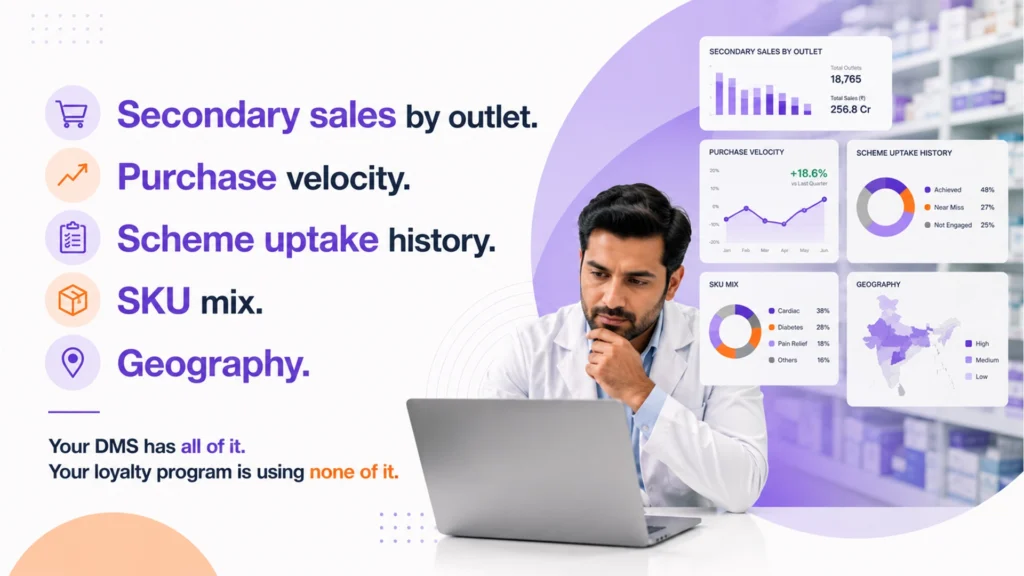
Before designing any pharma DMS retailer loyalty program India brands can sustain, it helps to inventory what the DMS is already capturing. In most pharma companies with a functional DMS implementation, the system holds:
Secondary sales data by outlet. Which retailer bought what, in what quantity, from which distributor, on which date. This is not an estimate or a model. It is a transaction record. For loyalty program design, this is the most valuable data type in the system because it tells the brand exactly which outlets are active buyers, at what frequency, and across which SKUs.
Purchase velocity and trend data. Whether a particular outlet is buying more, less, or the same compared to the previous quarter. A retailer whose purchase velocity is declining is a loyalty risk. One whose velocity is accelerating is a loyalty opportunity. Both signals are in the DMS. Neither is currently being used by most loyalty programs.
Scheme uptake and redemption history. Which retailers participated in the last scheme, what targets they hit, which ones fell just short, and which ones did not engage at all. This data is essential for calibrating the next scheme’s thresholds. Setting targets based on this history produces a program that is achievable for the broad middle of the network, not just the top 20%.
SKU-level purchase mix. What each outlet is buying across the brand’s portfolio. A retailer buying one SKU in high volume and ignoring the rest is a different engagement profile from one buying across the range. Portfolio breadth is often a better predictor of genuine retailer loyalty than total purchase volume.
Geographic and outlet-type segmentation. Which markets, outlet sizes, and distributor territories are generating the most reliable secondary sales. This segmentation is the foundation of any loyalty program that does not want to apply a uniform national structure to a deeply heterogeneous retailer network.
All of this exists in the DMS. The question is what connects it to the loyalty program mechanics on the other side.
Also Read: Motivating Channel Partners: Incentives and Training
2. What Most Pharma Companies Are Doing With It Instead
India’s pharma market is projected to reach USD 79.74 billion by 2031 at 5.74% CAGR, with retail pharmacies accounting for 64.57% of all pharma sales in 2025. The scale of the retailer network that pharma brands need to engage is enormous, distributed across hundreds of geographies, and overwhelmingly unorganised.
Managing engagement across this network with manual processes is not just inefficient. It is structurally incapable of producing the kind of personalised, data-responsive loyalty that builds genuine retailer stickiness.
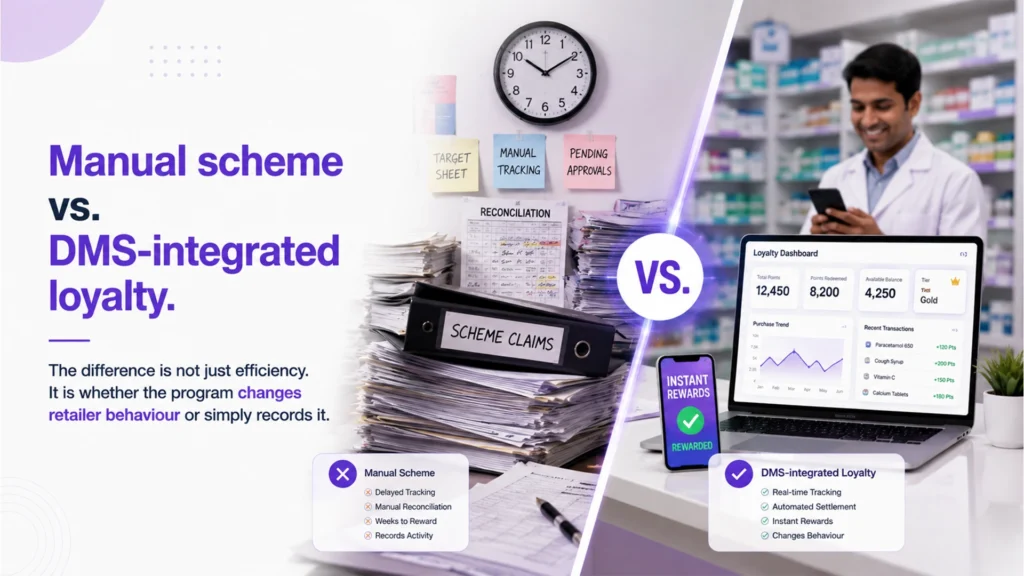
And yet, this is what most pharma loyalty programs look like in practice: a quarterly scheme designed by the trade marketing team using last year’s targets as a reference point. The scheme is communicated to distributors, who pass it to retailers via field representatives. Retailers who hit their targets report their purchases, sometimes manually via invoice submission. The brand’s team reconciles the claims at the end of the quarter, calculates points or cashback, and disburses rewards through a cheque or bank transfer that arrives weeks after the quarter has closed.
This process has three structural problems. First, it is entirely backward-looking. Second, it creates a lag between what the retailer does and what they receive, which weakens the cause-and-effect relationship that loyalty mechanics depend on. Third, it treats every retailer identically, applying the same target structure to a 200-chemist urban pharmacy chain and a single-owner rural medical store in the same district.
A study by BI WORLDWIDE India and KANTAR found that two-thirds of pharma channel partners in India feel “trapped” in their brand relationships, remaining not out of loyalty but out of the absence of a better alternative. Manual, undifferentiated schemes are a significant contributor to this dynamic. A retailer who receives the same scheme as every other retailer in their district, settled weeks after the quarter closes, is not a loyalty program participant. They are a scheme claimant.
Also Read: Trade Promotion Strategies That Move Inventory
3. What a Pharma DMS Retailer Loyalty Program Actually Looks Like
The shift from a manual retailer scheme to a pharma DMS retailer loyalty program India brands can scale is not primarily a technology change. It is a design change, enabled by technology. The DMS provides the data. The loyalty platform provides the mechanics. The connection between them is what creates the program.
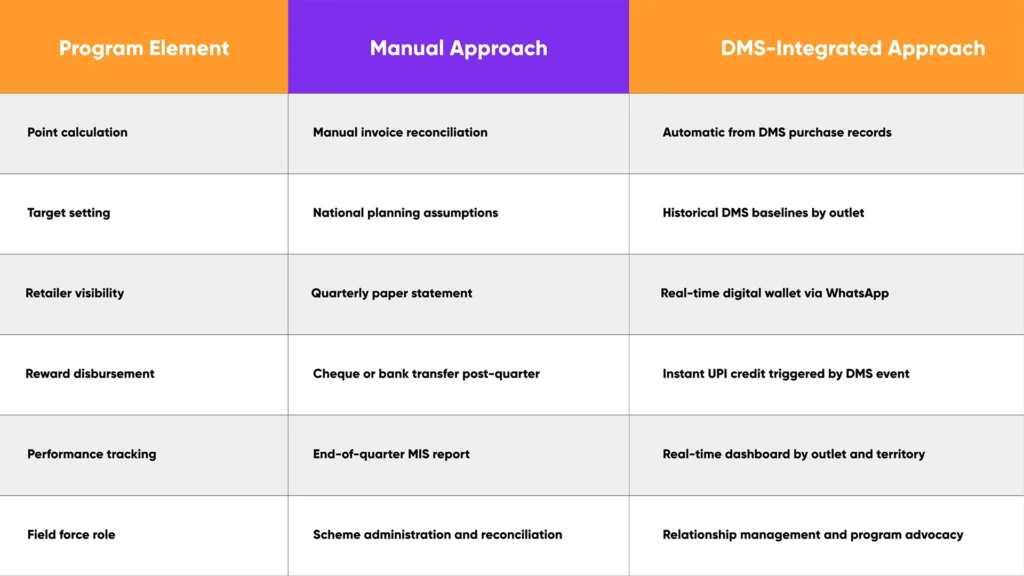
Automatic point calculation based on purchase records. Instead of waiting for retailers to submit invoices or for field force to reconcile claims, the loyalty program reads purchase records directly from the DMS. When a retailer’s order is processed through the distribution system, the loyalty platform automatically calculates the points earned based on pre-set rules: purchase value, specific SKUs, target thresholds, or a combination. Zero manual tracking. Zero reconciliation lag. The retailer’s digital wallet is updated as the purchase is recorded, not four weeks after the quarter ends.
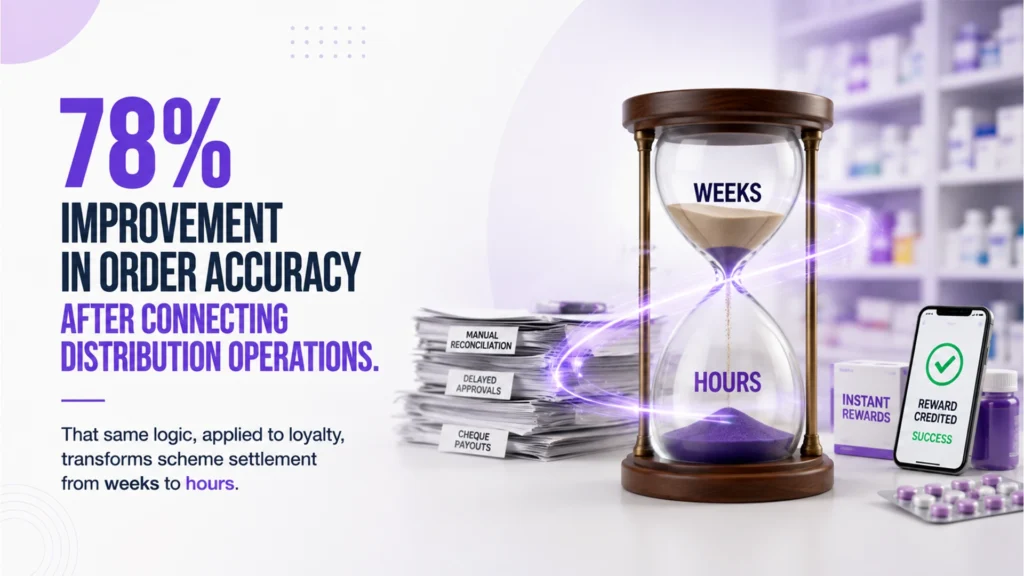
FDC, the makers of Electral, demonstrated this logic at scale through their distribution digitisation program, achieving 78% improvement in order accuracy after connecting their distribution operations through an integrated DMS and dealer portal. The same principle, applied to loyalty point calculation and redemption, transforms the retailer’s program experience from opaque and deferred to transparent and immediate.
Territory-calibrated targets from DMS baselines. Because the DMS holds historical secondary sales data by outlet and territory, target-setting for the loyalty program can be based on what each retailer has actually demonstrated they can achieve, not on what the national plan requires. A retailer who has consistently purchased at 80% of the district average over three quarters gets a target calibrated to that baseline plus a realistic stretch. This is not possible with a manual program. It is routine with a DMS-integrated one.
Real-time wallet visibility for the retailer. A retailer who can see their current point balance, their progress toward the next reward tier, and their purchase history in a digital wallet, accessible via WhatsApp or a lightweight web interface, has a fundamentally different relationship with the program than one who receives a paper statement quarterly. The retailer checks their wallet. They see they are 15% away from their next milestone. They make a purchase decision with that milestone in mind.
Automated reward disbursement triggered by DMS events. When the DMS records that a retailer has crossed a reward threshold, the loyalty platform triggers the reward instantly: UPI cashback credited to the retailer’s account, a digital voucher delivered via WhatsApp, or a merchandise reward initiated through the fulfilment system. The reward arrives in the retailer’s account within hours of the qualifying purchase, not weeks later. India’s loyalty program market is growing from USD 4.3 billion in 2025 to USD 17.1 billion by 2035 at 16.1% CAGR, driven precisely by this shift toward instant, digital, data-triggered reward experiences.
4. The Four Integration Points That Make a Pharma DMS Retailer Loyalty Program Work
A pharma DMS retailer loyalty program connects at four specific points in the distribution data flow. Getting each of these right determines whether the integration produces a working program or an expensive pilot.
Integration Point 1: Purchase data flow. The DMS records every secondary sales transaction. The loyalty platform needs to read these records in near real-time, or at minimum with a daily sync, to calculate points and update retailer wallets without manual intervention. The data field requirements are minimal: outlet identifier, purchase value, SKU codes, date, and distributor identifier.
Integration Point 2: Target and scheme configuration. The loyalty platform should pull target baselines from the DMS historical data, not receive them as a manual input from the trade marketing team. This ensures targets are calibrated to actual performance rather than planning assumptions, and it allows the program to update targets dynamically when market conditions change.
Integration Point 3: Retailer identity and wallet. Every retailer in the DMS network needs a corresponding digital identity in the loyalty platform, linked by a unique outlet identifier. The retailer’s wallet shows their current balance, recent transactions, tier status, and available rewards. This identity becomes the brand’s direct relationship with the retailer, independent of the distributor.
Integration Point 4: Reward disbursement trigger. When the DMS records a purchase that crosses a reward threshold in the loyalty platform, the disbursement is triggered automatically. The field representative does not need to be involved in the reward process. Their role shifts to relationship management and program promotion, not scheme administration.
5. What the Connected Program Produces
Beyond the retailer experience improvements, a pharma DMS retailer loyalty program India brands integrate produces commercial outcomes that a manual program structurally cannot.
Incremental purchase behaviour, not just reward claiming. When the reward arrives within hours of a qualifying purchase, and when the retailer can see their wallet progress in real time, the mechanic influences purchase decisions before they happen, not after. A retailer who is tracking their wallet and sees they are close to a milestone makes a different order decision than one who does not know their status until the quarterly statement arrives. This is the difference between a program that rewards existing behaviour and one that changes it.
Territory-level performance intelligence. The DMS integration means every loyalty program interaction is also a data event: which outlet earned points, for which SKU, in which territory, at what frequency. Aggregated across the network, this creates a real-time map of retailer engagement that is far more granular than any secondary sales report. Field force deployment, scheme calibration, and new product launch targeting all become more precise when this data feeds the planning process.
Reduced scheme cost for the same or better engagement outcome. A targeted program that rewards the right retailers at the right threshold, calibrated to their actual purchasing baseline, spends less on rewards for behaviour that would have happened anyway and more on incentivising genuinely incremental volume. This is the commercial efficiency argument for DMS integration that goes beyond the engagement experience: it makes the scheme budget work harder.
A first-party retailer database the brand actually owns. Every retailer who interacts with the digital wallet, redeems a reward, or checks their balance has provided verified contact information, transaction data, and engagement preferences. In a market where digital tools and automation are rapidly reshaping pharma distribution, this direct relationship is a durable commercial asset.
Also Read: Loyalty Program Best Practices for Retail Brands
6. Before You Build: A Quick Pre-Integration Checklist
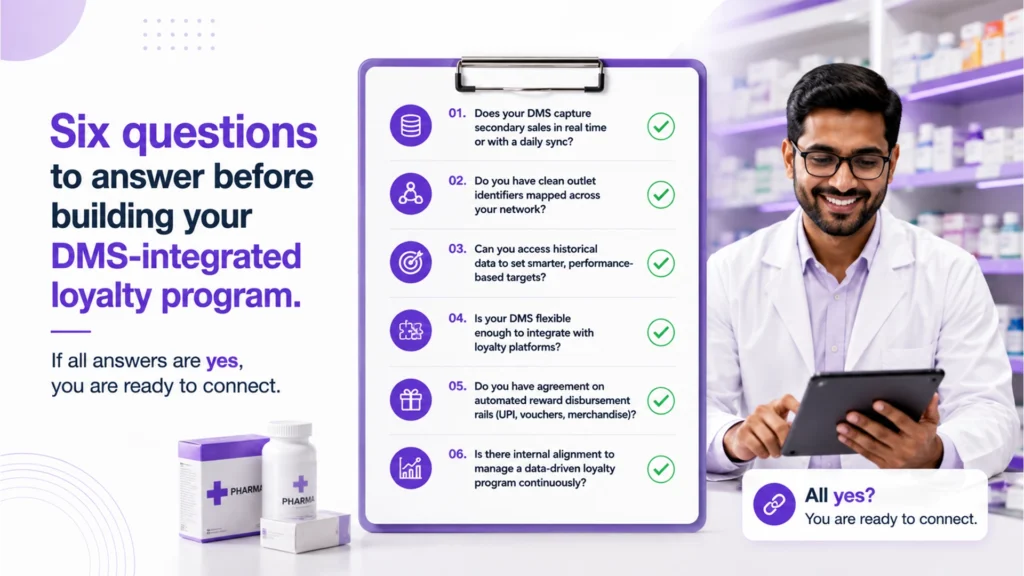
Before investing in a pharma DMS retailer loyalty program India integration, these six questions tell you whether the foundation is ready:
- Is your DMS capturing secondary sales at the outlet level in near real-time? If yes, the primary data feed for the loyalty program already exists
- Does each outlet in your DMS network have a unique identifier? If yes, this becomes the loyalty wallet anchor
- Are your current scheme targets set from national planning assumptions or from outlet-level historical baselines? If the former, the DMS can immediately improve target calibration
- How long does your current reward settlement take from quarter-end to retailer receipt? If more than 14 days, instant digital disbursement is a significant engagement upgrade
- Do your field representatives spend time on scheme administration and reconciliation? If yes, DMS integration frees that time for relationship management
- Do you have a direct communication channel to your retailer network that does not go through the distributor? If no, the digital wallet creates one
In Closing
The data is not the problem. The DMS is already collecting it. The problem is that most pharma companies have not connected the intelligence inside their distribution system to the engagement mechanics that are supposed to drive retailer loyalty.
A pharma DMS retailer loyalty program India brands build on this infrastructure closes that gap. It converts raw secondary sales data into automatic point calculations, real-time wallet updates, calibrated targets, and instant reward disbursement. It replaces a process that requires weeks of manual work with one that runs continuously, responds in real time, and produces outcomes — incremental purchase, genuine retailer engagement, and direct brand-to-retailer relationships — that the manual approach cannot achieve regardless of how generous the scheme is.
The retail pharmacy market in India is growing at 9.20% CAGR toward USD 50.88 billion by 2032. The brands that build direct, data-driven relationships with their retailer networks now will compound that advantage as the market grows. The ones that continue managing those relationships through distributor-mediated manual schemes will spend that growth period fighting for the same engagement they have always had, with the same tools that have always produced it.
If you found this useful, these related reads may also be worth your time:
- Motivating Channel Partners: Incentives and Training
- Trade Promotion Strategies That Move Inventory
- How Promotion ROI Analytics Helps Boost Your Campaign Performance
- Loyalty Program Best Practices for Retail Brands
Want to connect your DMS to a pharma DMS retailer loyalty program India that auto-calculates rewards and builds real retailer stickiness? Get in touch with Buyerr to discuss your program architecture. To explore more frameworks, write to us at [email protected] or follow our updates on LinkedIn.